
Introduction
This visual autoethnographic and interview-based folklore study asks how darkness and light relate to social, cultural, and religious meaning at a village temple in South China. Over the course of the study period, this temple underwent renovations that changed it from a dark space (in line with traditional Chinese village temple style) to a brighter, more colourful space. Although the study centres on a specific temple, its findings have a broader relevance to changes in religious culture across South China and to notions of darkness in religious spaces more generally.
This research forms part of a wider mixed-methods ethnographic project concerning deities as social actors in South China. The project combines participant observation, autoethnography, semistructured interviews, ethnographic drawing, photography, and analysis of historical texts in and regarding a large number of temples, particularly in Guangdong Province. At the heart of this paper are visual autoethnographic reflections from five visits to the Hou Wang temple in Dongfang Village, Humen Town, Dongguan City, Guangdong Province between December 2024 and November 2025.
The paper begins with an introduction to village temples and Chinese religion. It then reviews the literature on darkness in religious spaces, with an emphasis on Chinese research. Next, it presents its methods. This is followed by the visual and textual reflections of the first author regarding his visits to the temple. These reflections are then discussed in light of the literature and further interview results. The paper ends with a brief conclusion.
Village temples and Chinese religion
Dongfang is an ‘urban village’. China’s Reform and Opening Up era, which began in the late 1970s, led to rapid development in Guangdong Province’s Pearl River Delta. Many of the region’s formerly agricultural and fishing villages were swallowed up by expanding cities and transformed into factory sites and sources of housing for the many internal migrants who came from elsewhere in the country to work in the new industrial centres, students, young professionals, and others (Liu et al., 2010, 2015; Zacharias & Lei, 2016). Urban villages like Dongfang nevertheless continue to represent discrete units within the city, preserving traditional forms of tenure and collective land management that have in many cases allowed the old village families to acquire wealth through rental income and redevelopment processes. It is common for such villages to now possess exceptionally strong locally rooted cultures even while a considerable majority of their residents are migrants rather than villagers.
In this context, village temples are important sites for community sociality, maintenance of local cultural tradition, and religious activity. Thriving village temples are visited by diverse groups of people from a range of socioeconomic backgrounds, including villagers, internal migrants, and others in the area. Although it will typically only be villagers who feel particularly connected to the temple as a place for worship, many kinds of individuals may have occasion to visit a temple to enlist the services of religious professionals who operate there. Adam Yuet Chau (2019) has conceptualised these religious professionals as ‘ritual service providers’ (RSPs), ranging “from feng shui masters (geomancers) to Daoist priests, Buddhist monks to sectarian ritualists, fortune-tellers to spirit mediums, and their works deal with funerals, burials, memorial offerings, divination, healing, exorcism, and communal offerings” (p. 99). Changes in South China’s socioeconomic structure and spatial distributions of power have profoundly affected the ways in which villagers, RSPs, and others engage with the sacred in village temples (Grydehøj & Pan, 2025).
Although village temples tend to contain statues of numerous gods, they are usually dedicated to a single deity who, through complex historical processes, has acquired a strong local following. This may be a deity such as Mazu, Guanyin, or Guanyu who is worshipped across much of China and who possesses a more-or-less established (though still multifaceted, locally inflected, and changing) religious personality. However, it may also be a deity such as Hou Wang 侯王 who is worshipped in a smattering of Pearl River Delta villages and who is accorded various village-specific origins and characteristics.
Notwithstanding scholarly conventions, it is often difficult to strictly differentiate in practice between Chinese Buddhism, Daoism, Confucianism, and folk religion. These strands of religious tradition have interacted with and influenced one another over the course of millennia (Yü, 2001). Hou Wang, a little-known god even within Guangdong, adheres more to Daoist standards and expectations for deities than he does to Buddhist ones, but his centres of worship are all village temples lacking longstanding links to specific Daoist schools. As noted in the autoethnographic description below, the RSPs at the start of the study period (December 2024) were very much folk religion practitioners while the RSP at the end of the study period (November 2025) has received institutionalised training at a Daoist monastery. Nevertheless, the temple in Dongfang Village has remained dedicated to Hou Wang while also including an array of other Daoist and Buddhist deities. It is thus that we speak of ‘Chinese religion’ rather than being more narrowly specific in this paper.
Darkness in religious spaces
Temple architecture—including lighting—both reflects and influences religious culture and spiritual beliefs. The provision and regulation of light in temples not only help people undertake activities within these indoor spaces but also help construct the kind of religious atmosphere desired by the temple designers and help guide people’s sensory experiences of the sacred.
Relationships and transitions between light and darkness are important within Chinese religious symbolism (Grydehøj & Su, 2025). From Buddhist and Daoist perspectives, darkness may suggest the positive attributes of emptiness, silence, and tranquillity. It may also be the inevitable counterpart to light within a relationship of balance and harmony. These notions coexist though with a metaphorical system in which light may symbolise wisdom and goodness, and darkness may symbolise ignorance and evil. Yet even this conflict can be reconciled, as strong contrasts between light and dark may be critical for apprehending the sacred: Because of the existence of darkness, light becomes light. Without darkness, light could not shine.
Symbolic deployments of light, darkness, and movement in religious architecture are not unique to any one place or time but are present in many different cultural, religious, geographical, and temporal contexts around the world (e.g., Edensor, 2017; Feldman, 2019; Fleischer, 2015; Paiva, 2015; Richardson, 2004). Writing of ancient religious sites, Sundy and Bstieler (2025) suggest that “sanctuary places were believed to connect human beings with their immortal superiors … Light and shadow played an essential role in sacred monuments, either to enhance the belief of devotees or to optimize religious goals” (p. 2). In Indigenous traditions of today’s Southeastern USA, the total darkness of caves was used to connect religious practitioners with the spirit world through embodied practices of ritual movement (Dorsey, 2025). Sacred caves and cave temples are also important sites in Chinese and Indian religions.
Considerable work has been done on the role of darkness in Hindu temples, the architecture of which strongly directs movement, so that visitors advance through increasingly dark spaces with the aim of creating a “feeling of ‘sacredness’: segregation from the world outside the temple and focus on the deity” (Sharma & Deshpande, 2017, p. 316). The Hindu deity itself is located in the innermost garbhagriha गर्भगृह (‘womb chamber’). Geva and Mukherji (2007) note that while light is a symbol of the sacred across many religions, the sacred is often perceived in darkness:
Sacred light connects us with a higher order of things, with the essential, with the immutable truth. It is not tied to revelation of a particular deity, or to a particular religion, or even to a typical house of worship. Rather, light as well as darkness remind us that a higher order exists, and symbolizes that which is beyond our normal comprehension … When a worshipper is in the presence of the divine, there should be nothing to distract his/her senses, including vision. God shall reveal himself to his devotee gradually. Therefore, the innermost sanctum of the temple is shrouded in total darkness and the progression into the temple is a ritual movement where the devotee goes through the dynamic experience of the darkening spaces before reaching the darkest sacred chamber (Geva & Mukherji, 2007, pp. 509–511).
This perception connects with Arumugan’s (2020) conceptualisation of the sacred as unknowable, ungraspable, and unsocialisable excess—as that which is beyond the light of human comprehension. Yet in this lies a paradox, for this is not the kind of sacred truth that everyone (today) wishes to embrace. Panadura and Nawaratne (2023) opine that, in the case of religious sites, “darkness concentrates the mind in one point and leads us to the truth [yet] people are less likely to go to places where the tradition is preserved with the darkness.”
In a Chinese context, some scholars also regard darkness as a key element in the narrative of religious space, creating a solemn atmosphere for worship within temples. This can be realised in part through specific ‘light paths’, which help manifest the notion of the path of spiritual practice leading from darkness to light in many religious narratives (Chen & Zhang, 2022; Sun, 2017; Wang & Li, 2008). Such light paths are present both in many large, famous temples and in more ordinary, local temples, in which visitors move from the light of the gate or courtyard (a continuation of secular space) into the abrupt darkness of the main hall, and are then led onward by either a shaft of light from outdoors or by local highlights (oil lamps, candles) sitting before and/or atop the central altar. The gaze is drawn in reverence to the temple’s main deity. Visitors’ spatial movement thus mirrors a wished-for spiritual movement, suggesting a transition from the mundane to the sacred. This ‘from light to dark’ path design transforms abstract religious doctrines into perceptible spatial experiences, turning movement inside the temple itself into part of visitors’ ritual and spiritual journey.
Beyond the concept of the light path, Chinese temples often exhibit striking distinctions between interior and exterior light levels, as open courtyards or squares abut or are framed by largely unlit halls. This may emphasise the mystery of the sacred. There are further gradations of light and darkness in temple interiors. Light may shine through parts of the roof, casting a faint glow upon the centre of the hall and thereby dividing the temple space. The shaping of darkness in Chinese temple space suggests a particular relationship between humans and the gods. When people are in a dark environment, their insignificance is emphasised, while even faintly illuminated statues of the gods may appear intimidating, stern, and towering. The statues’ gilding and gold lustre may glow or provide weak reflections in the flickering candlelight, gesturing toward the gods’ solemn, transcendent status. The unknowability of the sacred is accentuated through darkness.
From a spatial perspective, in Chinese temple architecture, halls are usually rectangular in shape. The gods are placed in the middle and toward the back of the long side of the hall, opposite the entrance. Due to the relatively close proximity between the humans and the statues, the central interior of the hall lacks transitional spaces that can stimulate religious emotions (Lü & Zhang, 2011). When visitors step into the dark interior of the temple from the bright outdoors, this sudden change in environment may trigger a sense of awe and tranquillity. Darkness provides a place for worshippers to isolate themselves from the outside world and focus on their inner worlds, making it easier for them to immerse themselves in religious feeling. The natural light streaming into dark spaces through windows or from courtyards can prompt in worshippers a sense of the redemptive and supportive divine light of the deities, which is attested to in many legends about encounters with gods (Bingenheimer, 2016; Yü, 2001; Zhang, 2019) and can be perceived as part of the communication between people and gods. The weak light provided by oil lamps, the heavy darkness, and the shape of the statues can create a solemnly sacred atmosphere, strengthening peoples’ sense of awe in the gods.
In dim environments, people are forced to heighten their concentration on sensory perception, with the result that they become more aware of sounds, smells, and slight changes in light. Religious rituals such as chanting, burning incense, worship, bell ringing, the clatter of divination sticks or tablets, and prayer may produce a stronger resonance in dark spaces, encouraging people to sense a sacred power. At the same time, the uncertainty in darkness creates curiosity and a desire to explore, guiding people to follow specific spatial paths and gradually venture into the mysterious core area of the temple. Temple darkness creates a sacred space for people to interpret their belief and experience and in which people can communicate with gods, for instance by connecting their thoughts with those of the deities and expressing their wishes and desires (Meng et al., 2020).
How do temples achieve the effect of creating a dark atmosphere that prompts a sense of sacred beauty? In his book In praise of shadows, the Japanese author Jun’ichirō Tanizaki (1933/2009) suggests that the beauty of an object comes not from the object itself but from the effect produced by the fusion of light and shadow. The simple and quiet beauty of temple interiors often comes from shadows. The notion of harmony between light and darkness is crucial in Chinese religious thought (Grydehøj & Su, 2025) and finds expression in the light environments of many ancient Chinese buildings. The natural light of temple interiors mainly manifests as diffuse light. The deep eaves, window frames, and window paper in many Chinese temples makes it difficult for direct light to penetrate the interior beyond the area around the entrance to the hall. The colours of the upper spaces such as the roof and beam frame are often dark (such as black wood or a blue-purple colour scheme) in order to absorb reflected light. This leads to a gradient change from bright to dark inside the temple, moving both from the floor to the roof and from the gate to the altar. The interaction of colour and light heightens the sense of a religious journey from the entrance of the hall to the altar of the gods.
Xu and Ma (2007) find that Fugou Temple’s main hall can precisely control the incidence angle of direct light by adjusting the height of the window openings and the length of the eave overhang, maintaining a soft and diffuse light environment inside the hall. The eave overhang distance is adjusted according to the regional climate. In the Guoli Temple’s Guanyin Pavilion in Hebei, a ‘light-dark-light’ change from below to above the Buddha statue is created simply by positioning the windows (Jin, 2019). The dark areas in the temple are not absolutely black but possess a subtle balance of shadow and weak light. This balance is a core source of the religious space’s solemnity and tranquillity. Xu and Ma (2007) further note that the diffuse reflection of light on the temple floor, walls, and windows helps propagate and distribute light within the dark interior. The varying reflectivity of different interfaces allows light to flow from the bottom up within the architectural space, which softens the facial contours of statues and highlights the visual centre of the main deity without destroying the religious atmosphere. In their study of a Guangdong village ancestral hall (a different kind of sacred building), Feng et al. (2025) emphasise how the play of light on the open courtyard symbolises the worldview embodied by the hall, and hence sense of the hall’s sacred space. They furthermore comment that efforts to prettify Guangdong traditional buildings by plastering and painting over brick walls often fail because they do not meet the environmentally and climatically conditioned needs of the existing architecture.
Apart from architectural forms and design methods, temple decoration and colouring techniques may aim to shape light and shadow effects in dim environments. In research on decorative art in the Great Hall of Kaihua Temple in Gaoping, Shanxi Province, Li et al. (2025) find that traditional painting and carving techniques are crucial for creating light. The research shows that craftspeople actively shaped the light perception effect through careful application of colours: Contrasts in colour brightness, contrasts between cold and warm tones, and contrasts in overall colour allow them to create a ‘lighting’ effect; enhance the perceived depth of space; and construct visual segments, levels, and boundaries. The craftspeople used a stacking and shading technique, with green, blue, and red as the base colours, supplemented by black and white pigments, to create different gradations of brightness. Taking the backlighting of the Buddha statue as an example, the diffusion effect from deep blue to white creates a dynamic visual experience of divine light in the dark temple. This virtual light perception is key for connecting the dark base with the sacred image (Li et al., 2025).
There are gaps in the current research on the role of darkness in Chinese temples. Crucially, the preponderance of research has been on broadly Buddhist temples rather than broadly Daoist or folk religious temples. Although Daoism and Chinese Buddhism share many principles, Daoist approaches to space may differ in some respects due to practices related to feng shui. Furthermore, there has been little academic discussion of potential negative experiences associated with the dark atmosphere of temples as well as a wider lack of systematic sorting and analysis of feedback from worshippers and tourists. For instance, in our ethnography, we have heard a few individuals express that some people might be inclined to fear dark temples. Nor has sufficient attention been paid to the effects of modern tourism development on the integrity of traditional approaches to light and darkness in religious spaces. For example, some temples add strong lighting to illuminate statues and murals and thereby meet the needs of tourists, which may improve visual clarity at the expense of degrading the temple’s sacred atmosphere.
Methods
At the core of this paper is autoethnography performed by Adam Grydehøj across five visits to Dongfang Village Hou Wang Temple between 21 December 2024 and 05 November 2025. During these visits, Grydehøj spoke with RSPs, worshippers, worshippers’ family members, and artists at the temple; participated in both individual and collective rituals; prayed to the gods; took photographs; made sketches; and more generally observed the passage of time in the temple. On three of these visits, he was accompanied by one or more students, who themselves undertook observations, interviews, and rituals, and who are coauthors of this paper. Unless otherwise noted, all direct quotes given here are approximations of the words spoken by the researcher and other individuals at the study site, given that these conversations were unrecorded and were not part of formal interviews. All participants were made aware of Grydehøj’s status as a university professor who was engaged in researching Hou Wang and village temples.
Grydehøj has been undertaking autoethnography concerning temple culture and interactions with gods in South China since 2023. This research has involved both repeated visits to numerous temples (especially village temples dedicated to Hou Wang and temples dedicated to the goddesses Mazu and Guanyin) and more general integration of these gods into his life, for instance through prayer and rituals using statues at a home altar.
As discussed in a previous paper (Grydehøj, 2024), Grydehøj—who has an American-Danish background—comes from what David Hufford (1982) terms a ‘tradition of disbelief’ that takes as its point of departure the assumption “that supernatural beliefs arise from and are supported by various kinds of obvious error” (p. 47). Autoethnography can be used to grapple with this disbelief by situating the researcher as a participant in the gods’ social interactions with humans (Grydehøj, 2024). This is also a remedy to the scholarly pretence of objectivity, which by leaving the researcher out of the writing, leaves “the subjective realities of our work uncontrolled” (Hufford, 1995, p. 58).
Autoethnography comes with risks (Grydehøj, 2025) but also offers opportunities for deep engagements with the multiplicities of culture, knowing, place, and power (Butz & Besio, 2004; N’Diaye, 2021). This is true not just for text-based autoethnography but also for visual autoethnography (Scarles, 2010). It is important in this context to highlight that the visual elements of this study (the present paper contains 20 images) are not simply ethnographic but specifically autoethnographic. These images reflect the researcher’s subjective experiences over time. As discussed in the analysis below, they show how personal perceptions of darkness and light affect the ways in which the temple is experienced.
Just as objective scholarly writing is an illusion (Hufford, 1995), so too is objective scholarly photography (Bleiker, 2019). The researcher selected photographs at many different stages: deciding which photographs to take with his camera, which to upload to his laptop, which to retain in the folder among those that were uploaded, which RAW files to adjust with photo editing software, which RAW files to export as JPGs, and ultimately which JPGs to include in this article. The choices of how to adjust images—whether through individual manual adjustments, by clicking a button to adjust in accordance with predefined settings, or even by choosing not to adjust at all—are likewise subjective and unavoidable.
All image adjustments were made within a short time of the visits at which they were taken so as to preserve their emotional immediacy. By looking back over these selected images in association with the writing of this article, Grydehøj has been able to further iteratively reflect upon his experiences at the temple. The images thus both convey immediate impressions of the temple to the reader and serve as mnemonic devices for the researcher (Heller, 2024; Küttel, 2021).
Reflections on visits to Dongfang Village Hou Wang Temple
21 December 2024
I exit my ride hailing car and savour the brightness of Dongfang Humen, one of the many urban villages in this vast and multicentred South China city. This is my first visit to Humen, and I have chosen the perfect time for it, with the early winter’s crisp air and clear blue skies contrasting sharply from the wet, hot, and overcast seasons that came before.
I look up the steps to where the village temple—part obscured by a tree—peeks out from the top of the hill. The choice to relocate this temple from the bottom of the hill to the top during its 1995 reconstruction in the boom years of the Reform and Opening Up era was a curious one. As Dongfang Humen was acquiring apartment buildings, becoming more prosperous, and growing up, perhaps it seemed fitting to elevate the temple too.
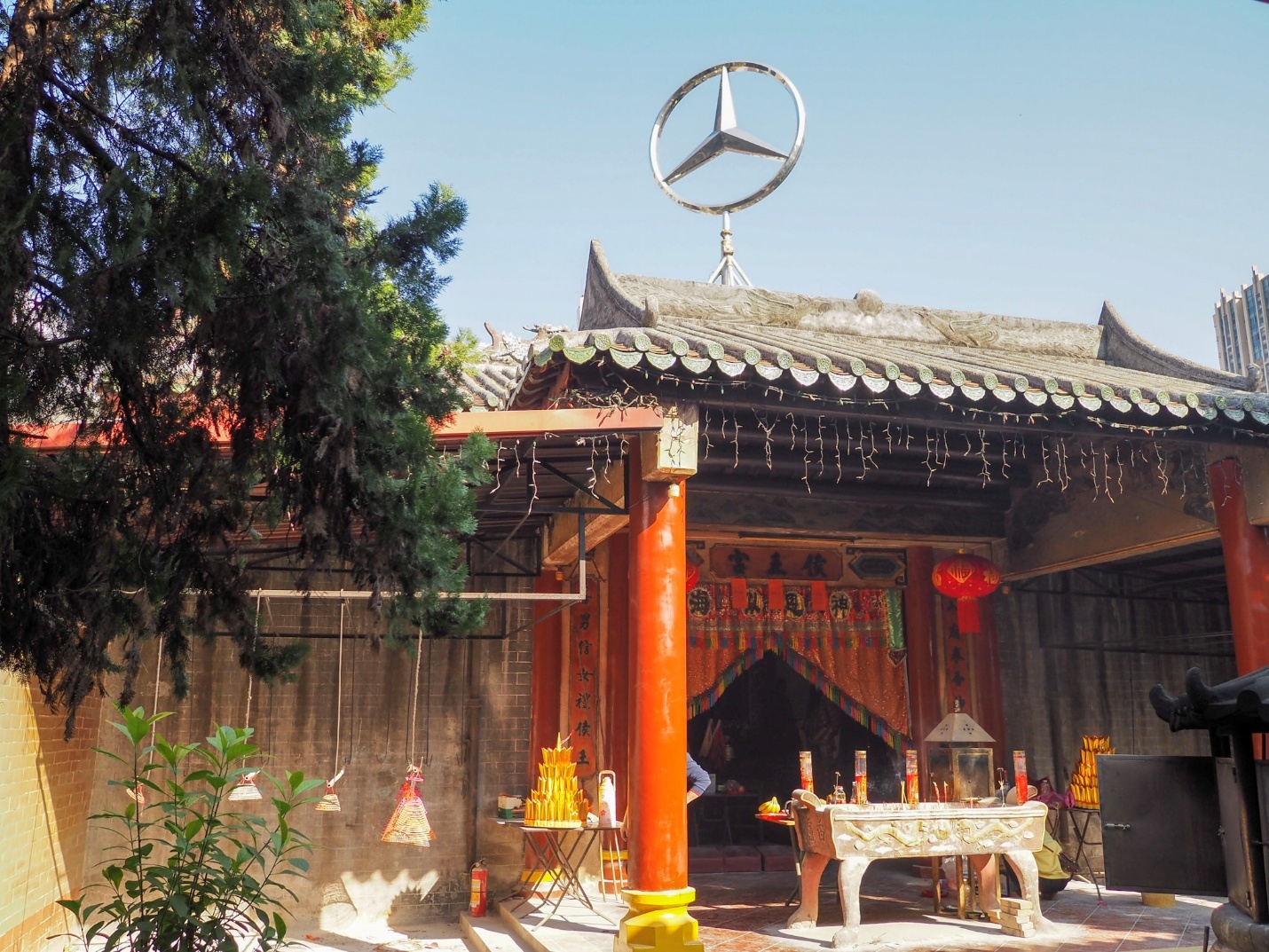
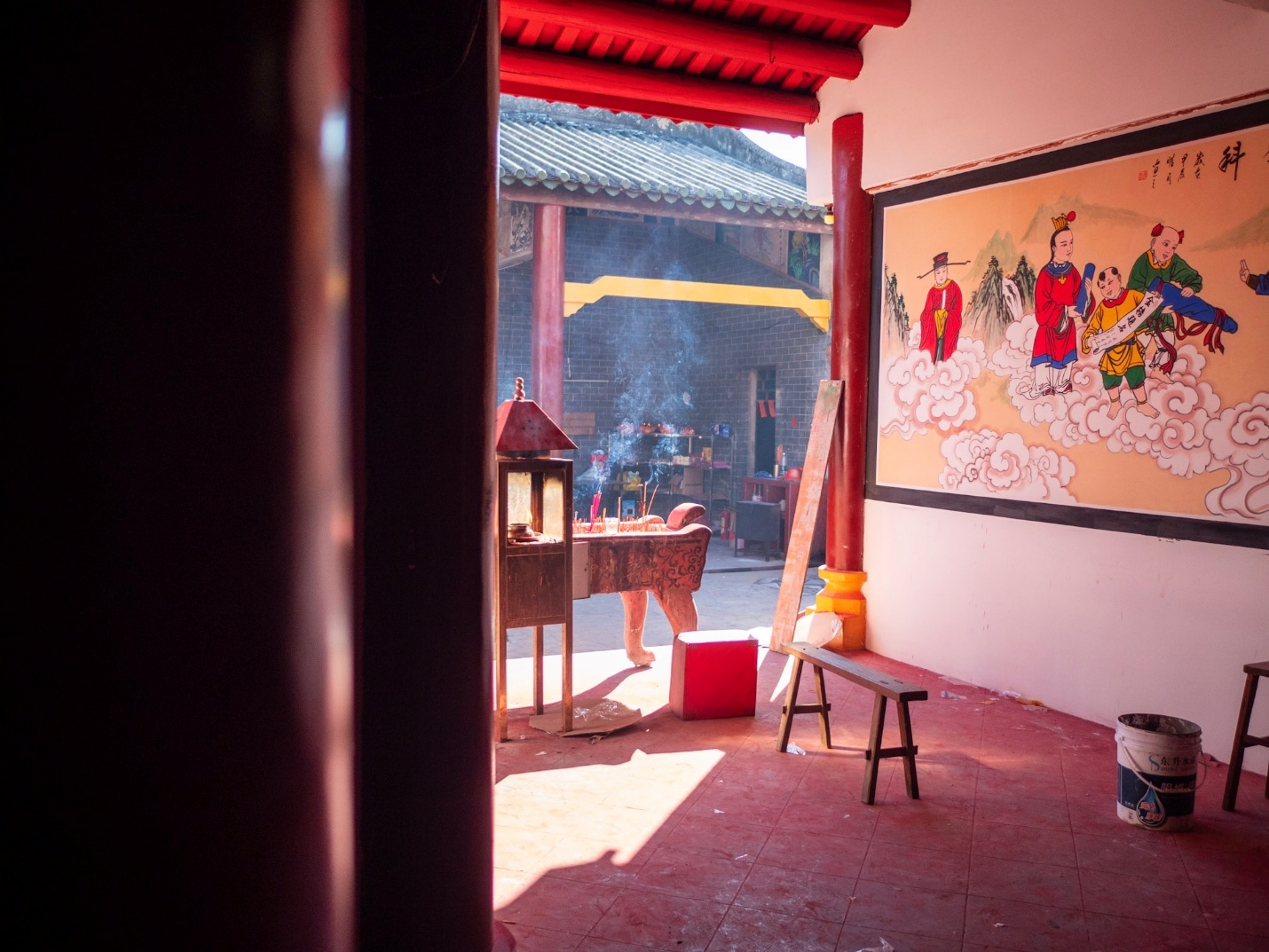
I ascend the stairs, cross the narrow square, and go through the temple’s main gate, entering a shadowy colonnade. In front of me is a sizeable courtyard, a patchwork of shade and blinding white in the morning sun. On the opposite side of the courtyard from the gate sits the main hall. A large Mercedes-Benz logo hovers disconcertingly above its roof, evidencing a car dealership down the back of the hill (Figure 1). An incense burner sits in the open antechamber before the entrance to the main hall. Red columns support the roof, and the temple walls are of unpainted dark grey brick, with their white grouting showing through. In places, the lower portions of the walls have turned light grey from incense dust.

The temple is busier than I had expected. Village temples tend to be rather sedate places, visited by worshippers and those seeking ritual services as the need arises (Grydehøj & Pan, 2025). I had forgot that today is the winter solstice. Groups of older villagers are stopping by to give offerings to the gods and pray for fortune in the coming year. The two resident ritual service providers (RSPs), Chen Yuhui and Zhang San Mei, are facilitating, serving as go-betweens for the gods and the villagers. Chen Yuhui takes me around to various spots in the temple to place incense and, crucially, to scan his QR code to make donations/payments.
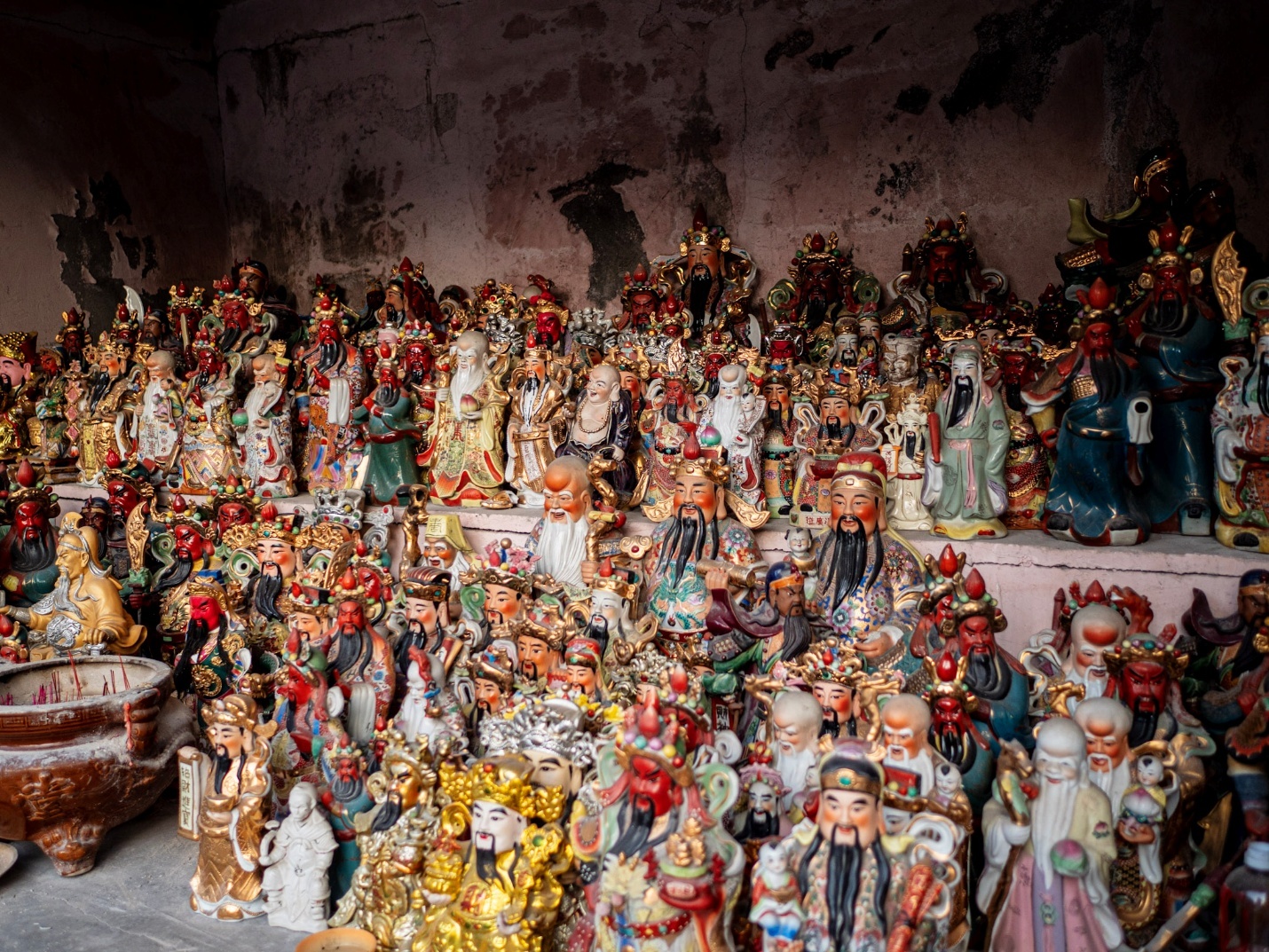
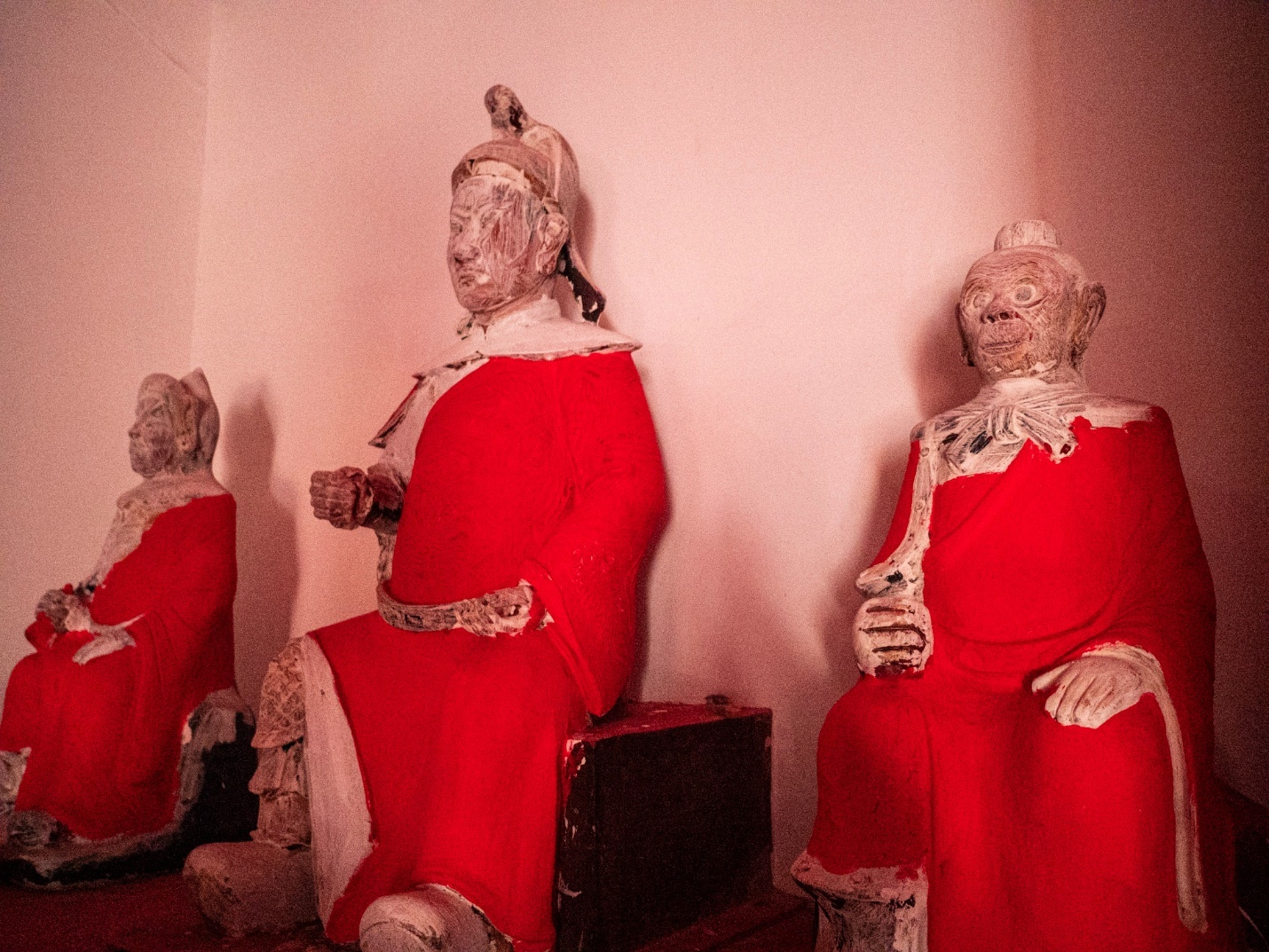
Seen from the courtyard, and even its antechamber, the temple main hall is a place of darkness and gloom. Hou Wang himself sits in the central altar, invisible from most of the courtyard, but the temple also contains an unusually rich array of other gods who, away from the light of the hall entrance, are half concealed in shadow.

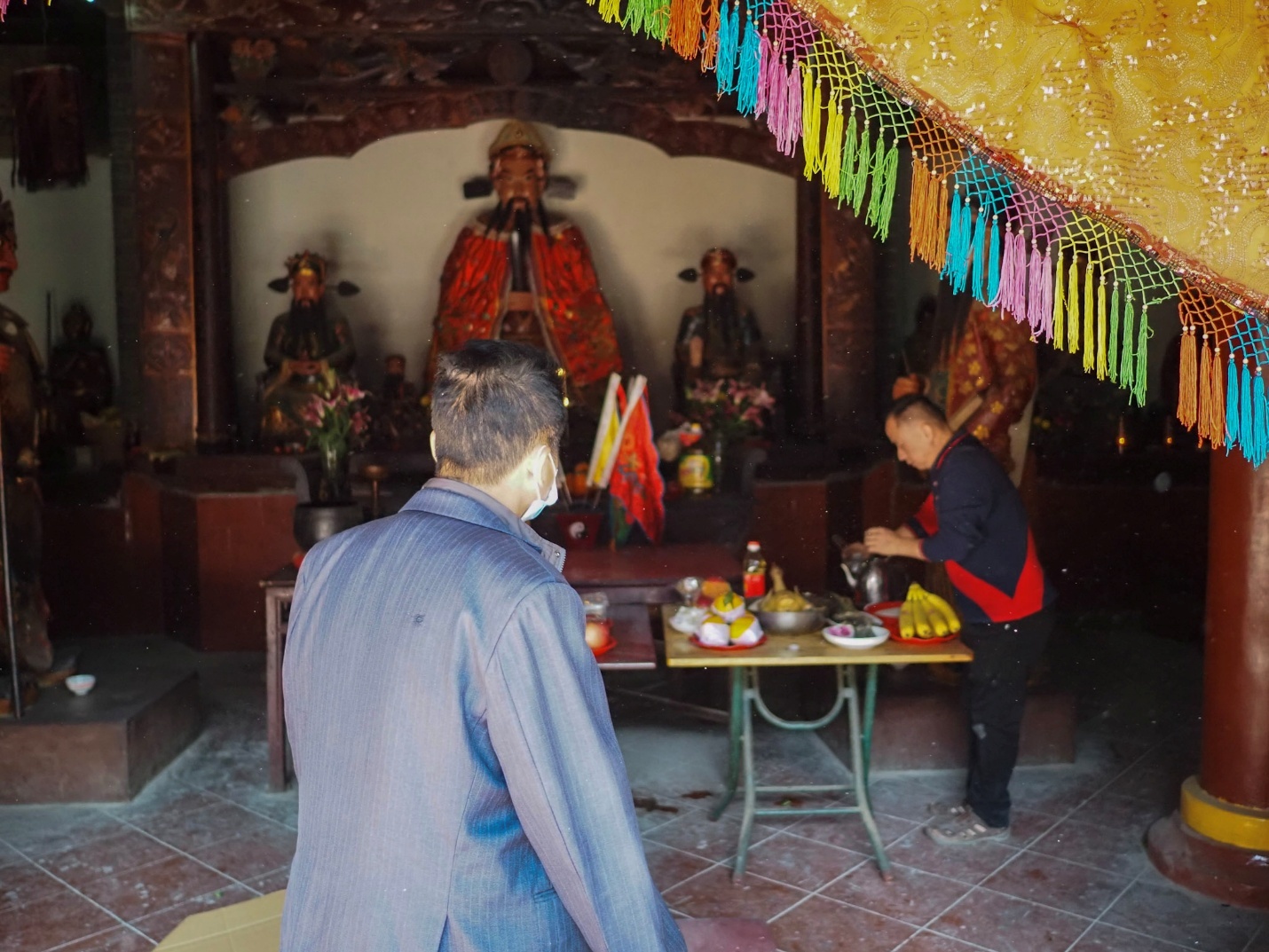
The RSPs take a back role in the solstice activities, largely observing as villagers prepare their offerings (Figure 2). This may be because, like most Guangdong village temple RSPs who I have met, they are migrants from another city, in this case Maoming, in the far southwest of the province. Their skills at magic do not extend to much knowledge of Hou Wang or local ritual customs.
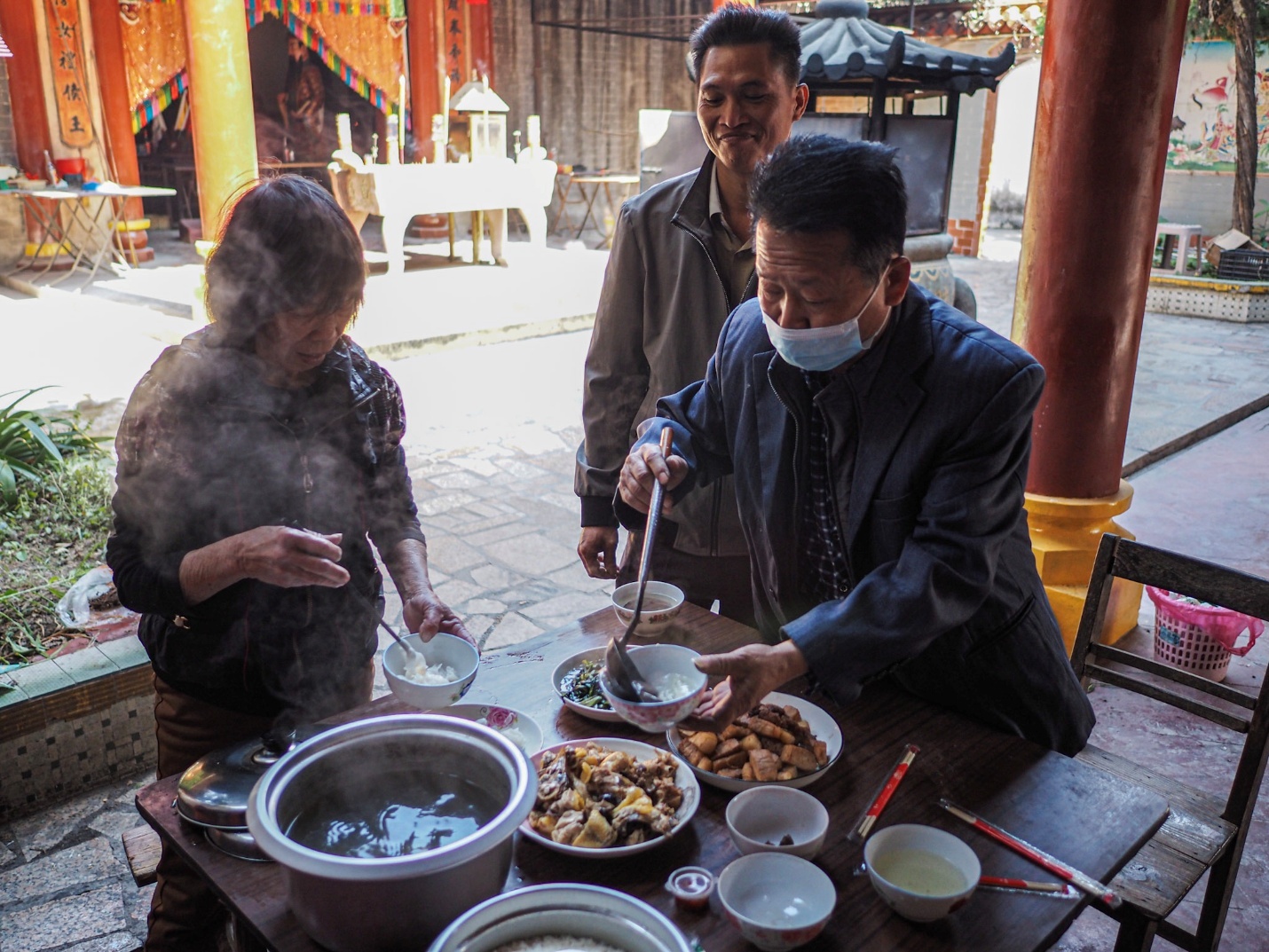
As the morning passes, all but one of the villagers departs. The ceremonies are complete, and the gods have accepted the incense smoke and consumed the spiritual essence of the food offerings. The RSPs and the lone villager take the cooked food offerings from the altar (including a whole steamed chicken) and rapidly transform them all into a meal in a small side room. The four of us share the food of the gods in the shade of the colonnade (Figure 3) before I step back into the sun and depart to catch my train.
__chen_yuhui_(right)__and.jpeg)
28 December 2024
I next visit the temple a week later, now together with the coauthors of this paper. It is late in the afternoon. We have come to interview the RSPs.
The village temple is now busy in a different way than it was during the solstice: A digger is in the process of breaking up the square in front of the temple, and rubbish is being loaded into the back of a large green truck. Zhang San Mei tells us that she and her fellow RSP will be leaving in a few days; the temple is being renovated, and the villagers have arranged for a new RSP to take over once renovations are complete. We speak briefly with this new RSP, South Sea Master Huang, who is overseeing the renovation process and has come to Dongguan from Jiangsu Province to work at the temple. Whereas the outgoing RSPs, who learned their folk religious skills through familial inheritance, are dressed like ordinary working people and resemble the older villagers of the kind we met at the solstice, Master Huang wears fashionable clothes; has not just inherited skills from his family but has also studied at a famous Daoist monastery at Maoshan in Jiangsu; and presents his professionalism in an altogether cleaner, slicker, and brighter way.
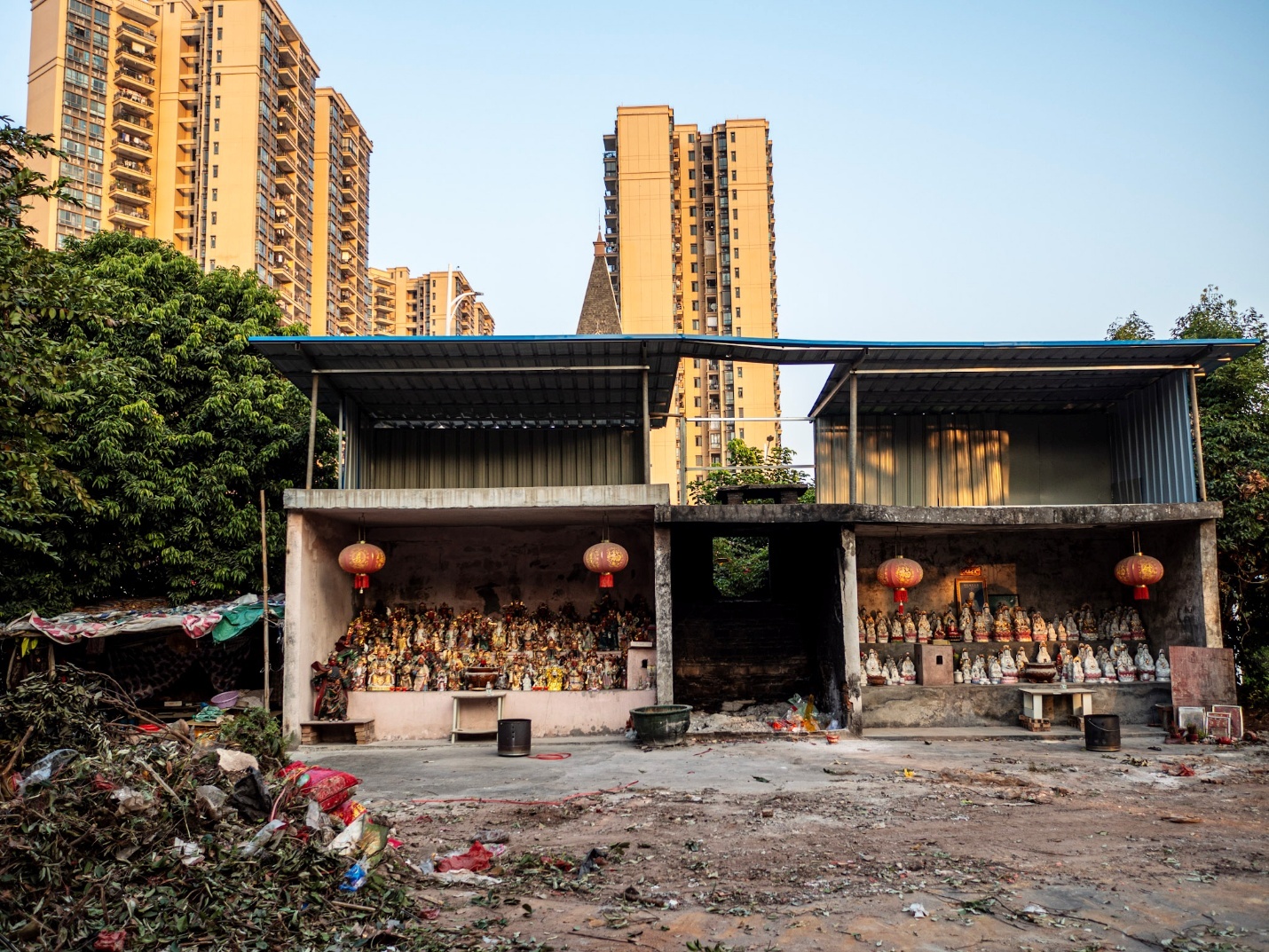
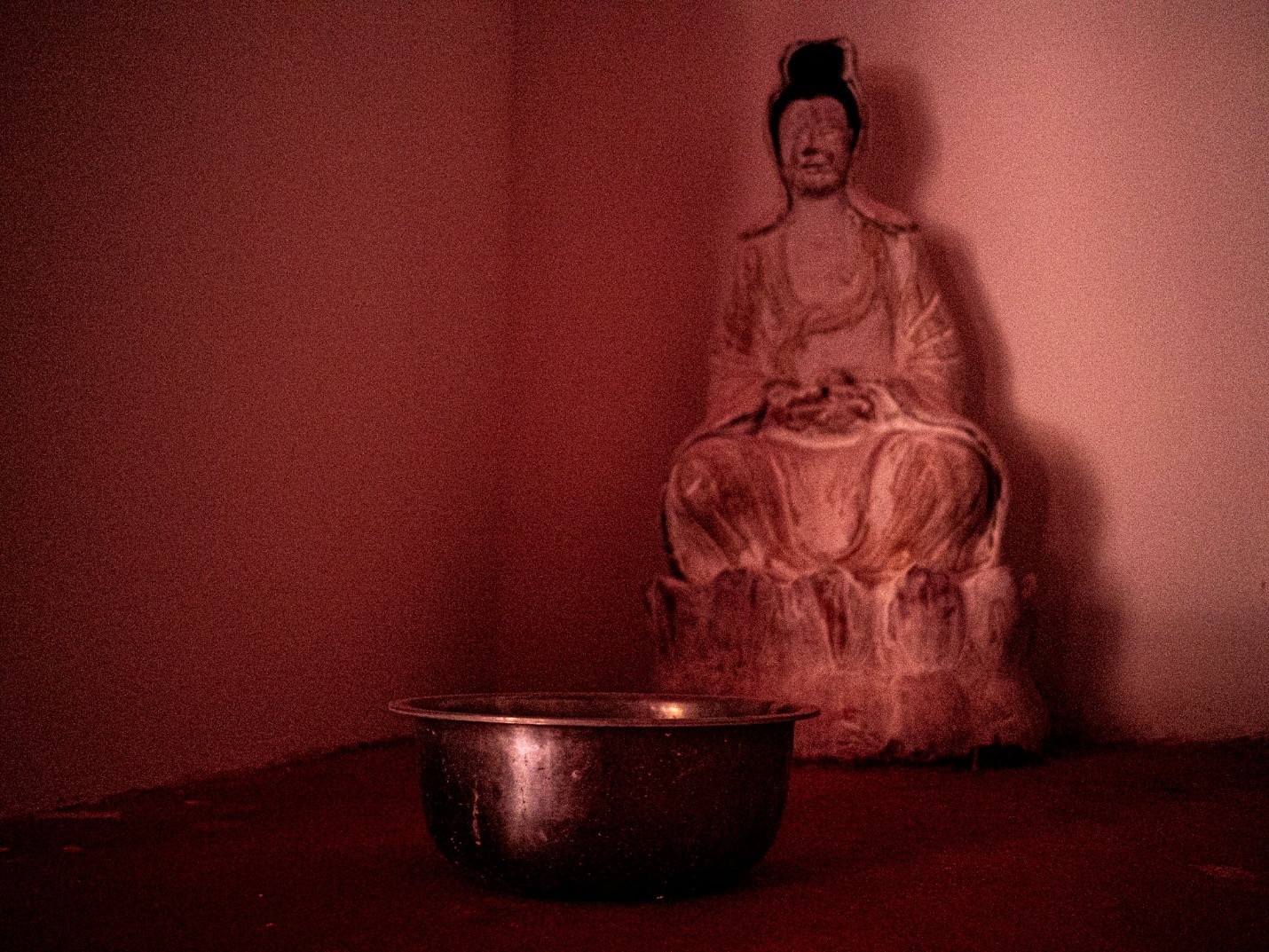
I light some incense and pray, then deposit it at the various stops around the temple: Hou Wang in the main hall, the gods in the side halls, the tutelary deities Tudigong and Tudipo enshrined in the external wall to the right of the temple gate—and finally at a pair of freestanding shrines off to the east of the temple, backed by residential high-rises across the road (Figure 4). These shrines contain discarded and displaced deities, with various Daoist gods to the left, mainly Buddhist Guanyin statues to the right, and a burning site in the middle. Such collections of statues are not uncommon: When local residents move house or must for other reasons dispose of a statue, they may deposit it at or near the closest temple, for consecrated objects cannot simply be thrown out in the rubbish bin. The rays of the setting sun fall upon the gods, and for a few minutes, they glow, until the interiors of the shrines are enveloped in dusk (Figure 5).


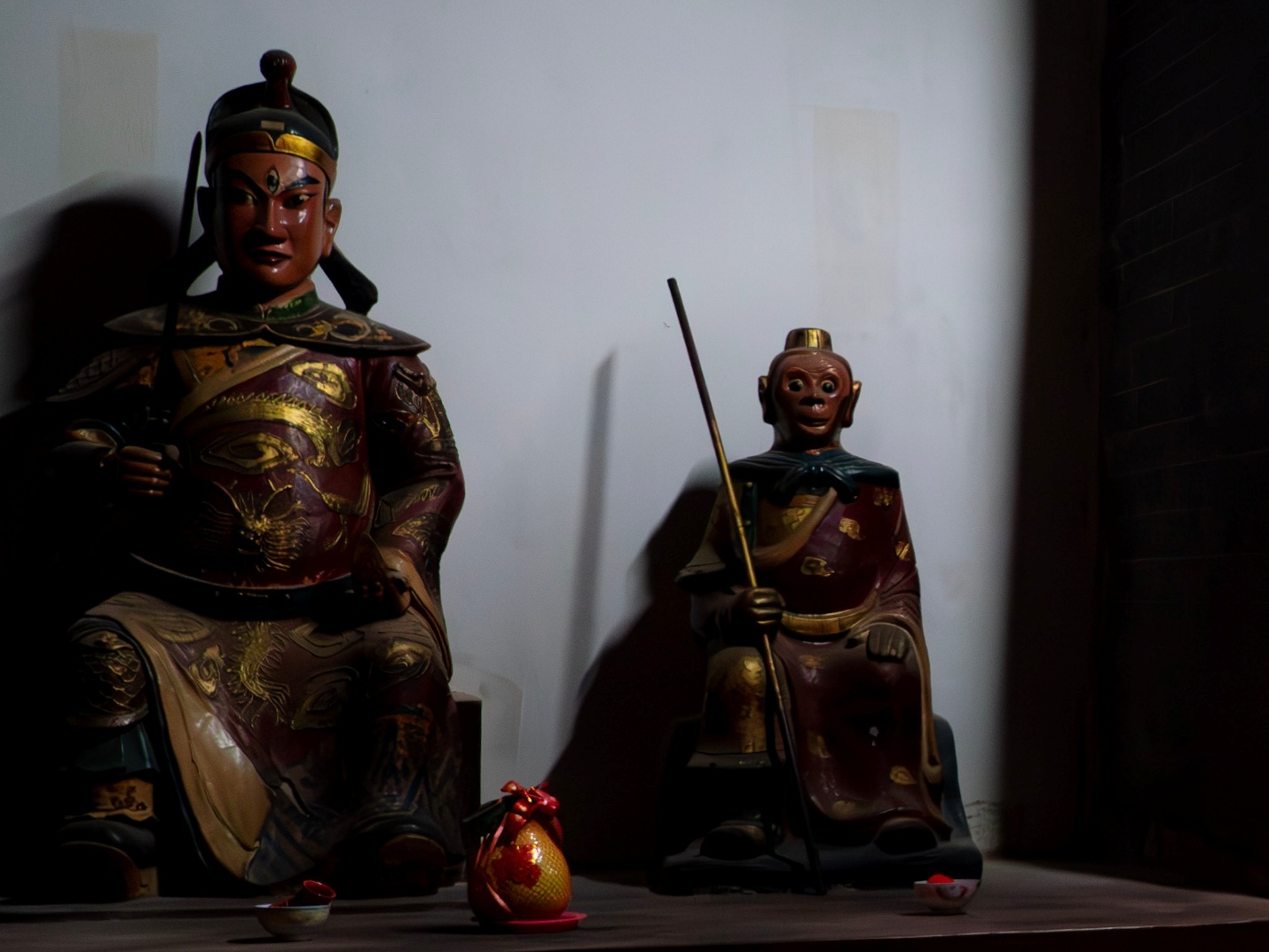
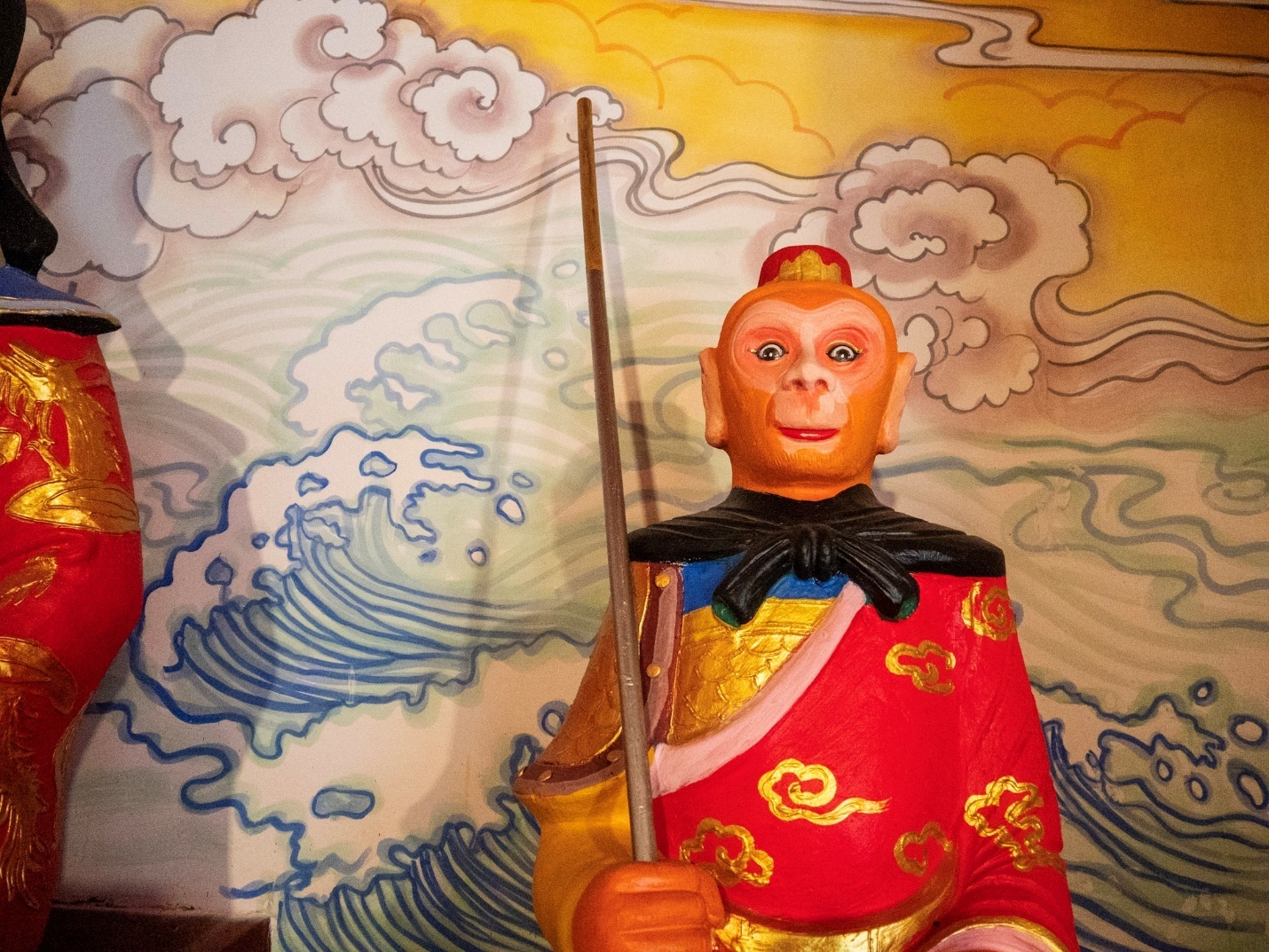
Already on my first visit, the main hall was sombre. Now, in the evening, without the worshippers and offerings, it seems particularly desolate. Electric lamps in the courtyard and the lantern in the antechamber cast some light into the main hall, creating dark shadows on the white-painted walls behind the statues. Long tables lined with statues stretch around the walls of the hall. The walls immediately behind the statues are painted white, but the spaces above are composed of the same bare, grey brick. Curiously, the nearest statue to the left of the central altar is the Monkey King, holding his magical staff (Figure 6). The Monkey King’s Chinese title Hou Wang 猴王 is a homophone for the title of the god Hou Wang 侯王 to whom the temple is dedicated. Do people perhaps sometimes come to the temple to worship the wrong deity by mistake, with the result that a statue of this other Hou Wang has been installed to receive their offerings?
._28_december_2024.__adam_grydehj.jpeg)
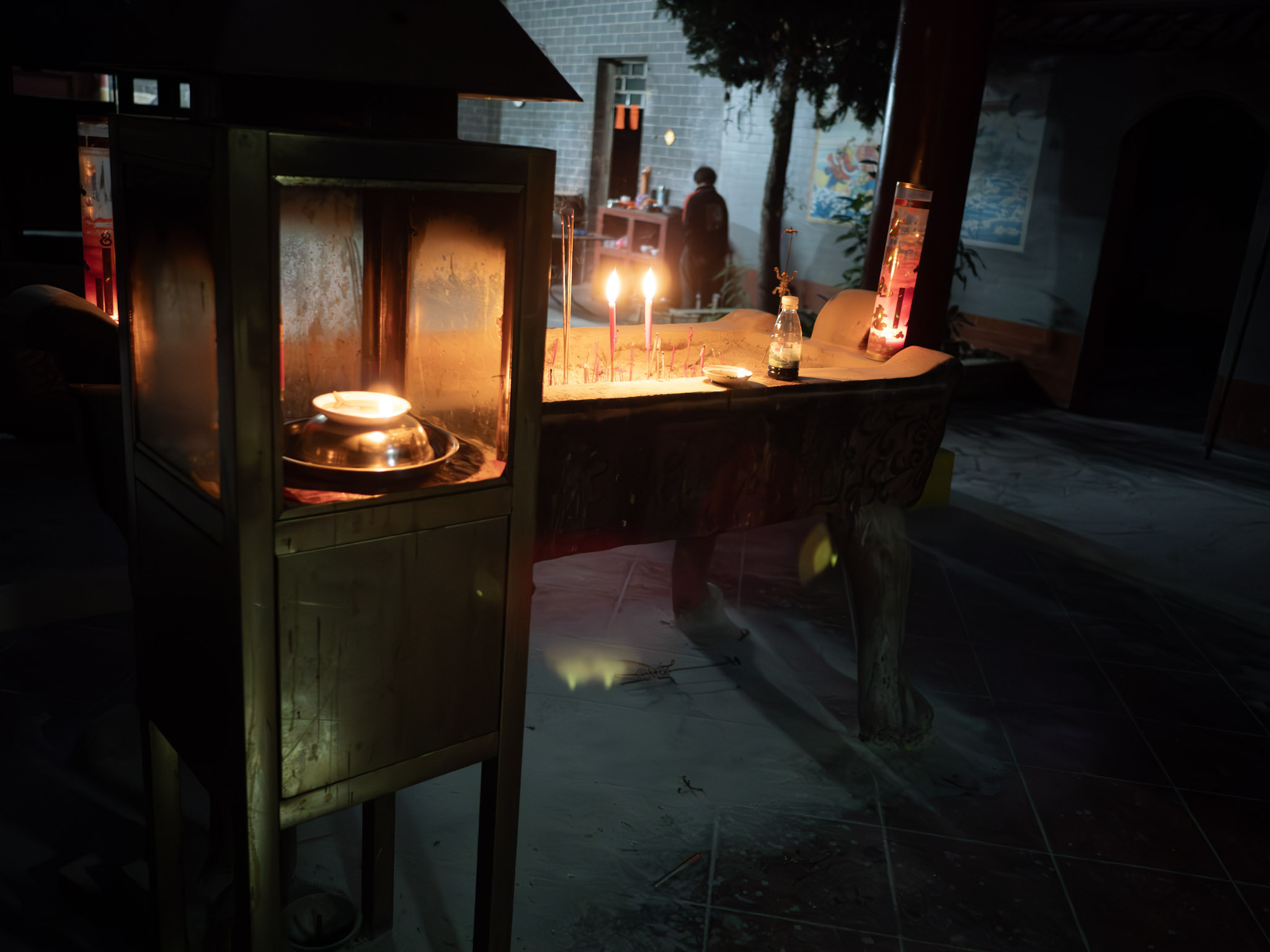
I walk slowly around the main hall and the side halls looking at the statues, occasionally crouching to sketch in my notebook. The rooms are murky and dusty, as they were when I visited on the morning of the solstice. Yet the temple is not entirely dark, and where there is light, the blackness of the surroundings makes its effects more striking. A bottle of lantern oil seems to glow of its own accord on a cluttered table in a storeroom. In the antechamber to the main hall, the paraphernalia of incense burning produces an aura of gold and red, contained within the surrounding dark walls (Figure 7).

I am drawn back to Hou Wang at the central altar, seated between his two attendants. The statue wears a robe of red fabric, embroidered with dragons. Like the other gods here, he has been painted with clothes in a dark palate of teal, burgundy, black, and gold. I hear distant laughter from the colonnade, but the hall seems cocooned from outside noises, from the outside world.
I think of the first Hou Wang festival I attended, in 2023, in Guangzhou’s Luobian Village. The festival was held in the middle of night, with candles, incense, and prayer lighting the square before the temple, culminating in the RSPs and the elderly villagers sitting down together inside the entrance area to share food offerings. That temple complex is totally enclosed inside a single building, all under one roof, with room dividers separating the entrance area from the interior. The central altar is so distant from the entrance that it is dim and dark. In such a place, darkness brings worshippers closer to the gods, and it brings them closer with one another. During that festival in 2023, the temple darkness provided worshippers with a private, enclosed space for conviviality in which to share food and memories.
08 January 2025
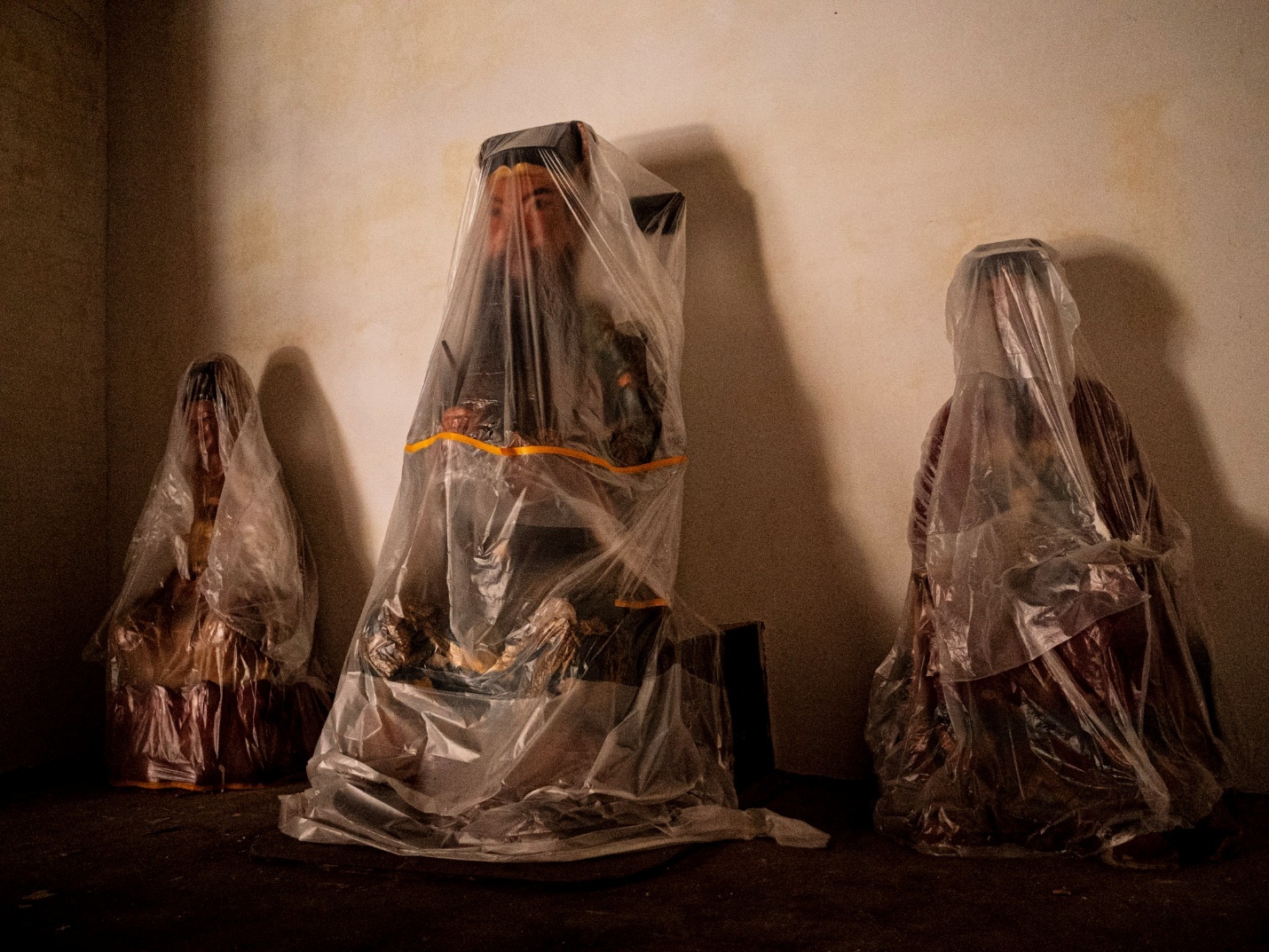
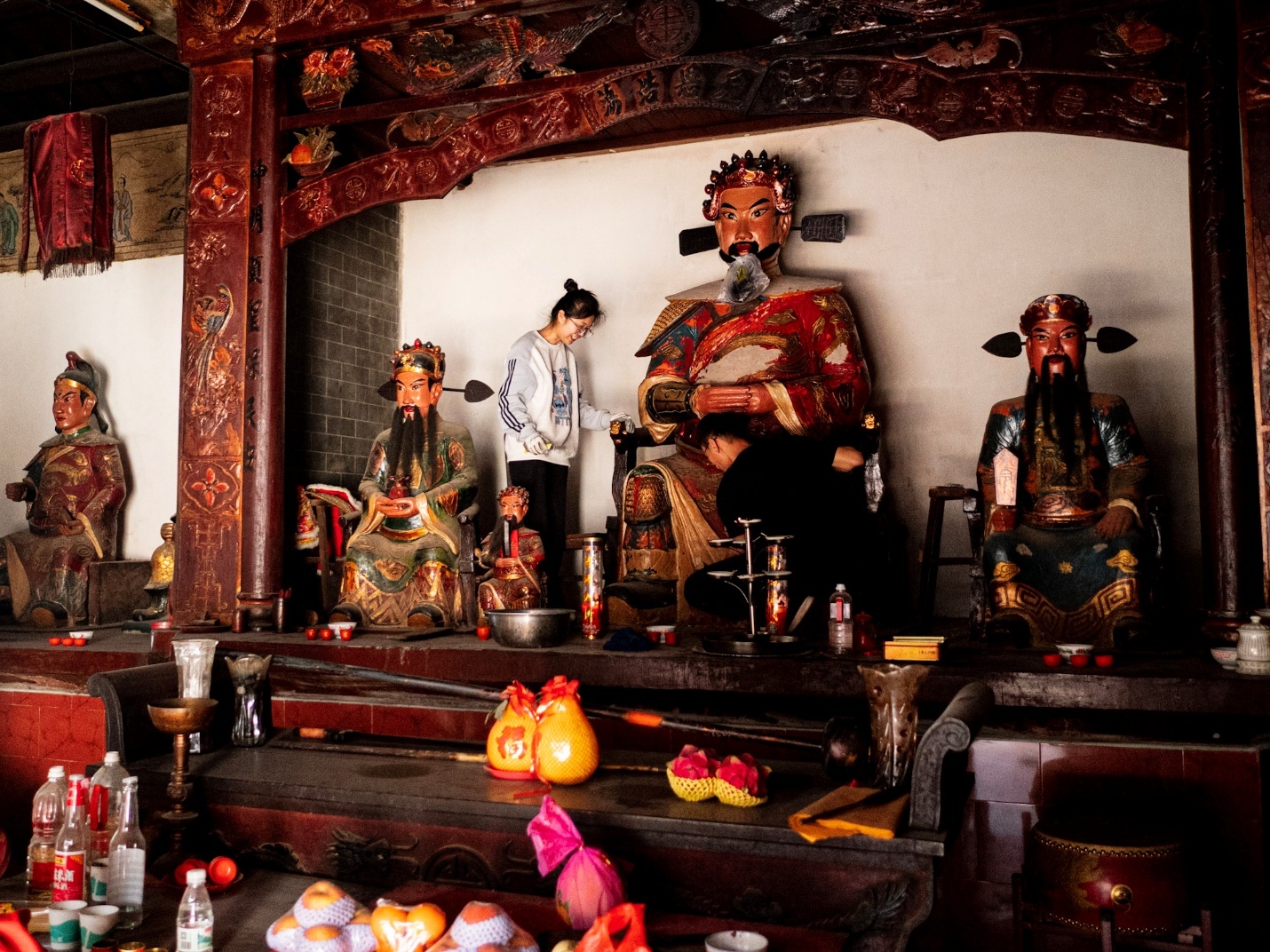
When we return a week and a half later, the temple has changed. The former RSPs have departed, and the complex is abuzz with different kinds of activities. Workers are breaking up concrete and tiles in the courtyard of a side hall. Walls haven been erected between the columns on either side of the incense burner, partly closing off the antechamber so that it leads directly into the main hall. All the interior walls of the main hall are being painted white, covering over the brickwork. Plastic has been wrapped around the gods lining the walls of the main hall to protect them during the renovations (Figure 8). There is something spectral about these deities in their semitransparent bags—shrouded, unknowable.

It is not just the buildings that are being renovated. Inside the murky main hall, lit only by the daylight coming in from the antechamber, the larger statues are being revitalised. Two travelling art professionals in their late 20s or early 30s are happy to chat with us as they work. The woman is called Chong Ning, and the man is called by his Daoist name Shan Yin Dao Ren 山隐道人 (Mountain Recluse Daoist; hereafter, Shan Yin). Before a statue can be repainted, they tell us, the existing layers of paint need to be removed.
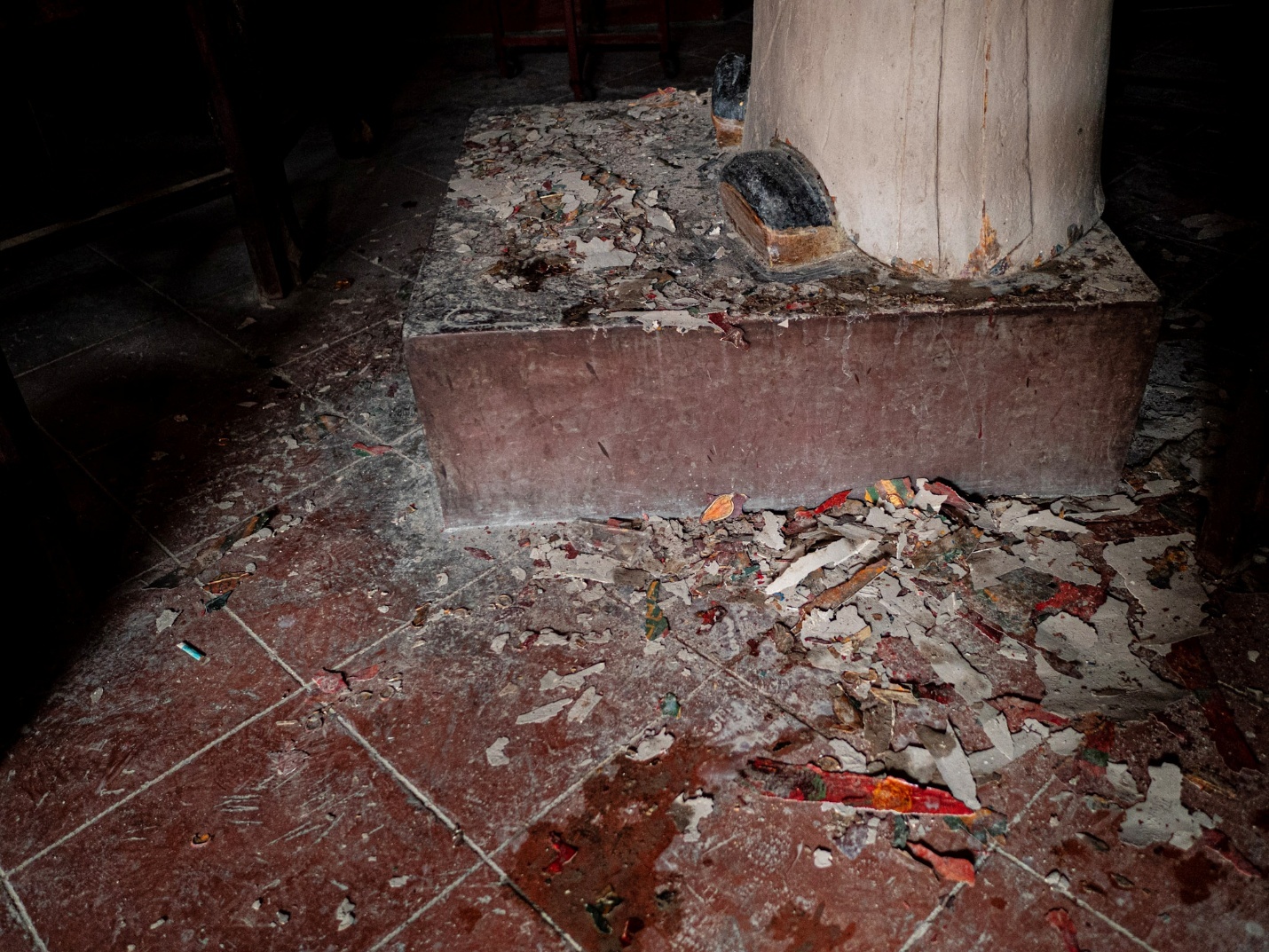
I look down at the paint chips piled about the feet of the freestanding statue of Wenchang Dijun (Figure 9). “What will happen to these?” I ask. “Do they need to be disposed of in any special way?” I wonder whether—having been part of a consecrated statue—even the old paint needs to be treated with care. But no. It will be gathered into bags and dumped in the truck before being taken away with the other rubbish.

Chong Ning and Shan Yin are working on Hou Wang, chipping paint off his chest (Figure 10). The god’s beard is wrapped in a plastic bag. The style of the statue, the artists say, reflects the time of its construction in the mid-1990s. Its clothing is historically inaccurate to the (conjectured) identity of the human general who became Hou Wang after his death. There are limits to what they can do when restoring an existing statue, but they are aiming for something more appropriate.
_and_shan_yin_(right)__chipping_paint_off_hou_wang._08_january_2025.jpeg)
“How do you feel about people taking photos of statues? Will the gods be offended?” I ask. We have experienced that some temple RSPs feel it is inappropriate to take photos, that some do not care, and that some actively encourage it. Shan Yin laughs while chipping away at the paint. “If it were bad to take pictures of statues, imagine how bad what we’re doing must be.”
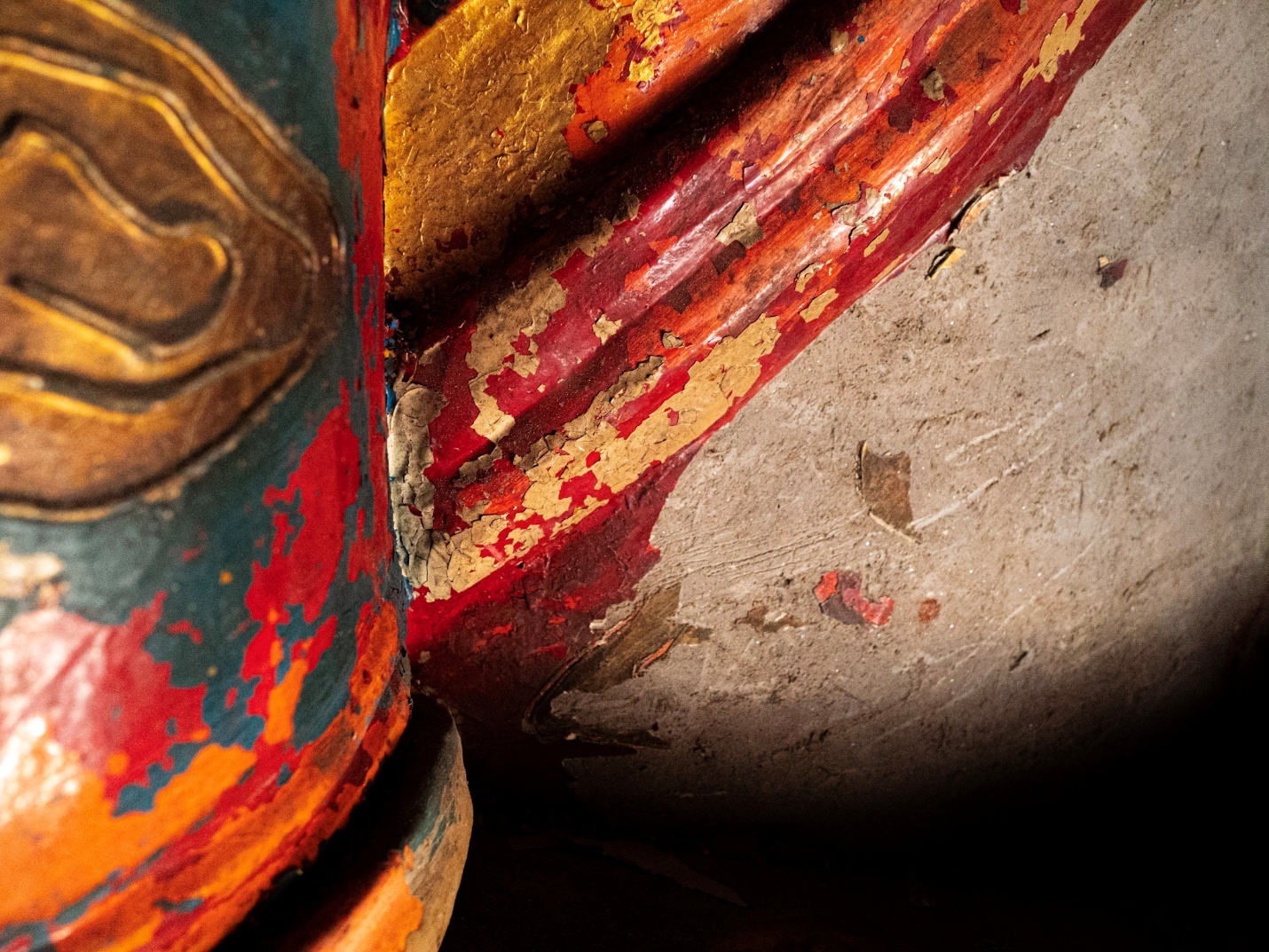
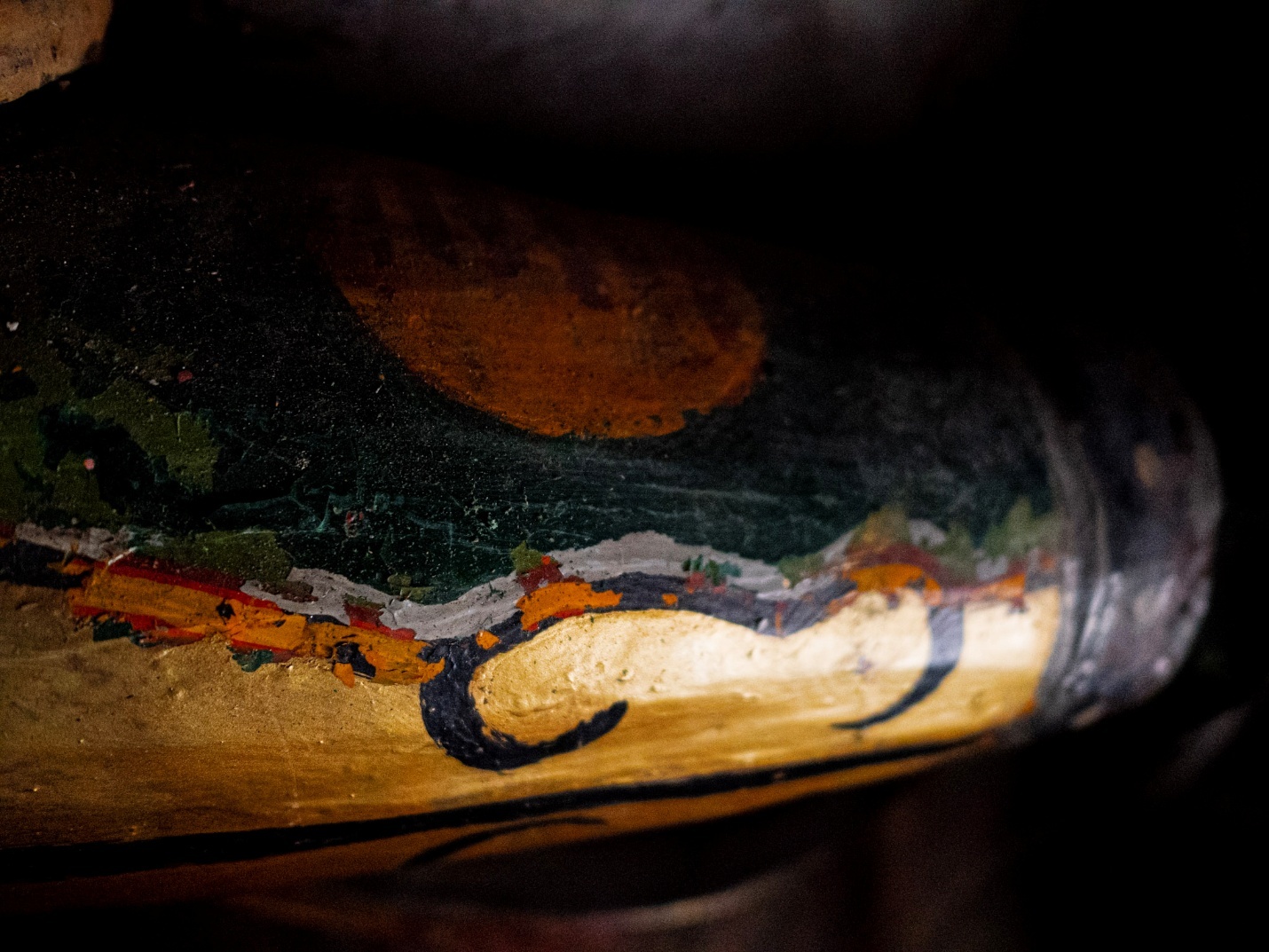
They invite us up onto the altar to take a closer look. I have never stood on an altar before. A swath of grey clay has been exposed on the statue’s stomach, flecked with bits of paint. Hou Wang has not remained consistent over time. At least three layers of paint are visible where the artists are still working (Figures 11-12).

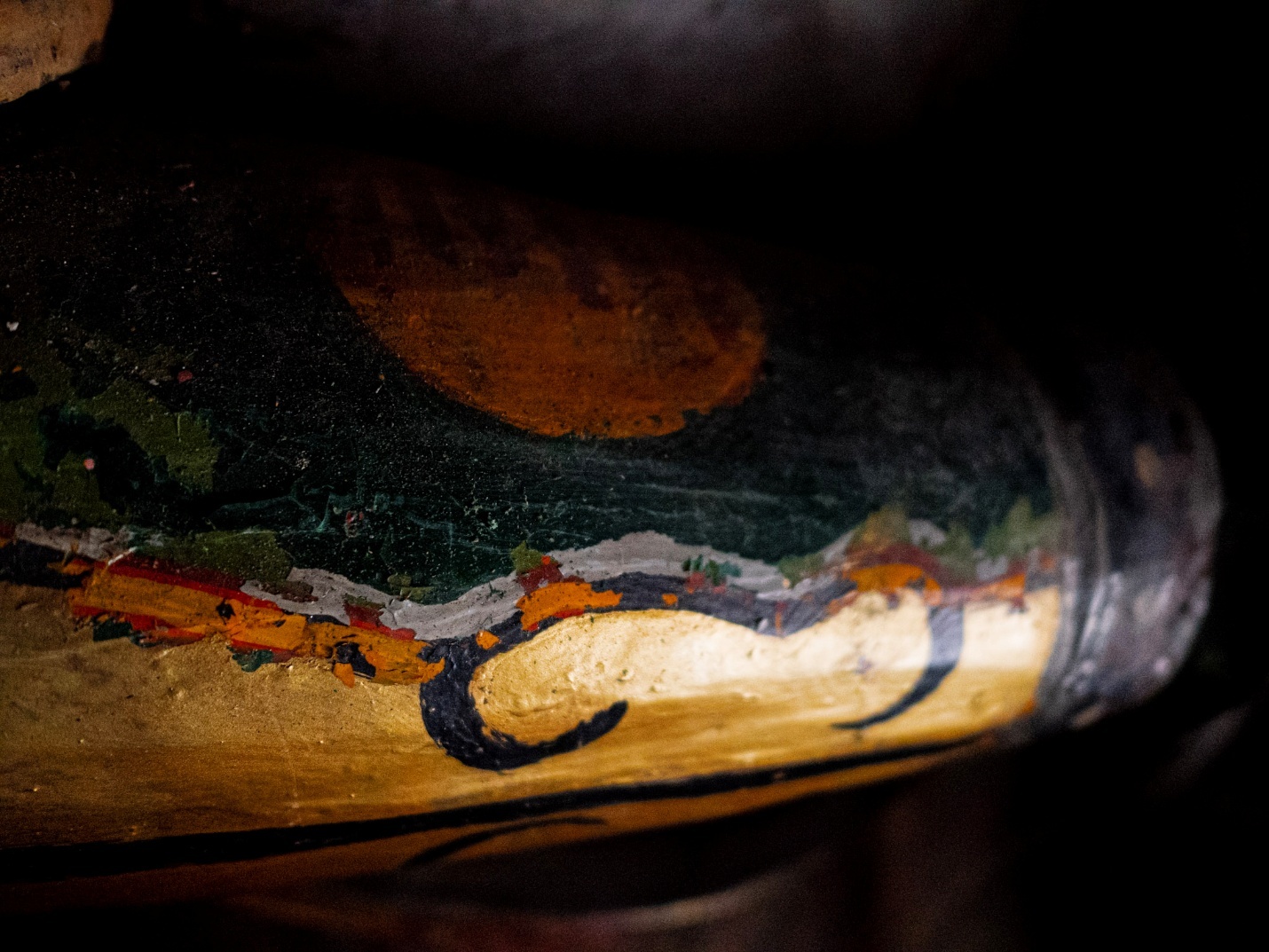
Shan Yin and Chong Ning offer us their paint chippers and ask if we would like to have a go. I start out just tapping at the statue. This feels wrong. Back home in my living room, I pray and burn incense in front of a small Hou Wang statue every day. What if I scratch him? I look at his chest, already marked by scratches.
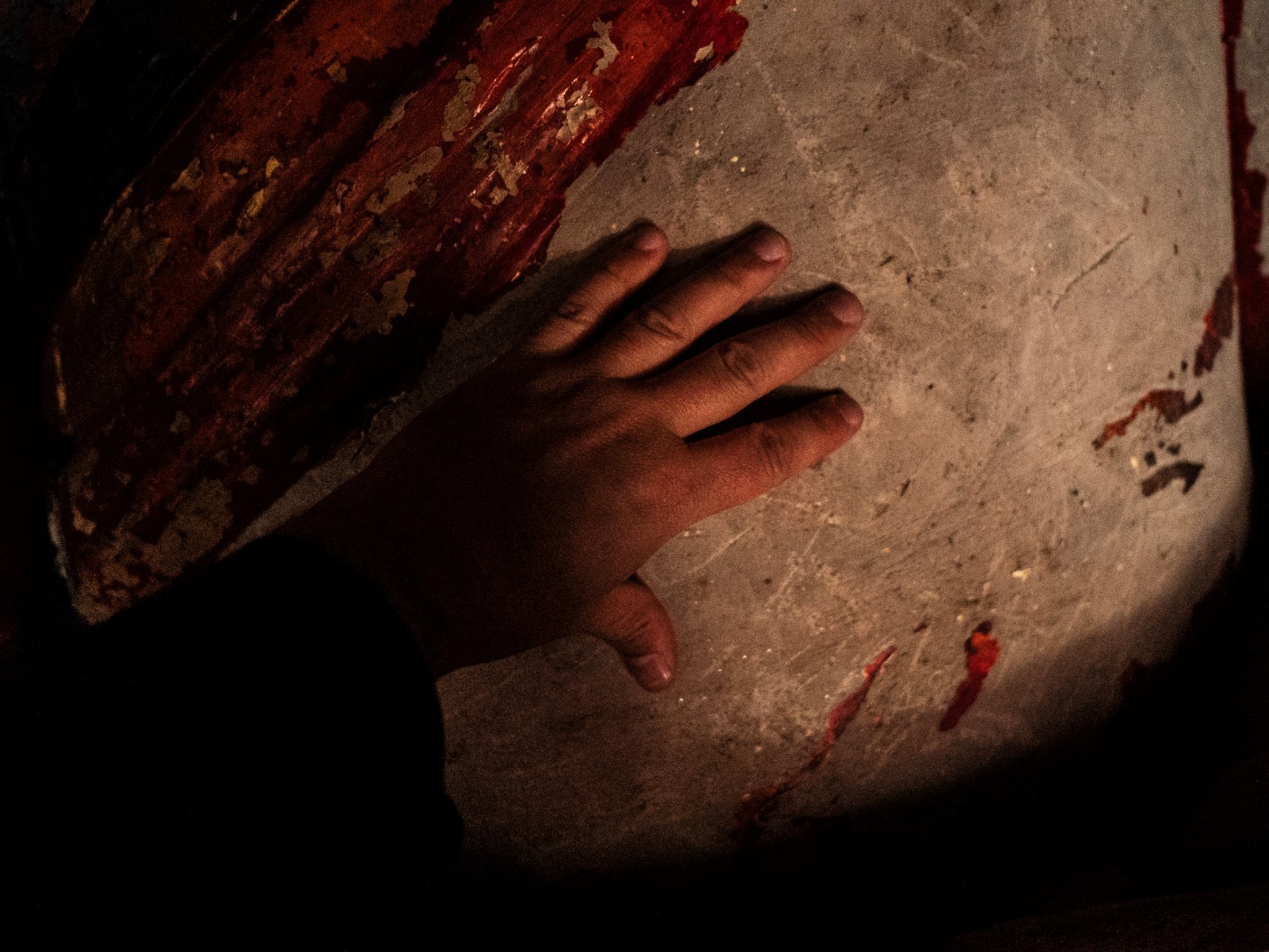
I put my hand to the clay, which is cold in the dry January air (Figure 13). A week and a half ago, just before my last visit to the temple, I experienced—fine, precipitated—a major change in my personal life. My emotions have been all over the place. Now, with my hand on Hou Wang’s stomach, what do I feel? Is there a god in there? Can I hear him in the dark?

As I grow more comfortable with the statue, I get less cautious and begin chipping off larger flakes of paint. There is something calming in this. The statue is solid, rough, good to hold. I have had many experiences at temples but never one this tactile.
I look to my student Qi Pan, who is carrying out an impromptu interview with the young artists. Better ask our research questions now, I think. There is no time like the present. Who knows when we will get another chance?
There are so many ways of approaching the sacred. You can burn incense for it, you can eat its food, you can perform interviews for it, you can sculpt it, you can strip it back down to rock.
13 January 2025
In the five days since our last visit, the temple has continued to change. On the new, white-painted antechamber walls, Shan Yin has painted bright murals, one of which depicts the story of ‘Five sons ascending the ranks’ (Figure 14), which symbolises filial piety, academic success, and wealth and good fortune. There are only four sons in the mural; the fifth son has already ascended.

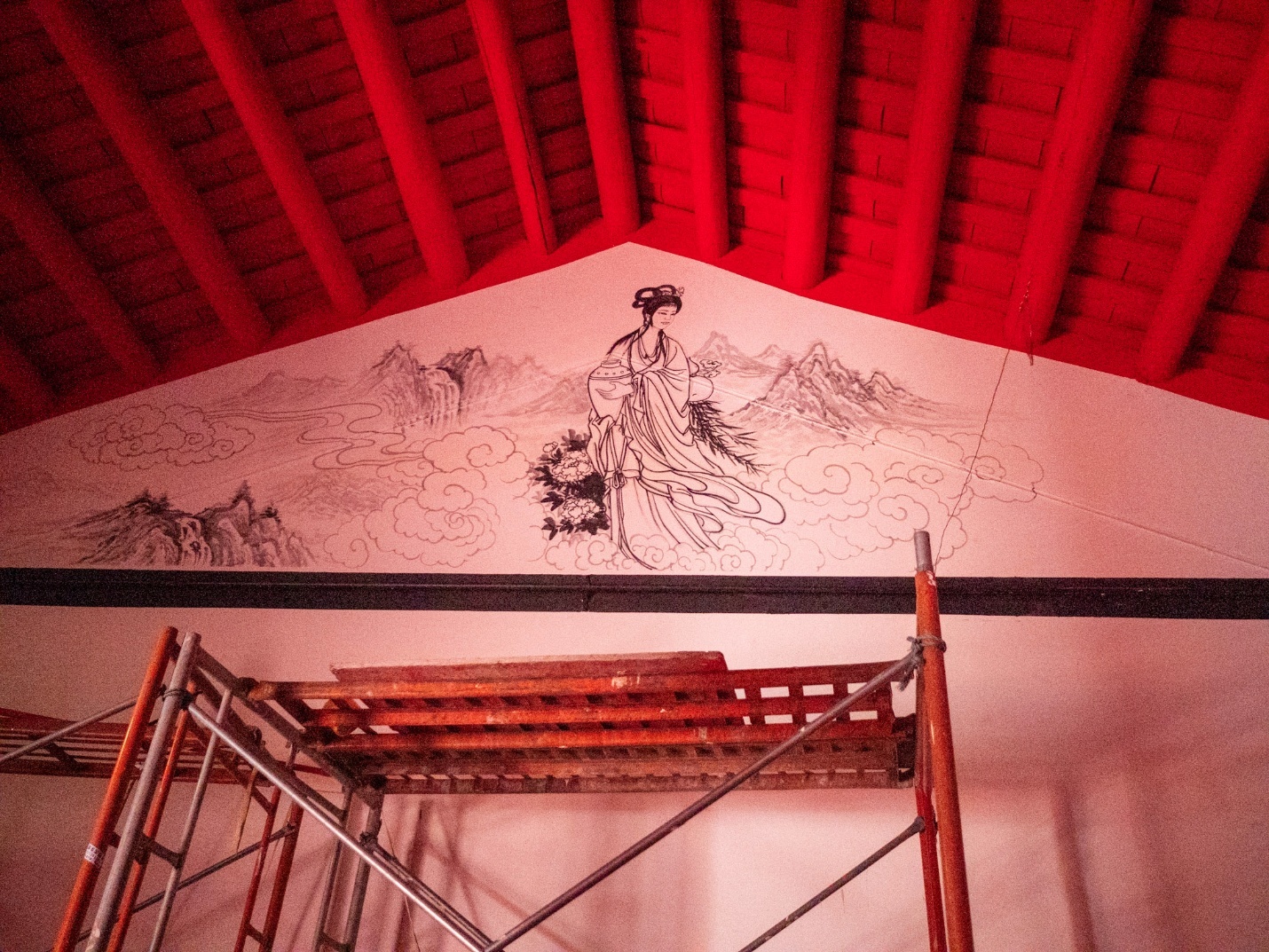
Even though the antechamber has been closed, these bright walls light up the space far more than did the previously open, dark-walled construction. On an internal gable of the main hall, Shan Yin has painted a black and white mural of a heavenly maiden (Figure 15). We comment on the new colour scheme. The South Sea Master wants the temple to be brighter than before, Shan Yin says.

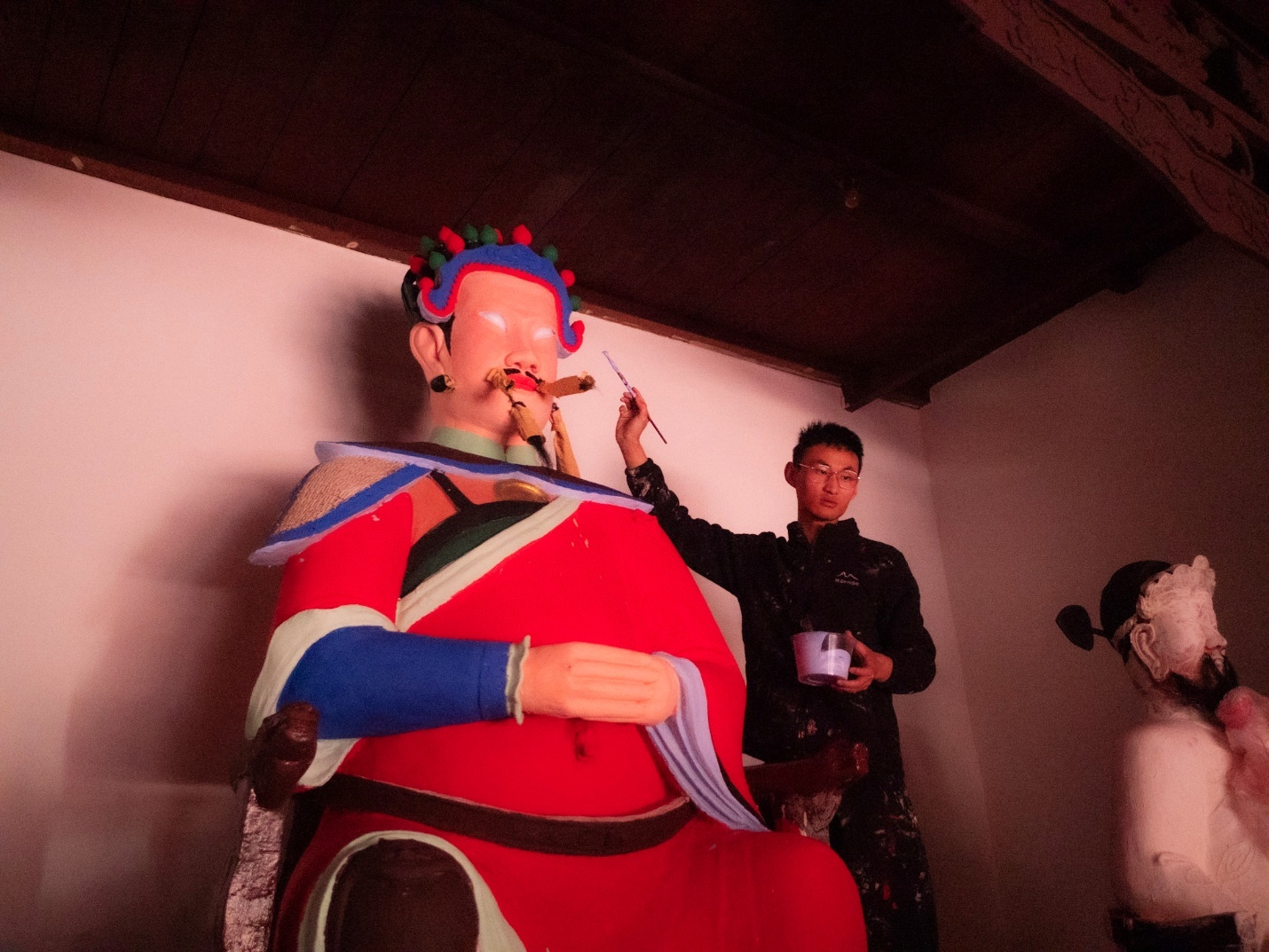
All of Hou Wang’s old paint has by now been removed, and his new paint is being applied (Figure 16). The appearance is bolder, brighter—simpler. He looks like one of the figures in the murals. As for now, the god’s eyes still lack pupils.
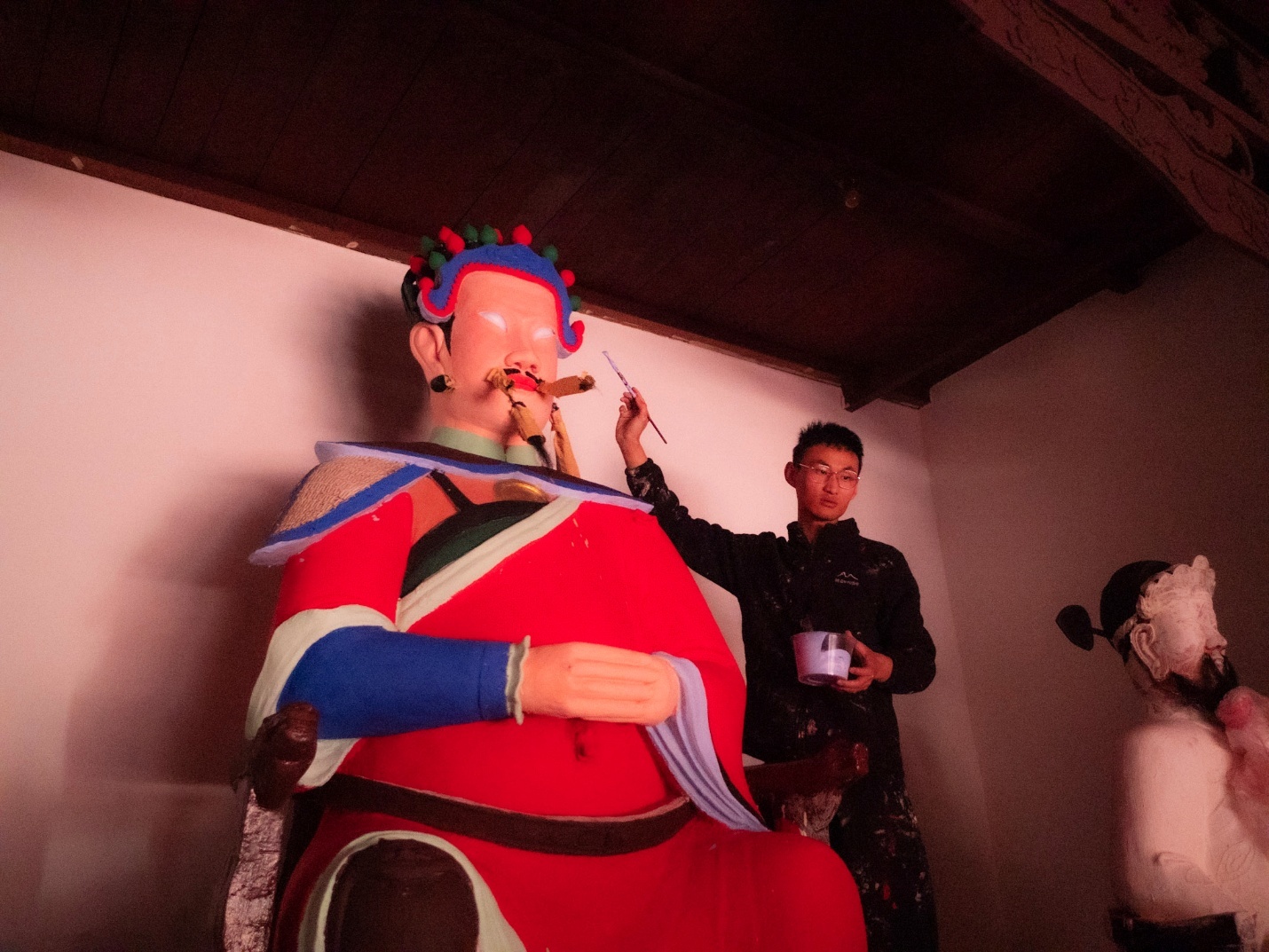
Soon it will be the turn of the smaller statues in the hall. Even the monkey king has been given a new, red cloak to match Hou Wang’s, and his face has been whitened, awaiting the next layer of paint (Figure 17). The statues, once all dressed differently, are being standardised.
._13_january_2025.__adam_grydehj.jpeg)
The temple that I had first visited on the winter solstice had been powerfully, mesmerisingly dark. It had been dusty, underlit, steeped in decades of incense smoke. The new temple is something else. Perhaps more suited for this new, brighter time. Maybe an emptier time too, it feels to me.
But I do not know. These statues are still unfinished (Figure 18). Roughly whited over, half-dressed, caught off guard in that tremulous state between creation and completion. They, I, us can yet become anything.

At some point, the artists leave, and I am the only human left in the hall. Now, past dusk, the freshly painted walls are deeply shadowed. I think of turning on the lights but do not. At last, everything is unknowable again, just as it should be.
A bit over a year earlier, I stayed the night at Nansha Tianhou Temple (Grydehøj, 2024). There, I experienced Mazu on the hillside, in the pre-dawn dark. The temple buildings were shut for the night, there were lights from boats on the river, and Dongguan and Shenzhen shone on the horizon. Behind me, through slats in the windows of a temple hall, I saw a mysterious light. And for a moment, I wondered: Could it be Mazu? Could I be in the dark, and she be the light? Walking farther along the building, I came to realise that the light was from a security camera.
Yet the feeling did not quite leave me.
05 November 2025
I know that Shan Yin and Chong Ning completed their work and departed to renovate another temple shortly after my last visit, nearly ten months ago. When I enter the temple this morning, it is peaceful and quiet, populated only by the gods and a young woman named Zhuang Wanling, who is studying a Daoist book.
As I cross the central courtyard, I feel that it has shrunk in size since my last visit, perhaps because of the incense burner having been moved there from the antechamber and given a roof. This opens up the antechamber—and hence the central hall—to more light, even as it reduces the brightness and openness of the courtyard.
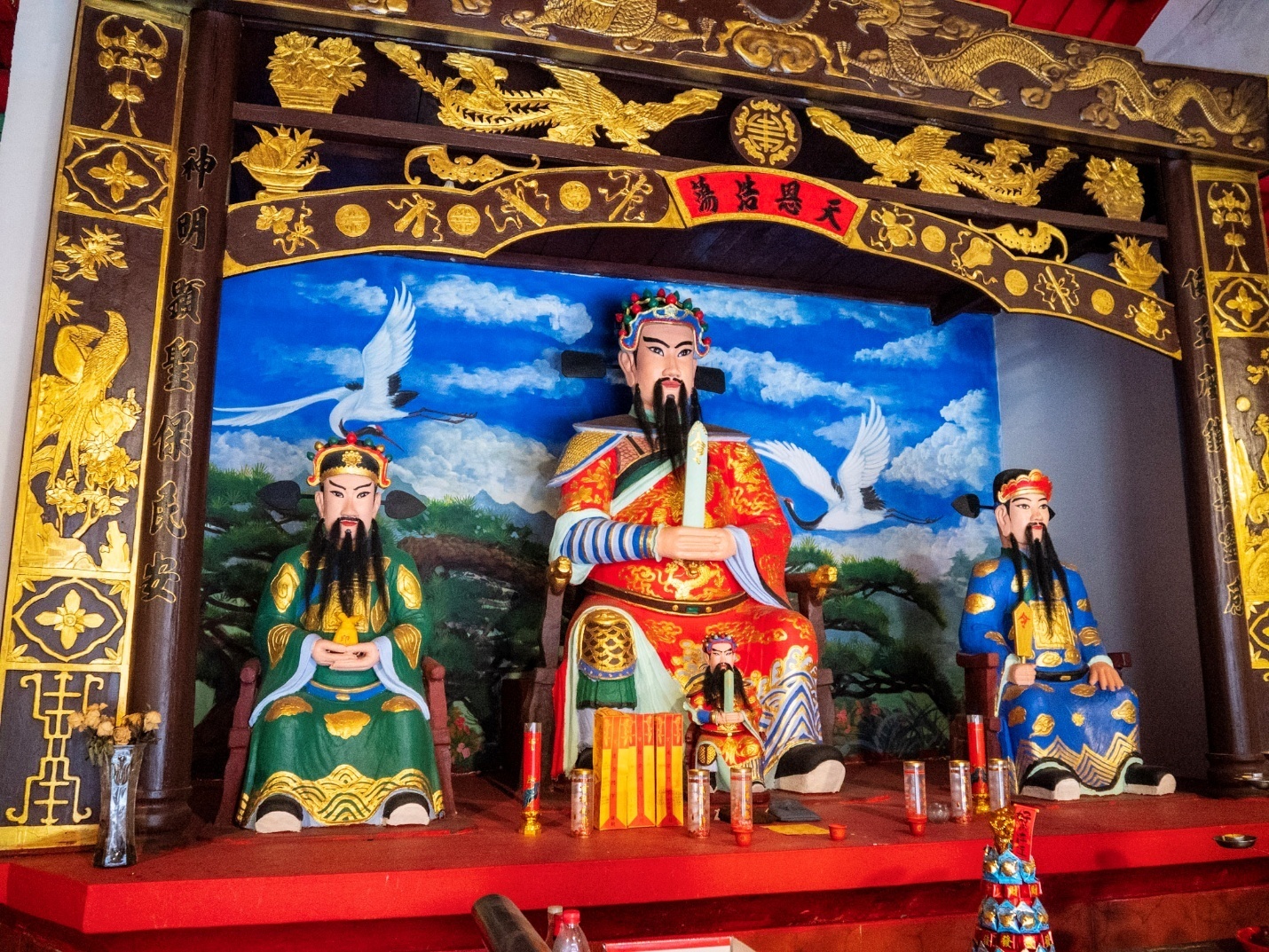
The statues in the main hall there have achieved their final form (for now). The new Hou Wang in the central altar is much cheerier and less intimidating than the one I first encountered, no longer wearing a fabric robe, the dragon pattern of which has been transferred to his painted chest. The once-white wall behind him is now covered by a mural of cranes in flight (Figure 19). All the gods bear simpler, more boldly coloured clothing. As for the Monkey King, he now seems endlessly cuter and cuddlier (Figure 20).


I send Shan Yin a photo of the central altar on the messaging app WeChat to show him I am back at the temple. He replies by sending me a photo of the central altar pre-renovation, which he evidently has readily available on his phone. I tell him I am writing an article about darkness and shadow in temples. How, I ask him, do people know how the gods would prefer their statues and paintings to appear? He replies (translation our own):
Shan Yin: There are rituals and the drawing of lots, and some people say they communicate with the gods and can [figure out how they should look], but really, it’s whoever’s willing to pay who has the final say in this. At least, that’s how things are now. …
Adam Grydehøj: I’ve seen a lot of different representations Hou Wang. A specific statue is accepted in a specific village, and this image becomes the focus of worship for the villagers living there.
Shan Yin: Yes, it’s like there are a thousand different versions of Hou Wang in people’s heads, and everyone knows that this is the definitive version.
I contemplate the artist’s philosophical attitude. Everywhere he goes, he creates the gods as people wish to see them. I suppose he has his own definitive version inside his own head, but it is not always—or even usually—this that he paints. In January 2025, the new master of this temple wanted something happier and brighter, so that is what he got.
The gods can be whatever we make of them, and we can be whatever they make of us. I do not dream to understand it. But I hope someday to accept it.
Discussion and conclusion
The visual autoethnography at the centre of this paper illustrates the researcher’s own notion of temple darkness as positive and as formative for encounters with the sacred, showing how it was influenced by his previous experiences at other temples.
The renovated Hou Wang temple in Dongfang largely retains the shape of the original, but its redecorations significantly alter the experience of being inside the temple. Although no changes have been made to the temple’s electric lighting, the journey along the path of light from the entranceway to the central altar has been simplified by the new, light-reflecting walls in the antechamber and the bright background to Hou Wang. The colourful murals around the complex brighten the atmosphere, and the black and white paintings in the gables help draw the eyes up the height of the now-white walls. The temple is now less intimidating, less mysterious, and possibly more pleasant.
At the start of the study period, this temple met the researcher’s expectations for how village temples ought to look. But the autoethnography raised the question: Does this association between village temples and darkness exist because darkness is best for sensing the sacred or simply because—unlike most other buildings in urban villages—village temples are still being constructed using traditional architectural forms? Since the start of the Reform and Opening Up era, Dongfang has been altered beyond recognition, with the village’s former built environment being replaced by high-rise and low-rise apartment blocks, factories, commercial streets, parks, and other features in accordance with the shifting architectural tastes and economic conditions of the past four decades. In many villages around Guangdong, the village temple and ancestral halls are now among the only remaining structures built in line with traditional forms and ideals, which were themselves developed in line with traditional technologies and construction techniques adapted to local environmental and climatic conditions (Feng et al., 2025). Perhaps dark and mysterious is how many people expect village temples to look just because the region’s traditional architecture was designed to balance interior lighting with other needs, such as cooling and ventilation. Vernacular construction is a product and creator of culture (Glassie, 1990; Tao et al., 2018).
These contemplations do not, however, contradict the more general associations between sacred spaces and darkness in China or, for that matter in India, the place of origin of the Buddhism that did so much to influence Chinese religion. For example, sacred caves are not dark because they are difficult to illuminate; they are sacred because they are dark. Movement through dark space developed as a core element of sacred architecture in various Asian religious cultures (Geva & Mukherji, 2007; Meng et al., 2020; Sharma & Deshpande, 2017).
As these thoughts arose during the process of writing the present article, we decided to interview South Sea Master Huang himself about why the renovations made the temple so much brighter than before. The RSP explains (translation our own):
It used to be ridiculously dark in that temple … It was simply that the conditions of the time [when the temple was constructed] didn’t permit much in the way of splendour. A temple’s gods really ought to appear vibrant and lifelike, radiating spirit, while the entire sanctuary gleams with gold. In the past though, conditions were hard. It was totally impossible to achieve this luminous brilliance. If you think about [the pilgrimage site] Mount Putuo, when you walk into the temples, everything’s shining and splendid. Who wouldn’t want it to be bright? Brightness, a spacious interior, a grand feeling—that’s definitely the direction things should develop. Who’d say that dark is better? But you need the good conditions; everyone wants to make it look nicer. Visitors also feel different when they’re inside. Now, Hou Wang is sitting here in a clean, bright environment. He feels comfortable sitting there too. If you leave him covered in dust, sitting here with rain leaking down, that wouldn’t be comfortable either. … I still remember when I first stayed at this temple, I saw a few young girls who didn’t even dare go in. It was too dark, gloomy, and scary at that time. Never mind coming in to kneel, pay respects, and burn incense; they didn’t even dare step through the door.
While the autoethnography expresses a positive association between darkness and the sacred, it becomes clear that different people have different experiences of darkness. For the South Sea Master and some others, the old temple was too dark. Brightening it becomes a way of making the sacred both more comfortable and more approachable.
Changing perceptions of how temples should look may reflect changing ideas concerning the role of temples in village life. Although it was South Sea Master who decided on the details of the temple renovations, it was the villagers who decided to send away the former RSPs more rooted in folk religion and to bring in an institutionally rooted Daoist master to manage the temple. As Dongfang had changed, the temple—and its temple culture—had remained in the past. Perhaps the temple risked becoming a place left behind by Dongfang’s rise, not because people no longer used the temple but because its sacred mystery and excess no longer fulfilled people’s needs. Some of the new murals around the complex, such as ‘Five sons ascending the ranks’, concern easily graspable traditional concepts and virtues, not to mention worshippers’ practical aspirations. Efforts made by the new RSP to learn about Hou Wang’s human past and to have this inform the renovations (which we learned about in interviews) served to humanise the god, render him less mysterious, and—through murals—turn the presumed story of his life into a collection of admirable and imitable behaviours and merits.
In the researcher’s own perception, as explored through the autoethnography, the gods seemed to have transitioned from being sources of mysterious power to being generic symbols of good fortune, yet from the South Sea Master’s perspective, Hou Wang wants the temple to be cosier and brighter. Hou Wang wants people to feel welcome in his sanctuary. There are many ways of seeing—and not seeing—gods. There are many ways of seeing—and not seeing—the light.
In Dongfang, the temple darkness has receded somewhat. Yet the gods remain worshipped, and bonds between temple and village have been renewed. The gods that are needed today may differ from those in the past, but they are no less present, and as culture and place continue to change, we should expect the gods and their light to continue changing as well.
Funding
This work was supported by the Guangdong Planning Office of Philosophy and Social Sciences (No. GD24LN11).