


Introduction
Walking past Lister Park, a deep, booming, rhythmic bass beat starts to echo through the streets. I initially thought it was the sound of one of the (often illegally) modified cars so common in the district of Bradford. But as we continued walking, the sound did not pass with the traffic along the busy road. It just got louder. A half-mile later, we came upon the source of a sound – now at a full raucous volume – a musical group of four men of Sikh heritage (based on their dress) – 2 playing dhols (a large wooden barrel drum) slung around their necks, 1 playing a shehnai (a double-reeded instrument similar to an oboe), and one singing. They were dancing and playing pretty much in the middle of the street while hundreds of guests and the Pakistani Muslim wedding party arrived at the Majestic, a popular wedding hall popular with Bradford’s South Asian cultural communities. It was an energetic affair, with men and women flowing into the venue, wearing stunning, colourful robes, while the band played on, stopping traffic as they danced into the street.
We continued walking towards the city centre and the sounds faded. But the memory remains of an event that seemed unique for a Northern English environment. The band and guests were of different religious and cultural backgrounds (something unlikely to occur in countries of their cultural heritage). This was Bradford (a city I had recently moved to) and, as I would later come to learn, this sort of scene was a common occurrence throughout the ‘wedding season’.
The picture of this joyous scene is not one usually associated with the city of Bradford. It is a large, post-industrial city in West Yorkshire with all of the poverty associated with these types of places after the mills and mines closed. This is compounded by it being very multicultural (a factor which seems to result in Bradford being more negatively stigmatised than similar but less-diverse post-industrial cities). The issues are exaggerated by the multitude of cultures living in a district that is divided, to some extent, both culturally and geographically along ethnic lines. This results in a subtle undercurrent of intercommunity mistrust, which periodically bubbles to the surface in the form of interracial tensions and sometimes violence. Thus, the snapshot in my opening vignette is all-the-more significant: Sikh musicians, at a Muslim wedding, with white middle-class bystanders, drawn together by the sound of the dhol drums.
Experiences like that described above exemplify how the dhol, an instrument originating in the Punjab region of India and Pakistan, has become embedded in the cultural fabric of diasporic locales, such as Bradford. Its booming sound represents more than musical accompaniment at a wedding, it signals place. In a city marked by post-industrial fragmentation and cultural pluralism, such sonic encounters can co-create shared spaces of belonging. Yet these vibrant scenes are not what most people imagine when they think of Bradford, England, a city often associated with poverty and ethnic division. The contrast between these images suggests something crucial: music transcends mere entertainment, it can make place.
This article examines whether and how musical instruments with local resonance—here, the Punjabi dhol—can foster shared senses of place and act as cultural mediators in multicultural communities. Through a case study of the Bradford Dhol Project (a community music initiative developed by the author in partnership with local arts organisations), it demonstrates how the dhol’s migratory status might evoke memories of origin, while serving as a tabula rasa upon which new, collective senses of place can be assigned, fostering greater cross-cultural understanding and civic engagement.
While scholarship has explored music and placemaking, few studies examine instruments as active agents in fostering cohesion and placemaking in post-industrial multicultural cities, a gap this study addresses. Historically, the dhol has crossed geographic, cultural, and functional boundaries, moving from Punjabi folk and religious contexts to diasporic settings where it became a symbol of South Asian Identity (Leante, 2009; Schreffler, 2013). In Bradford, its sonic presence extends beyond traditional roles in diasporic communities, assuming new functions in civic celebrations, public festivals, and theatre programming. At such events, dhol-based ensembles often represent the South Asian community as a symbol of migratory heritage. It has also been appropriated into a broader popular music context through British Bhangra. In this way, the dhol exemplifies Bates’s observation that “the same instrument in different sociohistorical contexts may be implicated in categorically different kinds of relations,” positioning it as a potential tool for cultural mediation and placemaking (2012, p. 364).
Methodologically, the study draws on practice research, participant observation, interviews, and sound drawing during three workshop series with local groups: two with Touchstone, an interfaith women’s group and one with Stand and Be Counted (SBC), an asylum seeker theatre group. This connects workshop experiences to place outcomes (e.g., belonging, conviviality, active citizenship). Building on Bates’s call to consider the “social life of musical instruments” (2012, p. 364), this study argues that instruments are not passive carriers of tradition, but active agents in shaping social and spatial relations. To situate this argument, the next section reviews scholarship on placemaking, music and place, and critical organology, highlighting the ‘research gap’ this study addresses.
Placemaking, Music, and the Social Life of Instruments
Placemaking, as an area of academic inquiry, has evolved from top-down approaches to participatory, practice-based initiatives that co-create belonging, identity, and civic life in the public sphere. Numerous texts emphasize collaborative methods and reverse engineering from practice to policy (e.g., Hamdi, 2004), as well as the field’s shift to community-engaged, locally situated strategies (Courage et al., 2020), and recent efforts to theorise placemaking as a process model (Ellery et al., 2021). Widely utilised definitions – coined by Project for Public Spaces (What Is Placemaking?, n.d.) and formalised in the NEA’s (2010) Creative Placemaking white paper situate placemaking as a collaborative shaping of public space that leverages cultural elements to develop social ties and shared value. In this article, I rely on a participatory, culturally oriented reading of placemaking that frames it as a collaborative process through which people co-create meanings and attachments to place (Courage et al., 2020; Hamdi, 2004). It is treated as an emergent activity, produced through shared practice, in this case, collaborative music-making.
In academic texts, music features regularly as a placemaking agent that attributes meaning to particular environments, brings people into public spaces, and animates civic life. Scholarship in ethnomusicology demonstrates how music and sound facilitate place-based identities (Connell & Gibson, 2003; Krims, 2007; Stokes, 1994). Sonic ethnographies and methods such as sound diaries show how listening practices co-constitute place and belonging (Duffy & Waitt, 2011). Further philosophical work on music argues that it contributes to placemaking, locating sonic practices as a crucial way of inhabiting environments (Stone-Davis, 2015). Combined, these elements demonstrate how music can inspire collective narratives in communities; however, most studies foreground music practices or scenes, rather than the instrument itself as a mediating artefact, a gap that this study addresses directly.
Intertwined with the cultural perspective, health-focused research has underscored the social benefits of arts engagement, which can contribute to how people engage with places. The 2019 WHO report on Arts and Well-being collates evidence that participatory arts—including music—enhance prosocial behaviour, shared motivation and group identity (Fancourt & Finn, 2019). The report defines health as including physical, mental, and social well-being, further emphasising that societal well-being encompasses "integration within society, individual understanding of society, and belief in the potential of society (Fancourt & Finn, 2019, p. 2). Music-based activities are highlighted as particularly effective in encouraging social bonding through mechanisms such as “exertion, synchronization, self-other merging, and endogenous opioid release” (Fancourt & Finn, 2019, p. 9). Clarke et al. (2015), likewise, argue that music builds empathy and intercultural understanding by communicating culture and identity without a shared language, which contributes to its potential role as a facilitator of social bonding and place-based affiliation. Other studies support this assertion that music enhances social bonding and community cohesion, such as Tarr B. et al. (2014), Pearce et al. (2015), Bang (2016), and Skyllstad (1997, 2000). Together, these findings emphasise music’s potential role in fostering shared belonging and place-based affiliation, yet most research neglects how specific instruments mediate these processes.
In contrast, critical organology studies have long sought to investigate instruments as cultural objects, tracing their circulation, meanings, and social life across various contexts (Bates, 2012) and advocating for approaches that connect their material and social dimensions (Cottrell, 2024). Bates’s call to examine “the social life of musical instruments” and other recent organological work that centres instruments within cultural interaction move beyond viewing them as passive bearers of meaning; however, even these inquiries have focused primarily on physical characteristics, constructions, and performance contexts (Bates, 2012, p. 364). Limited scholarship frames how an instrument can play an active role in placemaking, especially through community engagement. This study addresses this gap by examining the Punjabi dhol in Bradford as a potential cultural mediator that fosters active citizenship and co-creates place through community workshops, demonstrating how a locally-resonant instrument can actively shape social and spatial relations.
Building on this theoretical foundation, the next section situates the study within Bradford, a post-industrial city whose socio-economic divisions and cultural diversity frame persistent challenges of placemaking. It then introduces the Punjabi dhol as a culturally-significant instrument that has the capacity to mediate these dynamics.
Bradford and the Punjabi Dhol
Bradford (West Yorkshire) is a paradox. On the one hand, it is the vibrant, multicultural city indicated in the opening vignette; on the other, it faces significant economic deprivation and cultural divisions. With a population of around 550,000, the fifth largest local authority in England, it was once the “Wool Capital of the world” (Bradford Metropolitan District Council, n.d.-b). Its economic fortunes declined sharply after mill closures in the late 20th century, leaving geographic and social fragmentation (City of Bradford Metropolitan District Council, 2011) Waves of immigration accompanied its industrial growth in the 19th and 20th centuries (Mundie, 2023). Today, 32.1% of the region identify as Asian or Asian British, compared to the nationwide average of 9.3% (People, Population and Community, n.d.) and the city hosts the second largest Pakistani diaspora in England, alongside Eastern European, African, and Middle Eastern communities (Bradford Metropolitan District Council, n.d.-a). While this diversity is an asset to civic life, it also intersects with economic inequality and geographic division, creating challenges for social cohesion. A 2017 survey conducted by Touchstone (a women’s interfaith arts charity), with over 600 respondents, 30% said they had no friends from different faiths; 43% said they had no friends from different ethnic communities, and 65% felt disconnected from the city. The economic woes and ethnic divisions are compounded by austerity-driven cuts to public services (e.g., Institute for Fiscal Studies, 2019) and inflammatory political rhetoric (e.g., https://www.aljazeera.com/news/2021/5/25/uk-conservative-party-has-ongoing-issue-with-islamophobia-report?utm_source=chatgpt.com), fuelling mistrust and periodic intercommunity tensions.
The Punjabi dhol (see Fig. 1) is a large, barrel-shaped drum originating in the Punjab region of India and Pakistan, historically central to Punjabi folk, religious (Muslim, Sikh, and Hindu), and celebratory contexts. It also accompanied seasonal festivals, devotional practices, and communal dances such as bhangra (Leante, 2009; Schreffler, 2021). The 1947 Partition disrupted and dispersed many of these traditions, yet the instrument retained symbolic significance, as it migrated with diasporic communities to, among other places, the UK (Schreffler, 2021). Within these diasporas, the dhol had become an audible signifier of South Asian heritage and identity (Schreffler, 2021).
In Bradford, the dhol has evolved beyond its original functions to become a sonic emblem of multicultural identity. It features prominently at weddings, festivals, and civic events, symbolizing migratory heritage while resonating with wider audiences beyond the South Asian community. Its visibility increased further through the genre of British Bhangra, a genre that fuses Punjabi rhythms with ‘urban black British music and pop sounds’ (Dudrah, 2002, p. 363). The British Bhangra style continues to circulate widely in mainstream media, with high-profile examples such as Panjabi M.C.'s seminal collaboration with Jay-Z, ‘Mundian to Bach Ke’ (1998).
Although situated in South Asian cultural practice, the dhol has continually circulated across borders, contexts, and genres. Its adaptability and symbolic associations enable it to resonate with audiences beyond the South Asian community, making it a viable shared cultural reference point in a city, otherwise marred by cultural fragmentation. This duality—anchored in memory yet open to reinvention—underscores its potential as a tool for cultural mediation and social cohesion (Bates, 2012).
Bradford’s socio-cultural landscape creates an opportune situation for participatory placemaking initiatives. Aligning with Hamdi’s (2004) approach of “reasoning backwards” from practice to policy, the dhol offers a culturally significant mechanism upon which to base initiatives for fostering belonging, civic engagement, and a shared sense of place. Its capacity to carry heritage, while enabling new collective interpretations, situates Bradford as an ideal site for exploring how musical instruments can catalyse placemaking. The following case studies leverage that potential through their focus on active place-making through collaborative music-making and cultural exchange.
.jpg)
The Bradford Dhol Project
The Bradford Dhol Project emerged in response to two observations: the dhol enduring cultural importance across Bradford’s diverse communities and its waning popularity amongst younger generations of listeners and performers (the latter of which increasingly choose to use digital alternatives such as drum machines or samples). While the instrument remains prominent at civic and religious celebrations, interviews revealed concerns that embedded community knowledge of dhol-playing was at risk of disappearing. Simultaneously, interviewees highlighted its untapped potential for building cross-cultural connections, which could revive heritage while introducing the instrument to new communities, genres, and genders.
In response, the Bradford Dhol Project was developed as a workshop-based initiative designed to facilitate shared musical experiences and promote cohesion through collaborative music-making. Delivered in partnership with local arts organisations, the project aligns with Hamdi’s (2004) participatory model of “reasoning backwards” from practice to policy. Each collaboration features a 2-session workshop series tailored towards the specific social remit of the groups. While the practical aims of the workshops are to teach dhol basics, the BDP’s primary objectives are social: to use the dhol for building trust, cultural exchange, and a shared sense of place in Bradford. The instrument’s local significance makes it a powerful mechanism for bridging cultural divides and creating new avenues for placemaking through sound.
Methodology
This study utilises a qualitative, practice-based approach, informed by applied ethnomusicology and community music research methodologies. The article focuses on three workshop series: two conducted with Touchstone Bradford and one with Stand and Be Counted (SBC), a performing arts charity for asylum seekers. Each series consisted of two sessions (3 hours each). Both Touchstone series included 15 participants from Muslim, Sikh, Hindu, Jewish, and Christian backgrounds. The SBC series, in June 2023, consisted of 14 participants, who were from Syrian, Afghan, Rohingya, and Chinese backgrounds.
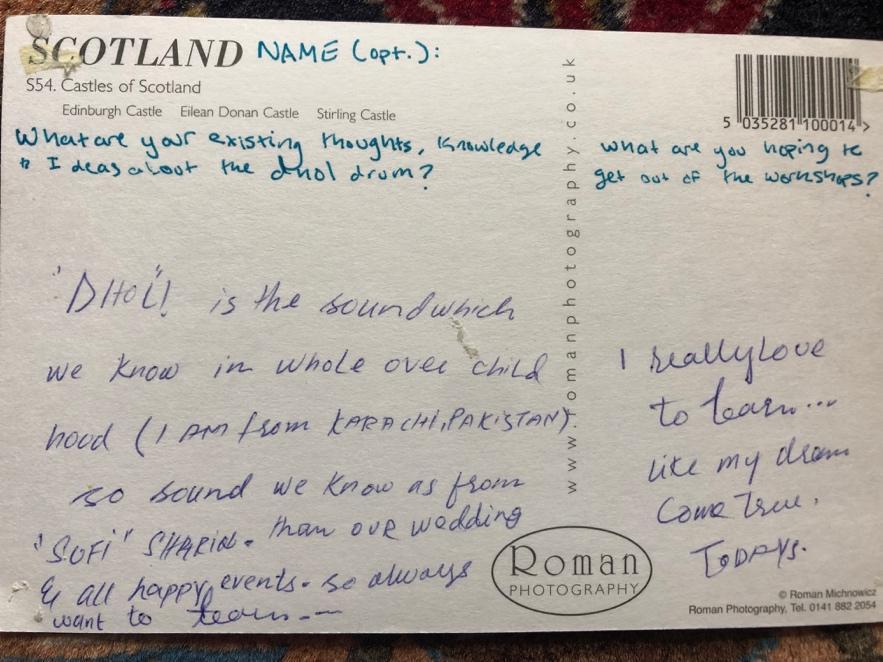
Data collection combined multiple methods: participant observation during all sessions, pre-workshop surveys (postcards for Touchstone, verbal for SBC), totalling approximately 15 responses per individual workshop; post-workshop vox pop interviews, 10 semi-structured interviews; and creative reflection exercises, such as sound drawing (approximately 30 artefacts). This is a method in which participants visually sketch the shapes, dynamics, or images of the sounds they hear as a way of expressing sonic experience and associations. These were complemented by audio and video recordings of each session, as well as researcher field notes. Primary research analysis included thematic coding of interviews, surveys, and observational notes. This linked emerging themes to placemaking outcomes such as belonging, trust, and active citizenship, understood here as “participation in civil society, community, and/or political life, characterised by mutual respect and non-violence in accordance with human rights and democracy” (Hoskins et al., 2008, p. 10).
These explored two different strands of social cohesion. The first strand investigated interfaith cohesion, involving women from across a variety of Bradford’s religious groups. The second strand explored cohesion and inclusion between asylum seekers and local communities. These two strands were chosen because they represent prominent points of community division in Bradford: between longstanding ethno-religious communities and between newly arrived displaced people and the locales they find themselves in. Participants were either existing group members or invited friends. Ethical considerations included informed consent and anonymisation of participant data.
Touchstone – Series 1, October. 2022
The first Touchstone series in October 2022 included women from diverse faith backgrounds to explore the dhol as a shared cultural artefact. The session began with postcard surveys, gauging previous knowledge and workshop expectations. Responses ranged from complete unfamiliarity to nostalgic memories of the dhol’s sound. After a brief introduction to its history, participants learned five basic tones (na, kin, ke, ge, dha) and the chaal rhythm used in British bhangra. In the next session, participants co-created dhol-tone vocalisations to encourage ownership and creativity. This was followed by a sound drawing exercise where participants listened to each of the five dhol tones and drew what they heard. The drawings reflected cultural memories and sonic impressions, which will inform a pedagogical tool for future learning. The series concluded with a group recording of chaal, marking a shared achievement and reinforcing the sense of connection that had developed. The first series demonstrated how learning the dhol together created a collaborative space where cultural associations could be shared and new meanings formed.
Stand and Be Counted (SBC)- June 2023
The SBC series ran in June 2023, including 14 participants of mixed genders and limited English skills. These workshops trialled a revised pedagogy that prioritised cohesion and accessibility over technical precision. We introduced a simplified version of chaal using the mnemonic “hit, the dhol, the dhol, the dhol, hit-hit,” alongside body percussion warm-ups and sound drawing to embed rhythms aurally before playing. Improvisation was central, providing space for creative agency and self-expression. The first session began with a verbal survey to gauge previous knowledge of the dhol. None had seen it before, except two Syrian men who recognised it from Bollywood films. As with Touchstone, we introduced the instrument’s cultural context and main tones before teaching the simplified mnemonic device for chaal. The rhythm was picked up quickly, and we moved into improvisation, giving each soloist as much time as they wished, followed by a dynamics exercise where the whole group played freely while I guided volume with hand signals.
The second session opened with sound drawing before returning to the dhol to revisit chaal and improvisation. Building on the group’s progress, I combined improvisation with dynamics: participants began in unison, then the ensemble was lowered while solos were cued in one by one. Finally, I invited volunteers to take over the leading role. Mustapha, a Syrian participant, stepped forward and divided the room into two halves, each following one of his hands. The session closed with this lively, internally led activity, a moment of collective ownership and organised cacophony that marked a strong conclusion to the series. This series demonstrated how the dhol could act as a cultural bridge and a placemaking tool, creating a shared sense of belonging situated around a locally symbolic instrument.
Touchstone – Series 2 (January 2024)
The second Touchstone series also utilised the simplified mnemonic device. It focused on building confidence and camaraderie through group improvisation and learning chaal, over technical precision. The first session’s teaching sequence moved between rhythm practice, call-and-response games, and guided improvisation, gradually layering skills together. Midway, we paused to introduce the dhol’s historical and cultural role in Bradford, which sparked conversation and deepened participants’ sense of local belonging, before returning to group practice. The session ended with a rhythmic “pass the parcel” game to embed chaal beat, as well as collaborative entry and exit cues.
The second session focused on building confidence in chaal, listening, and group improvisation. Participants recalled the ‘hit-the-dhol’ mnemonic and then progressed to a “finding the groove” warm-up, where each added a beat to a rhythm going around the circle. These playful interactions created a relaxed atmosphere where participants supported one another and celebrated progress. By the end, the group was recording videos to share with family and exchanging contact details, evidence of the social bonds formed through shared music-making. This series demonstrated how ensemble drumming can foster camaraderie and cultural exchange, while also acting as a placemaking tool by creating shared spaces of conviviality and embedding new cultural meanings in Bradford’s social landscape.
Observations and Analysis
Across the three workshops, the Bradford Dhol Project demonstrated the capacity of a locally significant instrument to foster shared cultural experiences, evoke new place-based meanings, and develop non-musical competencies that contribute to cohesion and placemaking. While the initial aim was to revive interest in the dhol and explore its potential for supporting active citizenship in Bradford, the workshops evoked other dynamics revolving around cultural negotiation, collaborative place-making, and embodied social interaction. These undercurrents reflect Bates’s (2012) argument that instruments possess (and facilitate) “social lives,” where their meanings and functions adapt across socio-cultural contexts. Two other key observations emerged. First, participants assigned new personal and cultural meanings to the instrument—whether rooted in heritage, local familiarity, or new associations—that informed their relationship to Bradford. Second, they developed non-musical competencies (e.g., confidence, self-expression, improved English language skills) that support longer-term goals of cohesion, inclusion, and shared culture. Combined, these observations demonstrate ways in which the dhol can function simultaneously as a cultural symbol, social catalyst, and placemaking tool in a fragmented post-industrial city.
Music-derived connections
A first observation was that participants encountered the dhol through three main pathways:
-
Direct cultural links.
-
Indirect familiarity where new understandings were facilitated.
-
Unfamiliarity where new meanings and connections were assigned.
With regards to direct cultural links, in the Touchstone group, several Pakistani Muslim women had cultural familiarity with the instrument, but had never played it. For example, Saima (personal communication, Jan. 2024) voiced that all through her childhood, it had been her dream to learn the dhol, having been a part of her religious life (Sufi) and other celebratory community events. It also evoked nostalgic memories of time spent in a Pakistani village. Playing it in Bradford foregrounded these recollections, connecting the past with the present. Sofia (personal communication, Jan. 2024) shared a similar story of growing up and hearing the dhol at celebrations and community events. For her, it was a symbol of festivity and rejoicing at parties, weddings, and henna nights where the dhol was brought out as a call to the celebration. Kimmi (personal communication, Jan. 2024) noted she had seen the dhol many times at community events but never had the opportunity to learn; understanding the basics increased her confidence to engage with playing an instrument that had always piqued her curiosity. Notably, even those who possessed cultural familiarity were “outsiders” to its practice, with gender and opportunity limiting their access. The workshops enabled them to move from spectatorship to participation, positively shifting their relationship with it and, by proxy, Bradford’s multicultural landscape.
Other Touchstone participants had indirect familiarity with the dhol through local (Bradford) and popular culture-related associations with the instrument. For example, Jenny (personal communication, Jan. 2024), who is the Diocese of Bradford’s interfaith adviser, imparted “I guess because of my work I hear it quite a bit, like at weddings or community events, but I feel I can understand a bit more what they are playing, like pick out the rhythms” (interview, Jan. 2024). Another participant, Deborah, reflected, “I have a Pakistani friend who plays the dhol in different congregations I’ve been in. I like seeing that instrument integrated into Western music, but it’s nice to know more about the feel and texture” (personal communication, Jan. 2024). For these participants, the workshops gave insider knowledge of an instrument embedded in Bradford’s public life, evoking a deeper sense of belonging to the multicultural fabric of Bradford.
The SBC participants—recently arrived refugees and asylum seekers—had no cultural familiarity with the dhol or Bradford. Here, new meanings emanated from positive associations with home cultures or personal memories. Mustapha, a Syrian man, reminisced about seeing the dhol in Bollywood films. Two Afghan women identified similarities between chaal and music used in wedding celebrations in their own cultural contexts. Rohingya participants saw similarities with the rhythms and tones used in the tabla drums from their musical heritage. As Rosie from SBC reflected: “everyone seemed to have connections and positive memories from home (. …) We have to be careful about what memories we might bring up for people, but this just felt really easy to stay in a very safe, happy place with it” (personal communication, June 2023). These participants assigned nostalgia and meanings to it that reflected their own cultural heritage, finding new positive associations with it, situating their culture within Bradford.
The significance of all participants finding different meanings in the instrument was that the workshops served to bring people who were previously outsiders into the culture of dhol playing. These associative connections for all participants demonstrated the potency and adaptability of the dhol as a cultural artefact. Participants projected their own recollections and identities onto the instrument, making it a cultural “meeting place.” The dhol serves as both a nostalgic reminder and a tabula rasa for the new, shared local meanings essential for placemaking.
Connectedness through dhol-playing
A second observation was that participants felt more connected through the collaborative act of learning the dhol. This was observable in both groups, across cultural lines. Despite some having previous knowledge of the dhol and others not, there were no tensions or feelings of guarded ownership over the instrument and its various cultural narratives. Participants were eager to share stories about it, but since no one knew how to play it, everyone was starting on the same phase of the learning process, and there was an air of collaboration that was established from the beginning. In all three series, a notable change occurred as the workshops progressed. Participants began the session by primarily standing and chatting with people they knew. After the first break, they would begin to relax and be more talkative with people they had never met and were outside of their cultural group. By the end of the second workshop, participants were generally interacting freely with one another, and many were exchanging social media and WhatsApp details, as well as taking photos with one another by the end of the series. That reflects the findings from music and social-bonding research (Fancourt & Finn, 2019; Tarr et al., 2014).
Rosie observed that the SBC group, often shy and withdrawn during other activities, became noticeably more confident during and after the drumming workshops. She imparted, “You bring in drumming and suddenly everyone is chatting away, more confidently speaking English in front of people they’ve never met before” (personal communication, June 2023). Rosie also noted that the dhol workshops emphasised a welcoming, relaxed space where there was no way to make a mistake, and they were “all in this together.” She felt that the collaborative nature of the drumming ensemble broke down barriers and shyness more effectively and there was power in the ‘learning something new together’ aspect of dhol workshops: "to be in a room of people doing it together really takes the pressure off you as an individual (…) we go for it and everybody goes for it in different ways that are RIGHT’, instead of focusing on whether you are doing it wrong.’ The workshops created a low-pressure, collective momentum: a feeling of being “all in this together” (personal communication, June 2023), where individual mistakes carried no stigma.
For the Touchstone participants, social bonding manifested in two ways: the experience of collaborative playing (similar to SBC) and the cultural meanings attached to the dhol. Jenny described how “you literally, physically start off as separate, but you’re doing something together, so you come together as a collective. When people arrive, they’re shy of each other, but by the time you have a break, everyone’s chatting. That feed back into playing together, and then when everyone leaves, they are swapping numbers” (personal communication, Jan. 2024). What was evident while teaching and observing the sessions was that the process of learning together something that requires collaboration (like ensemble playing) was highly influential in developing camaraderie. Participants could not just communicate with their existing acquaintances to accomplish group goals. This communication could not only be verbal, either, because the drums are loud, thus participants had to rely on non-verbal communication like gestures, eye contact, and watching others’ hands, which encouraged rapport. Deborah described watching her fellow players’ hands and listening for the ‘bump bump’ of the bass when she got lost (personal communication, Jan. 2024). She also noted in the improvisation exercises that she enjoyed watching other participants solo: their expressions, concentration, and joy.
Because everyone in the interfaith group had some pre-existing associations with the instrument, bonding occurred over dhol stories and cultural meanings. In an interview, Deborah reflected that “the power of this workshop is (…) communities learning about one another, which helps with well-being” (personal communication, Jan. 2024). Building on this, Sofia reflected that part of the joy of the sessions was keeping the dhol alive with different people learning it. The dhol seemed to provide a mode for cross-cultural learning that, instead of constructing ownership boundaries, broke these down and built new memories of collaboration and learning.
These moments demonstrate that ensemble drumming actively produces shared experiences and meanings. The workshops fostered a form of conviviality that facilitated trust and openness. Jenny observed that “when people think of community cohesion, they have an idea of bringing people together and getting them to discuss really difficult, serious issues. These workshops break all those barriers without even trying. If you did a number of these sessions, you could take that group and then discuss other issues, having already formed that bond and trust over music” (personal communication, Jan. 2024). This echoes placemaking scholarship that emphasises the role of shared practices in building civic capacity.
Development of Non-Musical Competencies
In addition to musical learning, the workshops fostered several non-musical competencies that support long-term inclusion and active citizenship. Emerging organically from the collaborative nature of dhol-playing, this demonstrates how musical interventions can extend into broader areas of social life.
Four primary competencies emerged: (a) confidence, (b) self-expression, (c) English language pedagogy, and (d) improved well-being/space for play.
Confidence
For many Touchstone participants, confidence arose from learning an instrument they previously thought too difficult or inaccessible. Several recorded themselves playing chaal for their families, expressing pride. One participant reflected that "the dhol was a huge part of my culture growing up (. …) Traditionally, dhol-playing was something men did, but it is more acceptable for women now and is something I would want to move forward with (…) having a little more confidence in my own ability (personal communication, Jan. 2024). This sentiment was echoed by other participants as well, that engagement with the dhol made them more confident to engage with the instrument within the local Bradford culture. Others reflected on how improvisation had helped them build confidence. For example, Deborah observed that “improvisation was difficult because I didn’t know what to dream up in my mind at first and how to get back in rhythm, but everybody else was doing the same thing” (personal communication, Jan. 2024), an element that she called out as a huge confidence-booster.
In the SBC workshops, confidence manifested behaviourally and socially. Rosie observed participants held themselves more upright and exhibited more playfulness. Their behaviour towards each other shifted too, while they had always been supportive, she noticed their ability to have fun together emerged in our workshops. These changes went beyond the workshops themselves. Since our sessions, Rosie observed, “the participants are now different in the room” (personal communication, interview, June 2023), maintaining positive behaviour shifts. The most striking example was Raheena, a Rohingya woman, who was previously extremely withdrawn and didn’t usually speak English. During the dhol sessions, she stood out as wanting to show everyone she knew what she was doing, playing loudly and with exuberant improvisations. The week following the dhol sessions, one of SBC’s funders arrived, whom none of the group knew. Raheena marched over, greeted her in English, took her hand, and introduced her to everyone – behaviour Rosie described as unprecedented. The dhol workshops had provided her with a platform not only for musical expression but also for agency and self-assurance.
Self-Expression
Another competency the dhol sessions encouraged was self-expression. Improvisation was a particularly powerful mode of facilitating creative agency, which reciprocally helped build confidence. It was presented as a safe, pressure-free exercise where participants could literally do anything with the knowledge that the group would support them. This is particularly powerful for people, like asylum seekers, who don’t have much agency in their lives. For Touchstone, self-expression emerged through experimentation with tones and textures. One woman decided to rub her hands on the drum skin, while another played the wooden shell. These quieter sounds prompted the other participants to adjust their playing dynamically, listening and responding together, a powerful moment of connectivity.
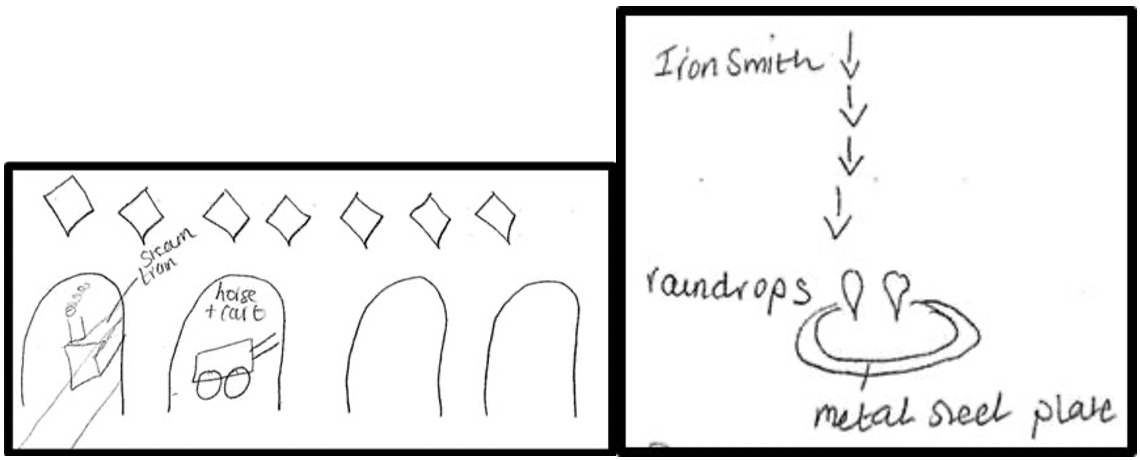
Also, enabling self-expression was sound drawing (See Fig. 3). With Touchstone, participants drew detailed pictures of nostalgic scenes or geometric shapes mirroring the sonic qualities of the tones. These reflected the various associations with the dhol – either as a prominent sound or a cultural symbol. Regarding the SBC participants, Rosie reflected, “the sound drawing exercise was really interesting – they were immediately at ease and I’ve not seen that before with this group, particularly with holding a pen (…) it’s quite an abstract thing that other groups would have queried; whereas this group, they totally got the language and communication that was happening” (personal communication, June 2023). She was particularly amazed at the Rohingya women’s engagement, as they were not usually comfortable writing (since their native language is not written). Self-expression via drumming and drawing did not rely on the English language. They could use this different energy to communicate, which coincidentally made them more comfortable speaking.
English language pedagogy
Although not a primary aim, the workshops support English language development, specifically within the SBC group. Lack of English proficiency is a significant barrier to refugees and asylum seekers engaging with host communities. Rosie reflected that “usually the issue is confidence; people have been made to feel bad about actually speaking really beautiful English, but sometimes it seems that those who only speak English like to make them feel bad” (personal communication, June 2023). Creative activities that remove the need for writing or speaking allow them to feel they are communicating, which gives them the confidence to speak more. When the sessions commenced, the participants sat with people they knew, speaking in their own languages, except when asked to engage with class activities. As the sessions unfolded, participants began to loosen up and engage with each other in English a bit more. This was especially evident after the sound drawing in the second session. There was a new participant, Zara, in the second session, who had not learnt the drum basics yet, so she was figuring it out as she went along. The Rohingya woman next to Zara would periodically lean over to help her when needed. At the end, Zara had to leave early, and the woman exclaimed, “oh no! you’re going!” and made a point of bidding her goodbye. Rosie was amazed at the exchange, “you bring in drumming and suddenly everyone’s chatting away, speaking English in front of people they’ve never met before!” (personal communication, June 2023).
In later interviews, Rosie reported that the increase in English communication and confidence continued, attributing the drastic improvements to the dhol workshops. Drumming, it seems, had the effect of boosting confidence in non-verbal communication, which, in turn, encouraged more verbal communication.
Well-being and importance of play
The final non-musical competency that emerged was notable increases in relaxation and well-being, which highlighted the importance of play and respite in contributing to active citizenship. What is often underestimated in a music outreach context is that sometimes people, whether they are particularly vulnerable or marginalised or not, need a space for self-expression, where they don’t have to lead or maintain formality, which may not otherwise be present in their daily lives. A brief period of respite in which to play, to build resilience, that carries over into daily life. For Touchstone participants—many of whom had demanding professional or caregiving responsibilities—the workshops offered a rare space for playful self-expression. Jenny reflected that “some of the women in that room have jobs where they have to be really serious; women in power often have to take on male characteristics and demeanours; it’s nice to see them enjoying themselves” (personal communication, Jan. 2024). Sofia imparted, “normally I have to be quite placid and composed. This workshop with this group gave me the ability to just let my hair down” (personal communication, Jan. 2024). She found particular empowerment from the experience of having this liminal space with a group learning something new together, “because we were all on the same page, starting from that premise, we were able to move forward as a group instead of individuals – I think that’s what music does for people” (personal communication, Jan. 2024). Echoing Sofia, Dion observed, “I can feel this being good for my mental health, as well as building new ways to communicate with one another” (personal communication, Jan. 2024).
For the SBC participants, whose lives are often marked with stress and uncertainty, the workshops provided a welcome respite. Rosie emphasised that SBC aims to create a “playful, relaxed space to come and do something that’s active and will take their minds off other things (…) just a couple hours can be really crucial” to overall well-being (personal communication, June 2023). These moments of play are not ancillary. They contribute to resilience, trust, and social connection, key components of active citizenship and placemaking.
Scaling up
Combined, these observations suggest how small-scale cultural encounters, such as dhol workshops, could be expanded into broader placemaking processes. Placemaking scholarship purports that large-scale cohesion emerges from localised acts of collaboration, accumulating into shared senses of place. (Ellery et al., 2021; Hamdi, 2004). The workshops demonstrated this through trust-building, cultural exchange, communicative confidence, and sense of agency over the dhol, a locally-significant artefact. As supported by interview data, these competencies are carried beyond the workshop space into families, neighbourhoods, faith groups, and community cultural events, where they have the capacity to shift how individuals experience and interpret Bradford. This makes the micro-level dhol workshops a catalyst for city-level placemaking.
Conclusion
The research emerging from the Bradford Dhol Project demonstrates the multi-faceted role that musical instrument-based interventions can play in fostering cohesion, shared culture, and non-musical competencies, particularly when the instrument holds local cultural significance, as the dhol does in Bradford. This research yielded four key findings:
-
Shared cultural experiences: Learning a musical instrument together served as a potent tool for social bonding in a multicultural context. The collective empowerment of learning the dhol created a space in which shared local meanings emerged, drawing both on participants’ existing cultural associations and on new meanings formed collaboratively in the workshops. This resonates with Bates’s (2012) argument that instruments possess “social lives”: as they traverse different contexts, they accumulate, shed, and transform meanings that shape social relations.
-
Locally-specific approaches: The intervention’s effectiveness was strengthened by its local relevance. The dhol evoked different meanings across different cultural groups, yet its wide-ranging associations made it ripe for deployment, reifying those meanings within diverse groups and creating poignant, alternative cultural significances. Collaborating with community organisations ensured workshops aligned with specific social aims—interfaith cohesion, asylum seeker and refugee cohesion, and community belonging—enhancing the intervention’s reach and resonance.
-
Creative empowerment: Empowerment emerged on multiple levels. All participants were outsiders to the instrument—whether by culture, gender, or circumstance—and workshops provided a route to accrue insider knowledge, deepening connections to Bradford’s cultural landscape. Group improvisation fostered a sense of shared progress, while non-verbal modes of communication (e.g., sound drawing, watching others’ hands, responding to volume cues) laid the foundation for trust, mutual recognition, and verbal confidence. These embodied practices further illustrate the agentive potential of musical instruments identified in Bates (2012), mediating not just sound, but social interaction.
-
Cohesion and inclusion: The workshops fostered cohesion and inclusion by providing insider perspectives on a symbolically rich instrument and supporting the development of non-musical competencies and active citizenship. These included increased confidence, linguistic engagement, improved well-being, and expanded capacity for creative expression. These extended beyond the musical setting and have the potential to contribute meaningfully to broader civic engagement.
Taken together, these findings demonstrate how musical instruments can act as cultural mediators, encourage active citizenship, and create avenues for collective placemaking, a process understood in placemaking scholarship as emerging from locally situated, collaborative practices (Courage et al., 2020; Hamdi, 2004). They are objects simultaneously loaded with prior meaning and open to reinterpretation. The dhol, in particular, operates within this liminal space: carrying historical and cultural associations, while also offering a tabula rasa upon which new, collective meaning can be inscribed. Through this dual function articulated by Bates and evidenced in these workshops, the dhol facilitates cultural exchange, active citizenship, and local placemaking.
Ultimately, this study suggests that musical instruments, especially those with deep local resonance, can be effective mechanisms in community-based interventions. When utilised as adaptable cultural artefacts, they create unique opportunities for cohesion, collective identities, and meaningful dialogue in disparate multicultural communities. In Bradford, the dhol surfaces not just as an instrument of music-making, but as an instrument of place-making, shaping how people understand themselves, one another, and the city they share.