
Introduction: The Battle of Okinawa and Yambaru forest
During World War II, US forces attacked the islands of Okinawa from the air, sea, and land. The horrific violence of this attack became known as the “Typhoon of Steel.” I was born in Okinawa in the late 1980s and grew up listening to war stories told by survivors who visited our elementary school for peace education. I still remember a small elderly lady who sat on a folding chair in front of hundreds of school students in the gymnasium. She had been a student nurse during the war. Holding a microphone, she told the most grotesque stories that I had ever heard. Her voice shook as she raised and lowered her voice while depicting different wartime scenes. Listening to the same elderly lady talk every year made me wonder about my own family’s wartime experiences.
Unlike the guest speakers at my school who went into such painful details, I seldom heard stories from my family. My maternal grandmother is from Naha City in southern Okinawa. She lost her sister right after they changed the order of the line they were walking in. My paternal great grandfather is also from Naha City, and he was killed as he tried to head back from the north to the south to pick up what he had left at his home. Even though we were encouraged to ask questions at the end of the school talk, it was not easy to do so with my own family. One time, I asked my grandfather what happened to him during the war. He was 14 during the Battle of Okinawa. We made eye contact, but he did not respond. Today, my ancestors’ names are inscribed on the Cornerstone of Peace at the Okinawa Prefectural Memorial Park. At that memorial, you can search for the names, addresses, dates of birth, dates of death, and locations where the inscribed individuals are thought to have died. I do not have stories about my maternal great-aunt or paternal great-grandfather. How they lived and how they died, what they saw and thought about to make sense of what was happening to their lives. As a third-generation survivor of the Battle of Okinawa, what I know from the absences in my own lineage is that my existence is an uncontrollable result of my ancestors’ death and survival, and that survival itself still carries enormous pain.
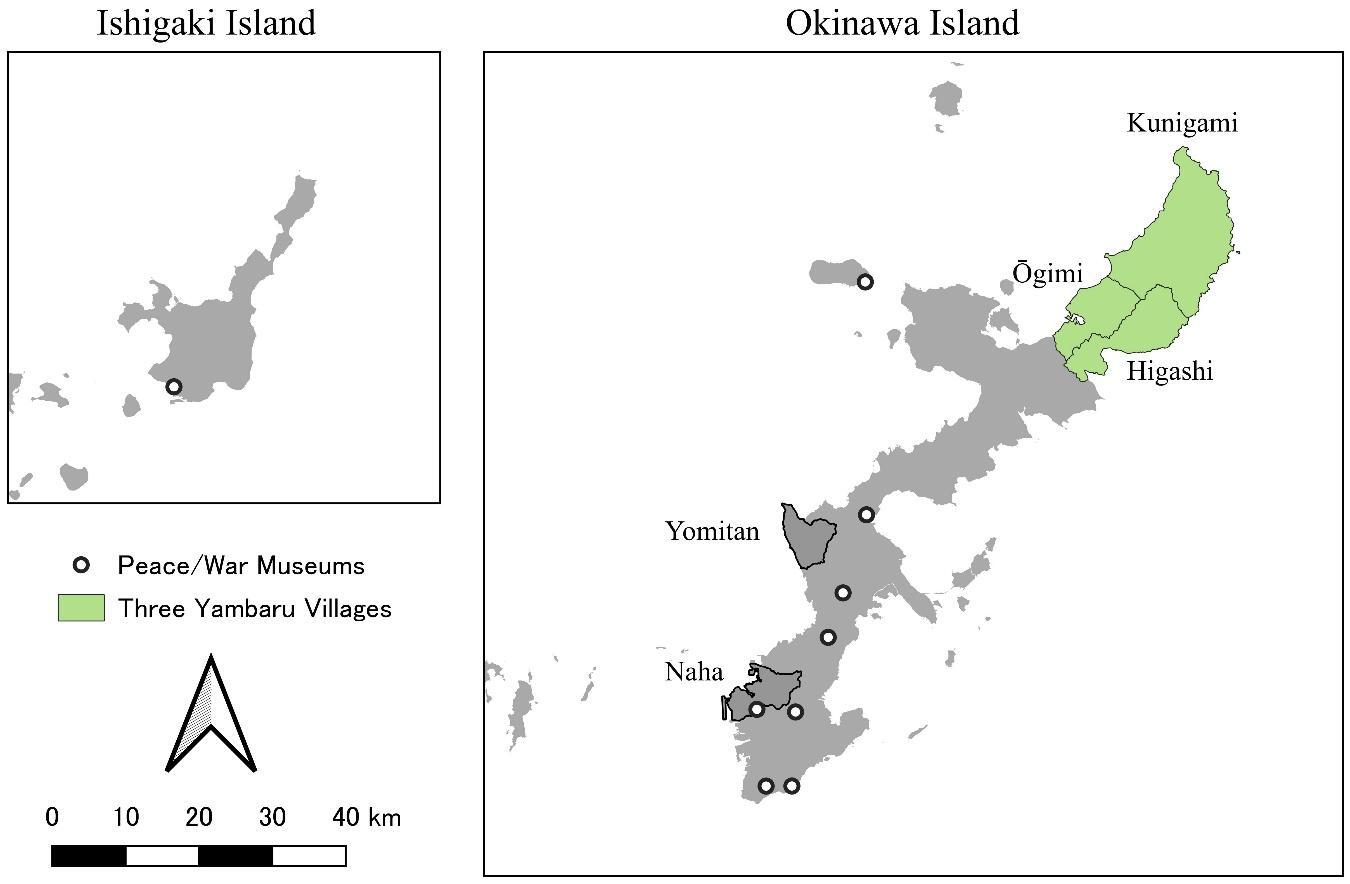
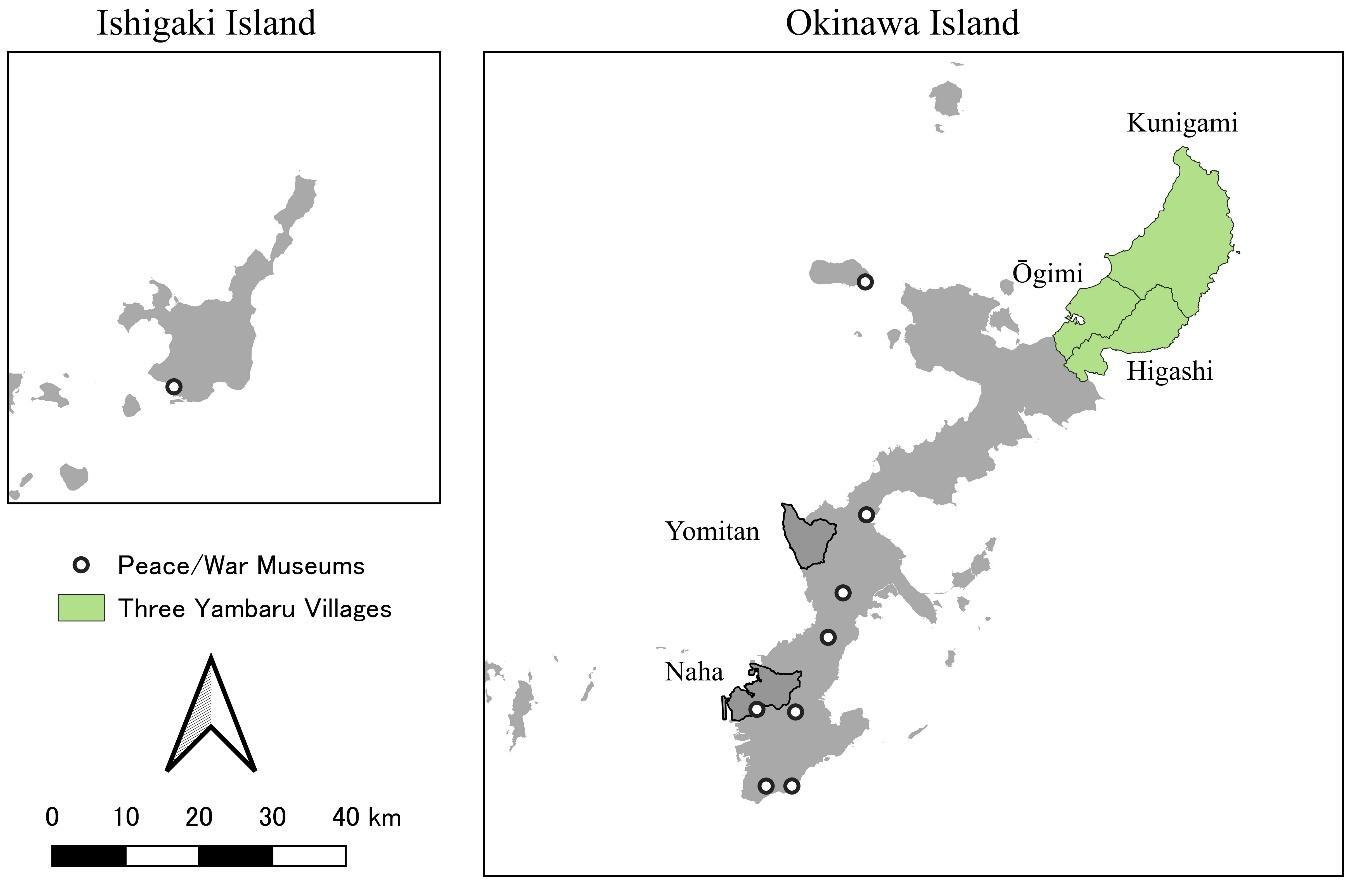
The dominant narrative of the Battle of Okinawa emphasizes Okinawan sacrifice and victimization. Following WWII, the US occupied Okinawa through the United States Civil Administration of the Ryukyu Islands (USCAR) until Okinawa reverted to Japan in 1972. The extensive memorialization of the war in the southern part of Okinawa Island had deep ties with the Japan-backed reversion movement (Figal, 2012). Sites for memorializing the Battle of Okinawa are concentrated in the south (see Figure 1). In this narrative, Okinawans endured horrific sacrifices for the Japanese Empire. Student nurses called Himeyuri, who endured horrific casualties, are widely upheld as exemplifying this sacrifice (Angst, 1997).
Despite this dominant narrative, Okinawans have sought to draw attention to the diversity of war experience, including violence by Japanese soldiers against Okinawan citizens. The Okinawa Prefectural Peace Memorial Museum had been a flashpoint for such representations, particularly changes to exhibits in the late 1990s aimed at deemphasizing cruelty by Japanese soldiers (McCormack & Norimatsu, 2012, pp. 40–42). In 2007, controversy arose because the Japanese Ministry of Education, Culture, Sports, Science and Technology demanded that publishers of high school textbooks revise descriptions of the Japanese military’s role in coercing the mass suicide of Okinawans, a demand that Okinawans strongly opposed (Aniya, 2008; McCormack & Norimatsu, 2012, pp. 33–34). Critical scholars highlight that Japanese strategic ignorance of Okinawa enables the ongoing militarization of Okinawa (Kim & Song, 2025; Nishiyama, 2022).
In this article, I focus on war memoirs of Okinawans who fled to Yambaru. Drawing from war memoirs in Yambaru, I highlight two key points. The first is that it is extremely rare to find English-language scholarship focusing on war memoirs in Yambaru Forest. While many works have been devoted to pointing out the diversity of war experiences within Okinawa, the focus on Yambaru Forest is missing. This article attempts to contribute to the understanding of war memories in Okinawa by recognizing their diversity and further engaging with the ground from which different war memories are shaped.
The second point is the role of liminality for war memories in the forest. Viewed from a state-centric perspective, Yambaru Forest is a peripheral part of Okinawa Island. For Okinawans, Yambaru Forest provided a harsh refuge from state-backed violence. The space of the forest, temporality during the war, and postwar commemoration are liminal. Rather than conceptualizing this ambiguity as a source of weakness, I emphasize the possibilities it enabled. This perspective draws inspiration from scholarship on the Hawaiian concept of kipuka as a source of resistance or resurgence (Kajihiro, 2020; McGregor, 2007). Kipuka refers to abrupt environmental changes, notably an oasis in a lava field. The in-betweenness and ambiguity of Yambaru Forest may resonate with other cases beyond Okinawan studies.
The perspective drawn from war memoirs of refugees who survived in Yambaru Forest unsettles the dominant narrative of Okinawan sacrifice for the Japanese nation and subsequent redemption by the Japanese nation through reversion. I highlight a different narrative, one that centers on the resilience of Okinawans to survive the war and the liminality of Okinawan war experiences in Yambaru Forest. This narrative arises from the lived experiences of islanders, drawing on memoirs to reveal an alternative to the dominant narrative of Okinawan sacrifice and victimhood. In making this move, I draw inspiration from advances in critical geopolitics and island studies that call for critical reassessments of state-centric narratives and deeper engagement with the agency and experiences of islanders (Davis, 2020; Mountz, 2015; Nimführ & Meloni, 2021).
Common themes emerging from the Battle of Okinawa testimonies are presented in English by scholars such as McCormack and Norimatsu (2012) and Tanji (2006). Sometimes, direct English translation of war testimonies is also available (Crandell, 2014). While there is a body of scholarship that engages with war memories, finding English-language work that focuses on Okinawan civilians in Yambaru Forest is extremely hard. War histories and commemoration sites often reference Okinawan refugees fleeing to the north, but such references are typically peripheral to the suffering in the south of Okinawa Island.
Other scholars have delved into the diversity of Okinawan wartime experiences. For example, Kaneshiro (2019) examines the wartime memories of Okinawans from Kin Town in Davao, Philippines, revealing complex experiences and traumas. My contention here is not that the Yambaru Forest should displace other narratives of Okinawan war memories, but rather that holding in mind the experiences of Yambaru Forest contributes to deeper way of engaging with the diversity of Okinawan wartime experiences and legacies of the war.
The geospatial context of Yambaru forest
There are three key dynamics necessary to understand the geospatial context of Yambaru in connection with war memories. First, Yambaru (山原) historically referred to the northern area of Okinawa Island, where the rugged terrain creates a much more mountainous landscape. The term Yambaru, especially when pronounced “Yambarā,” carried derogatory connotations of being a country bumpkin. While it is not common to hear the term used this way today, it suggests the distant relationship between the urbanized southern area and the mountainous north during the Battle of Okinawa.
Second, contemporary usages of Yambaru are influenced by the Ministry of Environment’s establishment of Yambaru National Park in 2016. This park later became a part of a UNESCO World Heritage designation in 2021. The park spans across three villages: Kunigami, Ōgimi, and Higashi. As a result, post-2016 references to Yambaru are more likely to indicate Okinawa Island’s three northernmost villages (see Figure 1). While the term Yambaru was used more expansively, Yambaru Forest refers to a more delimited area in northern Okinawa Island. Still, variations in place names persist, especially because place name usage common during World War II may differ from present usage.
Third, the liminality of the forest and refugee experiences there inform war memoirs and commemoration. Those who fled to Yambaru Forest often did so with minimal guidance or familiarity. The dense woods and rugged terrain were difficult to navigate, especially without local knowledge. Further, exact locations are often washed away. Paths erode, streams shift, and trees grow and fall. People may remember what plants and animals they ate but be unable to remember where they buried their loved ones. In this sense, the forest is not a fixed site for commemoration but a broader living ecology that contains collective memories. War memories of Yambaru are embedded in the forest and its cycles.
Situating Okinawans’ war memoirs from Yambaru
War legacies
While English-language texts on war memoirs from the Battle of Okinawa are available to a limited extent, it is important to note the work by Shun Medoruma and Kyle Ikeda, a prominent scholar of Medoruma’s writing. Medoruma is an Okinawan writer from Nakijin village and a second-generation Battle of Okinawa survivor. He mostly engages with the ongoing legacy of the Battle of Okinawa through fiction but has also written nonfiction books and essays on the topic. For example, in In the Woods of Memory, Medoruma (2017) crafts a fictional story that revolves around traumatic war memories such as the rape of an Okinawan girl by US soldiers. Drawing on war testimonies, Medoruma crafts stories that reflect experiences so terrible that they are not well documented in public records. He also problematizes the power-laden relationships through which the war was documented, and how such documents are made available. For example, he recalls hearing from his classmate’s mother, who was then a child, how US soldiers photographed a line of Okinawan villagers walking into an internment camp, while away from the photographer’s view, other American soldiers dragged women into the bushes to rape them (Medoruma, 2005). Documentation of the war often served propaganda the purposes of portraying the kindness of US soldiers aiding war victims or to emphasize the horrors of war by recording the dead bodies of civilians covered in flies. Such documentation omits what Medoruma (2005) calls “the perspective of the killed” (p. 88). Normalizing the perspective of soldiers risks normalizing the military’s gaze while overlooking the Okinawan perspective.
Kyle Ikeda examines how second-generation survivors of the Battle of Okinawa are often deeply affected by the war despite only having fragmented and incomplete knowledge of it (Ikeda, 2014). For Ikeda, war memories that went undocumented, what he calls “unarticulated memory,” are crucial. Accounts that are too traumatic, such as sexual assault, are often narrated not by the victims but rather by those who witnessed the suffering. Drawing on Medoruma, Ikeda develops the term “geographically proximate postmemory” (2012) to explain how proximity to traumatic sites impacts subsequent generations, especially second-generation survivors, because living proximally to traumatic sites heightens awareness of war traumas.
The liminality of the forest, including both wartime experiences and postwar commemoration, means that Okinawans live alongside a forest filled with histories of wartime suffering and survival, with bones of ancestors that were lost and never recovered. Okinawans are not alone in living alongside such traumatic sites. For example, villagers in Cambodia employ a range of strategies to negotiate living alongside sites of Khmer Rouge atrocities that lack formal commemoration (Guillou, 2012). Researching Okinawa more generally, not the Yambaru area, cultural anthropologist Christopher Nelson (2020) immersed himself in an eisā performance group to write about how people process the Okinawan past and ongoing militarism through playing and praying for ancestral spirits. Such research reveals Okinawans’ ongoing struggle with the haunting legacies of war and militarism.
Previous research on Yambaru Forest examined the ongoing legacy of militarization in the forest to argue that the transition of forest land from military use to conservation use can be problematic (Sakuma, 2022). In 2018, the Japanese Ministry of the Environment’s campaign to establish Yambaru Forest as part of a UNESCO World Natural Heritage Site encountered setbacks when a key committee deferred its proposal because the previously returned land from the US military in Yambaru Forest was not integrated into its management. In 2021, Yambaru Forest was inscribed as a UNESCO World Natural Heritage Site as part of the site Amami-Oshima Island, Tokunoshima Island, Northern part of Okinawa Island, and Iriomote Island. While contemporary efforts to brand the forest and its surrounding area for its outstanding universal value, the absence of the history of the Battle of Okinawa and lingering criticism about the ongoing militarization in the area remain unaddressed.
This scholarship mentioned above provides insights into the ongoing legacies of militarization and war trauma in Yambaru Forest. In English-language publications, the direct experiences of and words from Okinawans who survived the Battle of Okinawa in Yambaru Forest are scarce and difficult to access. This article is just one step towards improved English language documentation and awareness of the range of Okinawan wartime experiences in the forest. As the narrative of Okinawan sacrifice becomes entrenched, the alternative history of suffering and survival in Yambaru Forest provides an important contrast, one that foregrounds the agency of islands to articulate the past and to envision their own future.
Critical geopolitics and island studies
Critical scholarship provides a foundation for avoiding state-centric discourses that situate Okinawa as utilized by the security priorities of Japan and the US. Nishiyama (2024) highlights the politics of forgetting that comes with the construction of ignorance built on uncertainties within Japan. He uses the term “mainland ignorance” to refer to “a type of colonial unknowing that is strategically deployed to dissociate the continuity and inextricable relationship between the colonial past and the present for the interests of mainland states” (Nishiyama, 2024, p. 3). Embodied experiences of militarized landscape are often masked by the exotification of the islands, even while visiting the islands, as Ginoza (2007) points out how tourism and militarism mutually support the construction of Okinawa.
The focus on the local scale in feminist geopolitical critique and on knowledge production about islands becomes particularly important here. If the construction of ignorance underpins the ongoing militarism of the islands, a response requires moving beyond simply knowing and instead an intentional engagement with interrogating how discourses of place reshape understandings of that place, which, in turn, alters perspectives and conditions on the ground. Hyndman (2001) engages with the question about “security for whom?” by juxtaposing human security with state security. In revisiting security from a bottom-up perspective, bodies are not merely a scale where violence is experienced but also an agency to exercise alternative geopolitics based on peace and safety (Koopman, 2011). Considering how militarization of Okinawa is normalized in the US-Japan security politics, the focus on bodily scale in reimagining (in)security helps recognize the political and material implications of (un)knowing colonial history.
The acts of remembering and forgetting reflect broader geopolitical logics that shape how islands are positioned within imperial and national frameworks. Okinawa’s history of colonization by Japan and ongoing militarization fit within research on colonial subjects at the empire’s edge that use the concept of liminality to draw out the perspective of people who live in border spaces (Matsuda, 2018). Mountz (2015) argues that states routinely construct islands as peripheral spaces while simultaneously assigning them strategic functions within military and economic systems. At the same time, islands are not mere passive spaces receiving the state’s assertion of power over land. Davis (2015, 2020) urges attention to the messy competition between sovereignties - including capitalism, militarized national security, and local claims to land and belonging. Instead of a state-centric approach, critical geopolitics emphasizes a relational approach that considers islanders’ perspectives (Yamazaki & Davis, 2025). Rejecting islands as subjugated space, critical island studies enable seeing islands as where colonial knowing of space is pushed back and alternative futures are reimagined. Decolonial thinking on islands requires critical reflection on how and from where islands are studied, instead of focusing on claiming to support islands, while being alert about potential harms of reinforcing Western epistemic foundations (Nadarajah et al., 2022; Nimführ & Meloni, 2021).
Such calls for critical reflexivity continue to be relevant in Okinawa. In a review of English language ethnographic research on Okinawa, Roberson (2015) contends that depictions of the complex impacts of militarism on everyday life seldom appeared before 1995, and future research should continue to analyze the everyday impacts of gender, urbanization, capitalism, and militarism. In that vein, Chibana (2020) examines everyday acts through which seemingly ordinary activities, such as farming, become powerful tools to exercise sovereignty over the land. In this paper, I pay attention to war memories recorded by village officers, researchers, and individuals who wrote their own memoirs as opposed to unpacking the ongoing contestations over memorial sites and museums. In doing so, the focus is on our own everyday act of remembering and knowing the traumatic past of the islands. Instead of trapping Okinawan war memories within the representational politics of US-Japan relations, I explore what it means to be critical about the Okinawan past beyond the limiting framework of the states.
Accessing Okinawan war memoirs of surviving in Yambaru Forest
My research on war memories in Yambaru Forest draws from a range of archival sources. I conducted archival research at the Kunigami Village Library, Okinawa Prefectural Archive, the University of Hawaiʻi at Mānoa’s Okinawa Collection, and George Washington University’s Okinawa Collection to collect war memories in Yambaru. Kunigami Village Library holds some hand-sized books published by individual villagers who recorded their memoirs of how the Battle of Okinawa disrupted their ordinary everyday lives and further normalized struggles of surviving through the war. Such individuals’ stories often focus on the war experiences at a local scale through which many depictions revolve around families, relatives, friends, neighbors, and how they navigated encountering soldiers in the woods. The memories feature the writers’ war experience as it progressed through time. They often start with stories of leaving their houses in great uncertainty with the approaching attacks and end with how they survived, often with their experiences of being captured after surrender, and reflections on what the war meant to them.
Citizen memoirs of the Battle of Okinawa work to counter state-centric discourses, inspiring resistance to ongoing militarization (McCormack & Norimatsu, 2012; Tanji, 2006). Survivors cite a wide range of motivations for undertaking the painful process of documenting their experiences. They often write about a responsibility to create memoirs for the benefit of future generations and to caution against the horrors of war.
Gibo (2015) who recalls himself as 軍国少年gunkoku shōnen (militaristic boy) writes:
The Battle of Okinawa has remained in me as trauma. First, I see dreams of my mother and sisters being endlessly chased by American soldiers. I had this nightmare for a long time after the war. Second is my brother’s death during the battle. My mother cried for years over the loss of her beloved son, and the sorrow made our home always dark. Documenting this disaster has been my long-sought wish, and I repeatedly started and then stopped writing (Gibo, 2015, p. 116).
Reading through war memoirs, such writers' reflections on their war experiences draw attention to the enormous pain of writing down their memories.
As I review a series of memoirs and published interviews, I particularly engage with the following sources in this paper. In “Record of Wartime in Oku: Battle of Okinawa in Yambaru” (Oku mura no ikusayū no kiroku: Yambaru no Okinawa sen/奥むらの戦世の記録:やんばるの沖縄戦), written in Japanese, an Okinawa-born scholar Miyagi Yoshihiko compiles interviews with those who currently or previously lived in the Oku subdistrict of Kunigami village (Miyagi, 2018). Miyagi also challenges the general image of Battle of Okinawa being closely tied to conscripted student nurses and soldiers and the contrast between the heavily bombed south and the combat-less north.
Another source is history books published by municipalities such as Chatan Chōshi (Chatan town village book) (1985) and the Kunigami village history book titled Kunjan (2016) that quote interviews published by subdistricts within Kunigami village. The compilation of not only Kunigami villagers’ interviews but also those who fled to the village from other areas on the island gives additional details on how people made their way into the forest. These interviews were collected as part of a post-war prefecture-wide effort by groups of researchers and local governments to record people’s wartime experiences.
I chose these sources since the compiled interviews are more focused on experiences around Yambaru. In addition, a number of interviews contain descriptions by civilians who were not conscripted, including children and mothers. The stories often focused on walking or running, searching for food, negotiating encounters, and moments that determined survival. As opposed to the military documents on the progress of the war and troops’ locations, such stories help to place civilians’ faces in the war stories.
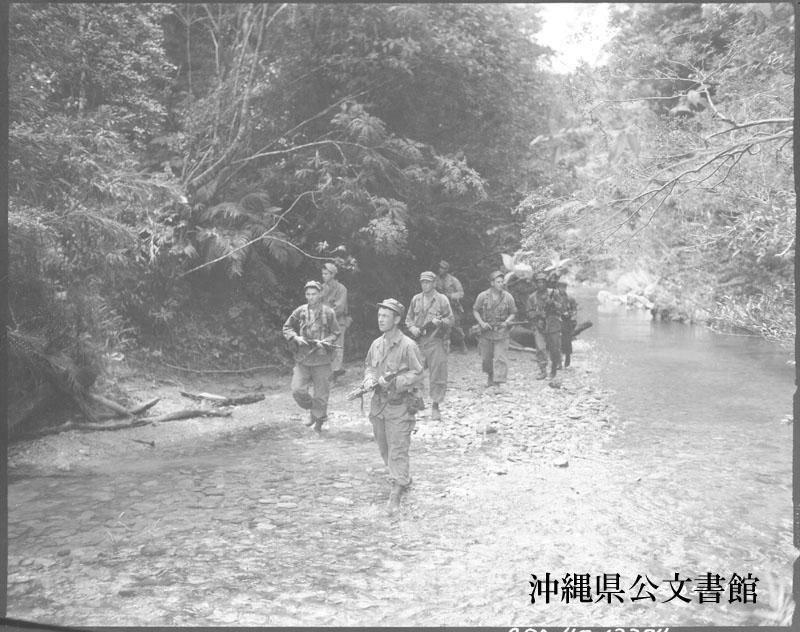
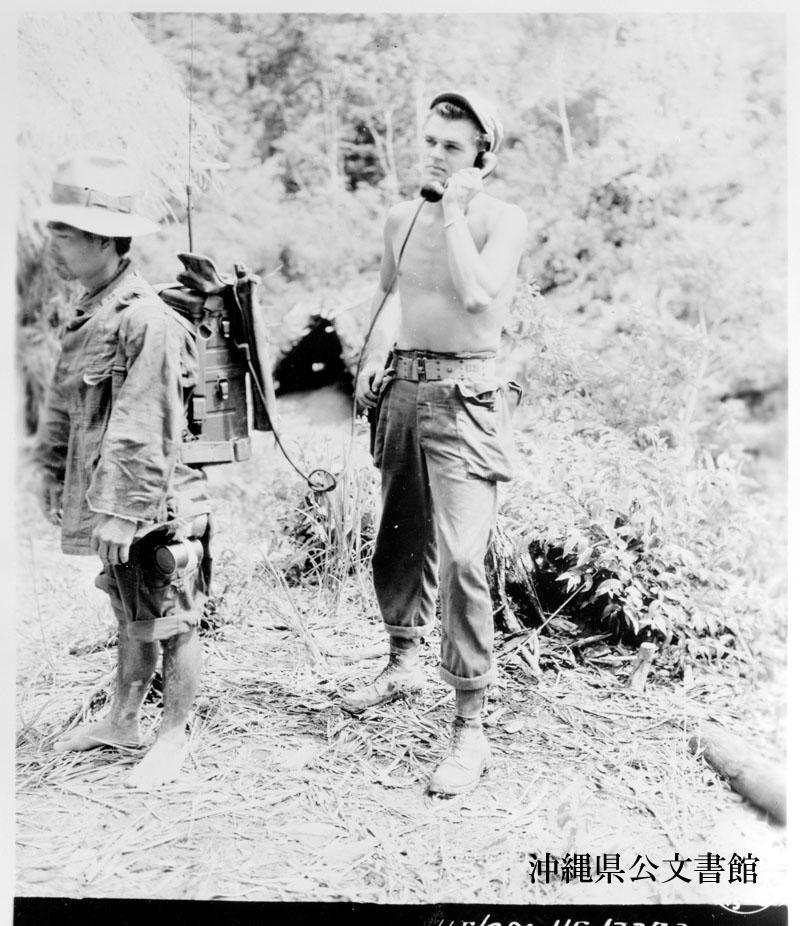
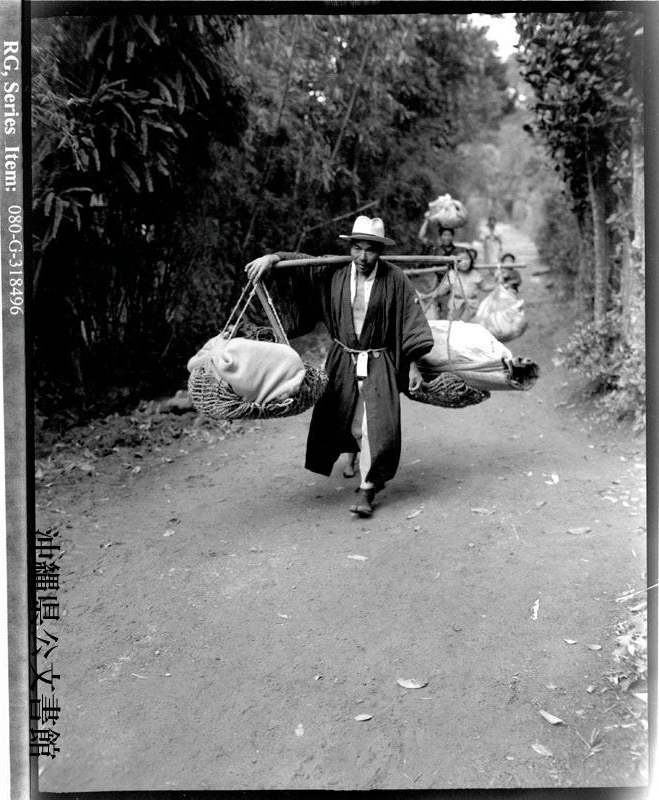
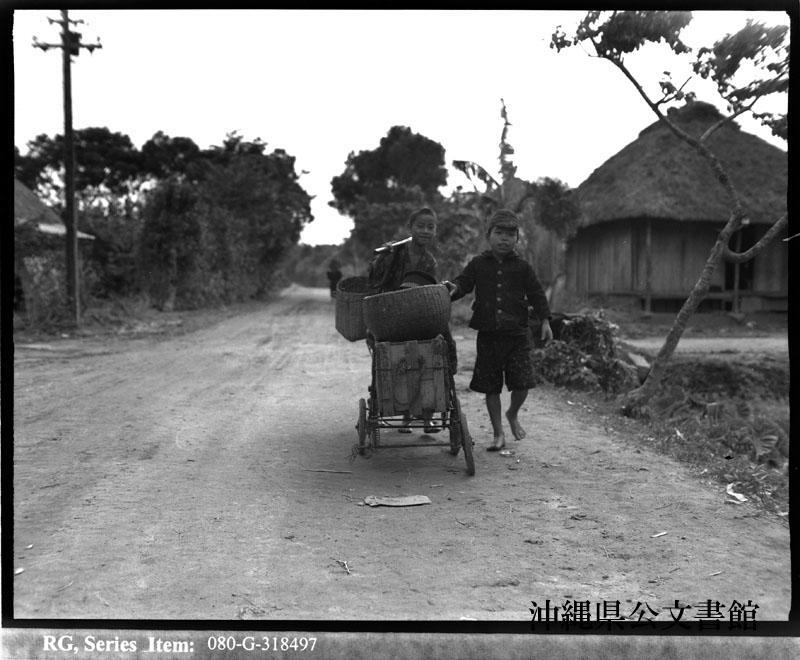
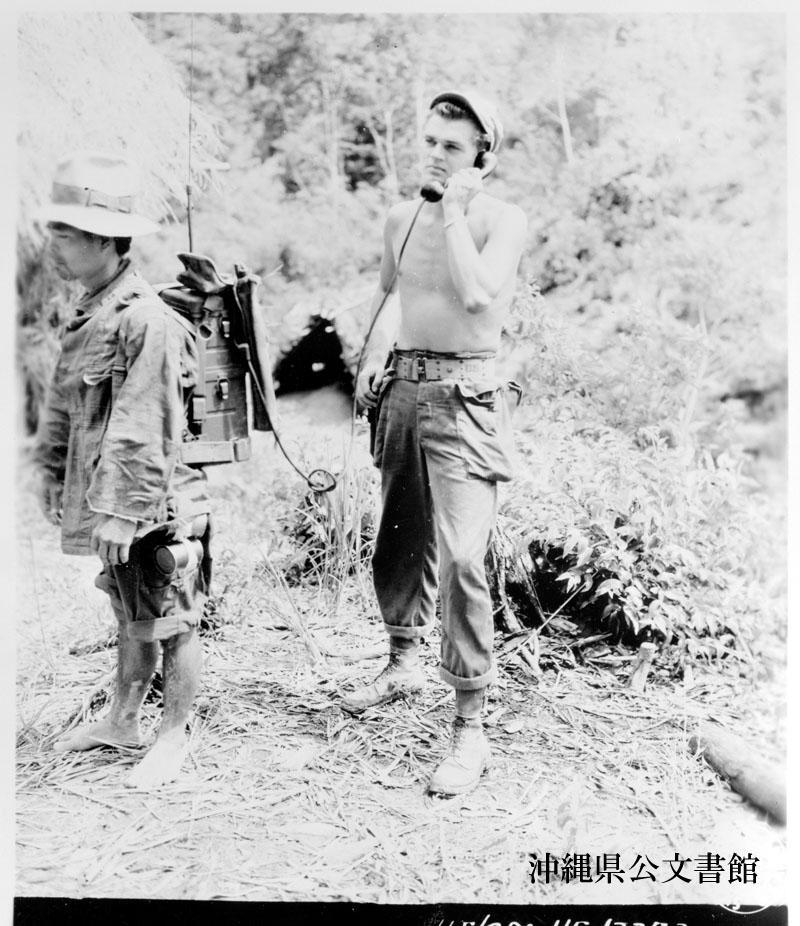
Some photos are also included in this paper from the Okinawa Prefectural Archives to help visualize some of the scenes. However, it is crucial to note that the photos are part of the US military’s war records. As the section above mentions Medoruma’s attention to the perspective of those who recorded the account, the photographs taken are by the US soldiers. The contrast between the stories told by people and the photos by the US military exemplifies the multiple ways of remembering the past.
Background on refugees in Yambaru Forest
After the US launched a ground invasion on April 1, 1945, organized ground battles lasted for roughly two-and-a-half months. Of the 122,228 Okinawans who perished, 94,000 were civilians, and 28,228 were mobilized combatants, including messengers and field nurses (Okinawa Prefectural Peace Memorial Museum, n.d.). As for military casualties, Japanese forces (excluding Okinawans) lost 65,908 soldiers, and US forces lost 12,520 soldiers. The number of reported deaths continues to be updated every year, and according to the latest record published by Okinawa Prefecture, a total of 242,225 people died in the Battle of Okinawa (Okinawa Prefectural Government, 2025a).
War memoirs do not simply start with the landing of US troops. Rather, they often describe the militarization of Okinawa that normalized new circumstances and uncertainties, such as military conscription and recruitment to work in war-related facilities. In February 1945, the Japanese military ordered the Okinawa Prefectural Governor Shimada to secure food supply for six months as well as to build shelters for evacuees. This relocation plan sought to move 100,000 non-combatant residents from the central and southern parts of Okinawa Island to the Yambaru area (Okinawa City Office, 2019). Using the preexisting administrative system that divided Yambaru villages into aza or subdistricts, the prefectural government assigned evacuees to each subdistrict and ordered them to prepare for the refugees.
Okinawans have long called the northern part of Okinawa Island Yambaru, referring broadly to the area from present-day Nago in the south to the northern tip of Cape Hedo. Written by combining the character for mountain (山) with field (原), Yambaru evokes a rural and forested image. In 2016, the Japanese government established Yambaru National Park in the densely forested areas of Kunigami, Ogimi, and Higashi Villages, but in this paper, I use the term “Yambaru Forest” more broadly to refer to the rugged and forested terrain in northern Okinawa Island to which refugees fled in an effort to escape the war.
The Japanese military’s plan to move 100,000 non-combatants to northern Okinawa Island fell apart with the US invasion. For example, Hentona subdistrict in Kunigami village had the goal of constructing 140 shelters, but only constructed a dozen before it stopped because of air raids in late March (Kunigami Village, 2016, p. 45). On April 1, US troops landed on the Toguchi beach in Yomitan village, 70 kilometers south of Kunigami, effectively cutting the north off from the south, where the battle would be most intense. Most of those who fled to the north were women, young children, elders, or those unfit for military enlistment.
US military tanks approached Kunigami Village’s Hentona subdistrict on April 12. As US ground forces moved north, Okinawan citizens fled deeper into the forest. The prefectural record estimates that more than 30,000 people hid in Yambaru Forest. Few, if any, lived in these densely forested areas except during the war. The Kunigami village history describes the forest and roads as “filled with people” (Kunigami Village, 2016, p. 359). Some refugees found or erected simple shelters made of leaves and branches. With the brutality of the combat in the south, increasing numbers of refugees headed to Yambaru Forest.
Before committing suicide on June 22, the Japanese commanding general Ushijima ordered the remaining Japanese troops to carry out guerrilla warfare in Yambaru Forest. Japanese troops who followed this final command traveled in small groups and disguised themselves in civilian clothes (Appleman et al., 1948). This order indicates the Japanese military’s disregard for the violence that a continuation of the war would inflict on Okinawan civilians. It also encouraged soldiers to head to Yambaru with devastating consequences.
News of Ushijima’s suicide was slow to penetrate Yambaru Forest, where wartime information was unreliable and manipulated for propaganda purposes. The US government established over 40 internment camps throughout Okinawa Island, including locations in northern Okinawa: Benoki, Hentona, Kijoka, Genka, Kayō, Kushi, Taira, Izumi, Imadomari, Noha, Sedake, Oourazaki, Ginoza, and Yaka (Nago Museum, 1995, p. 73; Nakasone, 1955, n.p.). US soldiers patrolled Yambaru Forest in search of Japanese soldiers and noncombatant refugees. They pressured refugees to surrender to these camps, which had harsh conditions of poor food rations, issues with diseases such as malaria, and mistreatment by US soldiers, including sexual assault. Refugees surrendered for a range of reasons, including a lack of provisions, the urging of a subdistrict chief, or a chance encounter with US soldiers. By August, most of the refugees who survived had surrendered. The following sections describe themes that emerge from the memoirs of or interviews with survivors who sought refuge in Yambaru Forest, focusing on the time from when they fled their homes to before they entered internment camps.
Evacuating to Yambaru Forest
The chaotic reality that Okinawan civilians encountered forced them to navigate harrowing choices, wartime realities that the government’s evacuation plan failed to grasp. Even before the ground invasion commenced, US forces bombed parts of Okinawa Island from early morning to evening. Many civilians hid in nearby caves and makeshift shelters during these bombings. These bombings convinced many to flee to the north. Survivors recalled their evacuation to Yambaru over days and nights while exposed to the danger of being caught up in the battle. Some fled to the north in trucks or on horses, but most walked on foot. The distance and the days that the journey took varied based on the condition of party members and the route they took. To give an idea of the distance, roughly 70 km separate Yomitan (where the US troops landed) and Kunigami.
Hamamoto Toyo, who was 15 years old at that time, recalled leaving her home in Chatan with her relatives as the battle intensified. Avoiding attacks during daytime, they walked through the night for about four to five days. She recalled her experience as follows:
Most of the Ishikawa area was charred black, and we walked over remains, but we couldn’t tell if it was animal or human. Perhaps it was human. I stepped on it “squish” and felt its flesh, thinking “ah, this is gross.” It was filthy and very scary. From there, we passed Kin, Yaka, and headed to Haneji. We left everyone who got shot on the way. There were many people, writhing in pain after getting shot, left in holes dug alongside the road. But no one looked back at them, because everyone was walking between life and death. Even children or elders, if you could not walk, you were left behind. Many elders were left at home from the beginning. We also left my grandma and grandpa behind (Chatan Chōshi Henshū Jimukyoku, 1985, p. 38).
Hamamoto documents the horrors that refugees faced as they fled to Yambaru Forest. They felt the nearness of death in an embodied way. Memoirs often recount seeing and smelling dead bodies along the trail and observing that they could end up the same way at any moment.
Struggling for food
Even those who fled with food supplies such as miso, rice, brown sugar, and beans eventually ran out of those provisions. Like the other refugees, they had to resort to scavenging and endured deprivations such as severe malnutrition. People also dug out the remaining sweet potatoes and vegetables from farmlands and ate wild plants such as sotetsu (sago palm/Cycas revolute), adan (Pandanus odoratissimus), and hego (Alsophila spinulosa). Several testimonies mention scavenging other edible goods such as fruits, birds, grasshoppers, frogs, small shrimp, snails, and crabs. The sago palm is one of the most frequently mentioned plants in war memoirs, but the plant contains a toxin called cycasin that can prove deadly without proper detoxification. A number of survivors similarly describe detoxifying and eating sago palm. Finding maggots in the plant was widely recognized as a positive indication that they had successfully removed the toxins. There are stories of refugees, such as Japanese soldiers, who died because they were unaware of or unable to remove the cycasin toxin.
The US military generally carried out patrols in Yambaru between 7 a.m. and 5 p.m., so refugees searched for food before and after those times. Some searched the area where US soldiers had passed to find leftover canned rations, jam, and cigarettes. Refugees sought to balance the goal of acquiring food with the risk that they faced in acquiring it. In the Kunigami sonshi, Tamaki, who was 15-years-old at that time, recalled the deadly risks some people took to obtain food.
Rumor had it that searching for food at night was safe, so we began searching for food at night. Initially, bringing back 20-30 kin [1 kin = approximately 1.3 pounds] of sweet potatoes was easy, but with many locals and refugees searching every night, the harvest decreased drastically. Even small ones became hard to find. People then began to crawl next to the US position to forage potatoes. The enemy’s base was covered with a barbed wire fence, to which they attached empty cans. When someone touched the fence, the cans made noise, and a flare was shot from the enemy’s base. They fired machine guns as soon as the shot made it bright like daytime. I lay on the ground and rolled down in a ditch to avoid bullets pouring in like rain. They launched flare shots repeatedly, and tracer bullets burning in blue lights hit the ground near me and made a terrible sound. I think it lasted about five minutes, but it felt like a long time, and I was sure I would die. These things occurred two to three times every night, and similar things also happened in Hentona, Kaganji, and Hiji. Increasingly, there were more shootings and casualties everywhere. (Yomitan-sonshi Henshū Iinkai, 2002, ch. 6)
In the dense forest, 30,000 people found it almost impossible to forage enough food to survive. In response, refugees undertook increasingly desperate actions to acquire food.
As the Battle of Okinawa stretched on and the presence of US forces became more routinized, the US established internment camps that many sought to avoid. In the Oku subdistrict, residents created squads with different responsibilities. Miyagi, an 18-year-old fisherman working in Itoman village in the south, was one of those who ended up not being conscripted as a combatant due to his residence not being registered at his home address in Yambaru. Not conscripted, he recalled working for the Oku’s guard squadron (keibōdan/警防団) in which 40 to 50 residents in Oku conducted organized watch on American soldiers. The guard squadron members would watch Americans’ activities as they approach Oku district and notify other community members so they could evacuate during their presence (Miyagi, 2018, p. 59). These squads enabled refugees to briefly return to their houses to farm and collect food before returning to the forest.
A resident of Oku, Taira Yukio, was a third grader who continued to walk back and forth between the village and the forest. He collected salt by collecting seawater from the beaches and boiling it (Miyagi, 2018). Many domesticated animals had escaped in the chaos, so when people encountered unattended domesticated animals in the forest, they would slaughter and preserve them. Taira recalls eating beef daily, commenting, “It feels like I ate more beef that time than I do now” (Miyagi, 2018, p. 170). Goats, pigs, cows, horses, and chickens were irreplaceable protein sources that sustained the lives of refugees. In contrast, some families lost access to food when rations ran out. Fortunate survivors like Taira experienced comparatively fewer hardships in terms of sustenance. The difficulty of getting food influenced the harshness and deadliness of the refugees’ experiences in Yambaru.
Terrifying encounters with US and Japanese soldiers
After the US invasion on April 1, 1945, increasing numbers of Japanese soldiers abandoned their uniforms and fled into Yambaru Forest alongside Okinawan refugees. These “defeated soldiers” (haizan hei/敗残兵) introduced a dangerous complication into Yambaru Forest for Okinawan refugees. Due to the threat of attacks from Japanese guerrilla soldiers who refused to surrender, US soldiers were on alert for ambush and viewed Okinawan refugees with suspicion as potential enemy combatants. Not only did Okinawans face heightened scrutiny from US soldiers, the influx of Japanese soldiers into the forest also heightened competition for scarce food resources and introduced a new threat of violence. War memoirs recount traumatic stories of violence by Japanese soldiers against Okinawan refugees. They also recounted Japanese soldiers consuming scarce food resources such as potatoes and animals.
Kunigami history documents three massacres of Kunigami villagers by Japanese soldiers who accused villagers of spying. In one massacre on July 4, Japanese soldiers attacked a group of refugees. They killed four men from the village, accusing them of spying because the villagers were heading back to their villages after leaving the Taira internment camp (Kunigami Village, 2016, p. 365). Japanese soldiers believed they were justified in killing any Okinawans who interacted with Americans. The soldiers also killed residents who sought to convince other refugees to leave the forest to surrender, and those who left the forest earlier than other refugees were taken captive.
At the same time, Japanese wartime propaganda portrayed Americans as evil monsters, so many Okinawan refugees feared that US soldiers would kill and humiliate them, making death preferable to surrender. Several testimonies attest that encountering American soldiers exposed Okinawans to the threat of assaults and slaughter. Many endured traumatic experiences or witnessed their families, friends, and neighbors sexually assaulted, beaten, or killed by US service members.
More encounters with Japanese soldiers meant that Okinawans who were unable to speak Japanese were vulnerable to accusations from Japanese soldiers of being spies. Sakihara Eisho was on his one-week leave from his work in Nagasaki Prefecture, where he worked for the Japanese military. Due to the severe attack, ships to return to his work were not available by the time he arrived on Okinawa. His attempt to join the Japanese military in Okinawa failed, and he made his way to Yambaru where he witnessed such moment. He recalled:
American soldiers always returned to their troop headquarters in Hedo around 4:30 or 5:00 p.m. We always watched Americans come and go. One day, I went to a farm to check the situation and found defeated soldiers from Motobu digging out sweet potatoes. It was okay for them to take sweet potatoes, but how they turned the whole farm land upside down bothered me. Suddenly, a grandmother in a neighboring house screamed at me, “Nīsan (young man), nīsan, nīsan, help me.” A defeated soldier was holding a dagger at her throat. I yelled, “Heitai-san (soldier), wait a second.” I said, “Please hold on. Did the grandmother say anything?” He said she told him to not take any sweet potatoes. I asked the grandmother, and she said, “I just told him, 'You can take sweet potatoes, but please put the root back in the soil.” The soldier did not understand uchināguchi (Okinawan) nor Okumunī (Oku dialect), so he did not understand her. Many Okinawans did not understand the standardized Japanese language. I explained what the grandmother tried to tell the soldier. I said, “Heitai-san, please put the root back in the soil after taking potatoes. Since we do not know how long this war lasts, we must ensure our potatoes keep growing. That’s what she meant.” The soldier withdrew his dagger from her neck and said, “I get it, young man.” The grandmother later said, “I would have been dead if you didn’t show up.” (Miyagi, 2018, pp. 89–90)
For Okinawans, the linguistic inability to communicate with Japanese soldiers could lead to misunderstandings and heightened the risk of altercations.
For a mother of five children, Iju Tomi, who was 37 years old at that time, the survival of the family members depended on her:
In Haneji, shelters were mostly occupied by Japanese soldiers. We thought we would be shut if we went there, so refugees made sheds out of leaves in the forest. We were soak wet if it rained. Sometimes, Japanese soldiers came to us and said “we fight for you, so give us food. You do not need to eat,” and they took all of our food. The Japanese military at that time was really frightening. Without food, our children were nothing but skin and bones. Without enough nutrition, even if they got to eat something they were immediately hungry and cried for more. I myself could not produce any breast milk, so sometimes I fed my one-year-old son just water. At night, I left the forest to look for something to eat. It was dark so I would sometimes hit my head on a tree and got hurt. When there was no food, I searched food amidst bombing. One time when I went to steal food with my second son (10-years-old), an aircraft came down to fly above us. I thought I would rather kill myself than getting shot, so I tried to throw myself into a river. But my son cried, “anmaa (mom), no dying, no dying,” and thus we survived. Even now, I see the river and remember the moment. Under any circumstances, I had to secure food for my starved kids waiting in the forest. Their lives were in my hand. They told me “If you die, we will die” (Chatan Chōshi Henshū Jimukyoku, 1985, p. 34).
Searching for food was mainly a job for women and children, as men were to be immediately captured once they left the woods. Thus, stories shared by young children and women often entail searching for food for family members who were hiding in the woods.
The brutal manner of some Japanese soldiers caused some Okinawans to view American soldiers as more humane. For example, Onaga Rinkō depicts US soldiers as providing crucial aid for his family. Onaga’s family evacuated to the forest in late October 1944, earlier than most refugees. Since his father had already been conscripted, at the time of evacuation, the family had four members: the mother, Rinkō, his younger sister, and his younger brother. Onaga’s mother gave birth to another sister in the woods in January 1945. Since the young children cried, other refugees told the family to keep a distance from others out of fear of being discovered. Onaga’s grandfather even suggested killing the baby. The family moved away from the other refugees only for further misfortune to strike. His mother got a bite from a poisonous habu snake, causing her leg to swell. At the age of eight, Onaga Rinkō was the oldest son, and he moved around by himself in the forest to communicate with his relatives and community members to get medicine and advice. He encountered American soldiers as he was the only mobile one in the family hiding in the woods. He described his interaction with American soldiers:
One time, I was watching some American soldiers from above a pine tree when another soldier found me. He pointed a gun at me and told me to come down. They seemed to be asking me if I was by myself. They made me guide them to where my family was hiding. It turned out that they were good Americans. It was pouring heavily, but they piggybacked my two siblings and took us to where they stored a big pile of American canned food. They tried to give it to me, but I was too scared to eat it. So, the American opened it and ate it, just like telling me, “It is okay.” It was so tasty that I ate a lot of them. They also saw my mother’s wound and brought a medic who put some flour-looking white paste on her wound. The wound healed within two or three days, and we were delighted. We told ourselves, “We got captured at a good time.” We were the first family to be captured. (Miyagi, 2018, p. 78)
In another instance, Onaga encountered Japanese soldiers at their house. As he went back there to feed their cow that they kept at their house, as a part of his daily routine, he encountered five Japanese soldiers killing the animal. Onaga was infuriated and in tears as he confronted the soldiers, resulting in them raising a knife over him and threatening to kill him. He cried as he headed back to his family in the forest. He recalls “Japanese soldiers were scarier than American soldiers” (Miyagi, 2018, p. 80).
The above description with American soldiers shows an intense event that begins with Onaga fearing that a US soldier will kill him as he is held at gunpoint. Later, the soldiers displayed kindness and concern for his family’s health, which, in many cases, is not exhibited by soldiers in war zones. Unlike the Japanese who killed his cow and threatened to do the same to him, the American soldiers showed a sense of mercy.
.jpg)
The stories of these soldiers are not to suggest that all American soldiers were kind or that American soldiers behaved more ethically than Japanese soldiers. There were cruel, kind, and indifferent soldiers on both sides of the war. An individual soldier’s disposition towards Okinawan civilians would shift based on the situation, their experiences, commands, and their emotional state. Okinawan refugees were caught between the US and Japanese military conflict, and each encounter with soldiers was fraught with the threat of violence. In rare instances, rather than being agents of state violence, soldiers acted as representatives of goodwill. Okinawans feared soldiers as devils but could be surprised to find angels. Refugees experienced this unpredictability in an embodied way in every interaction. They knew many who died, and they had to rely on a combination of persistence, resourcefulness, and good fortune to survive. Nobody knew whether such encounters would end or save their lives.
Deciding whether to leave the forest
The longer refugees held out, the more severe the conditions in the forest became. Negotiating whether and when to surrender became a life-or-death decision. By mid-July, a month after the end of the organized combat on the island, the US military implemented an operation to seek the remaining civilians in the forest. The US military also issued special passes for interned prisoners of war that permitted residents in the camp to return to the forest so they could persuade their families to come down to the internment camps. The operation also included air-dropping flyers to disseminate information to refugees. Mobilizing over 120 soldiers, they rounded up refugees from their evacuation huts in the woods, making it more difficult for refugees to continue hiding and searching for food without getting caught.
One Kunigami survivor reflected on how they weighed the decision whether to return to their village:
We are destined to die if we run out of food in the forest, so going down the mountain to be killed and starving to death in the woods is the same. We prefer to be killed as we go home with our family. Getting closer to our ancestors’ graveyard would be our heaven (Kunigami Village, 2016, p. 368).
This description shows how refugees doubted the possibility of survival as they hid in the forest without information on the war’s progress or conditions in the internment camps. On the verge of starvation, choosing how to surrender and possibly die was one of the most precious decisions over which they still had some control.
.jpg)
In the case of Oku, the subdistrict chief called for a meeting in early August with other leaders in the Oku community. With limited information and severe hardships, Oku members endured mixed feelings of fear, doubt, and hope for survival. They concluded that three male representatives would surrender and negotiate with the US soldiers for a safe relocation of the remaining refugees. An Oku resident, Koyama Matsumi, was one of the three men negotiating the surrender with the US troops so that their community members would come down without being attacked. He was initially sent from the Mie Prefectural Government to the Okinawa Prefectural Government to develop tea farming as a new agricultural industry in Oku, where he eventually married and settled. Matsumi was included as a representative with the subdistrict chief and a school principal from Naha to negotiate with US soldiers because he spoke some English that he learned to better research modern agricultural technologies (Miyagi, 2018, p. 175).
Matsumi’s wife, Koyama Yasuko, recalls the day:
Our son was born on August 3 in Naha the year before, so I remember the date it happened. August 3 was coming up when we were still hiding in the mountains of Oku, and we thought we did not want to stay in the woods on the day of the celebration. Also, we learned that US aircraft flying low overhead did nothing to those at the shore to catch sukugarasu [juvenile rabbitfish]. The aircraft not attacking people on the shore made us believe that the war was over, and since it was a day of celebration [son’s birthday], we decided to leave the mountain even if it was just us. However, we needed to let others know, so we consulted with people. Then we decided, “Let’s go down together.” That is how we went down…(when she pleaded her husband not to be the one to negotiate) [her husband] told me, “Americans are Anglo-Saxon. Although I don’t understand English too well, they won’t kill people too lightly. If anything happens, I will be the first to sacrifice.” He said that and left the forest with a white flag (Miyagi, 2018, p. 174).
The men raised a white flag and approached US soldiers staying at a shrine to negotiate so their community’s surrender would be conducted in a safe manner. They successfully negotiated for the community to surrender the following day. Refugees were afraid that women would be targeted for sexual assault. Hence, women intentionally wore oversized clothes, disheveled their hair, and covered their faces with dirt on their way to surrender to look unattractive to American soldiers (Miyagi, 2018).
In some cases, the fear proved to be accurate, and even entering the internment camps was not the end of violence from soldiers. Many refugees also died in the camps due to unhygienic living conditions, malnutrition, and diseases like malaria.
Oku was one of the few organized surrenders that were negotiated with US troops in advance. Many survivors from Kunigami village left the forest in July and August, but some from Nago city surrendered even later in September and October (Nago-shi Shishi Hensan-gakari, 2021, p. 121).
.jpg)
Conclusion: the ongoing life of war and its memories
War memories of survival in Yambaru Forest are emotionally heavy. They carry with them the terror of war and its rawness of life, death, cruelty, loss, survival, starvation, fear, and trauma. The fog of war persisted in northern Okinawa Island long after the end of organized Japanese military resistance. From survivors’ memoirs, an alternative narrative of the Battle of Okinawa emerges, one filled with horrors but one that also shows the agency of Okinawans and their resilience. Although survivors faced harrowing circumstances, common themes emerged around the decision to flee to the forest, the starvation conditions they faced there, the brutality but occasional humanity of soldiers, and the decision to surrender to the US military.
These memoirs are filled with the grief shared by survivors while they cope with the lingering impact of the war. For those whose bodies were never recovered from the field and whose stories were never told, survivors’ stories about them serve as an intangible memorial and record of their lives. Many survivors frame their interviews and memoirs in terms of their aspiration for future generations to never repeat the war. The act of documenting such painful experiences requires enormous labor, and yet there has been a significant effort to protect the memories from oblivion and misinterpretation of their firsthand experience of the ground battle. Eighty years after the Battle of Okinawa, the war memories weigh even more heavily while the US and Japan continue to amplify the strategic utility of Okinawa in the conventional geopolitical gaze.
In Okinawa, commemoration of the Battle of Okinawa is not a done deal. It is rather an ongoing contestation as to how to (re)represent such memories. Indeed, the public opinions gathered in 2025 about the operation of the Okinawa Peace Memorial Museum include a wide range of directions. One commented:
My grandfather, too, was killed in Mabuni. It is imperative that we accurately convey that, like my grandfather, the vast majority of Japanese soldiers—including those from Okinawa—risked their lives to defend Okinawa and became a shield for our homeland, Japan. To overly emphasize tragic photographs or extreme, inhumane acts committed under the harsh conditions of the battlefield is not genuine peace education (Okinawa Prefectural Government, 2025b).
Another cautioned that brutal and inhumane photographs might cause schoolchildren to mistrust others. When memories and records are displayed in a museum, such displays are evaluated from a wide range of perspectives and debates over which narratives warrant representation. Some interpret brutal accounts as an injurious criticism of Japan, while others interpret brutal accounts as a courageous contribution by survivors to establish factual records that are not lost to the fog of war. Once war memories are curated in the form of exhibits and museums, opinions often split over the politics of representation.
Rather than being locked into a fixed stance, Yambaru Forest provides an entry point to the Battle of Okinawa that is not distorted by memorialization. The stories are messy, some with surprisingly detailed accounts, and some are fragmented. They can cover wide geographic ranges, describing fleeing their homes in a rush or crawling through Yambaru Forest’s bushes and trees in the dark. Furthermore, carefully reading these memoirs reveals unanticipated aspects of war experiences. Despite the horrors, survivors’ records also depict appreciating birdsongs in the forest, outwitting soldiers, and witnessing unexpected humanity. Such stories illustrate how people are capable of finding a brief respite in the brutality of war. Memoirs of surviving in Yambaru Forest underscore that the impacts of the war vary drastically depending on individual experience, gender, age, physical condition, and luck. An Okinawan’s wartime experiences played out at the personal level, and such personal experiences sometimes diverged widely from geopolitical expectations.
A key characteristic of war memories of Yambaru Forest is liminality. Yambaru Forest provided harsh shelter for Okinawan refugees as they sought to survive the battle. This in-between space enabled tens of thousands of Okinawans to survive the war. The length of their time in the forest varied, as did the way that they processed and shared their experiences afterwards. The forest itself is a living ecology, where the scars of war and its commemoration are only visible if you know where and what to look for. The meaning and value of the forest today is more often praised in terms of biodiversity instead of its more complicated role in the Battle of Okinawa.
Critical and feminist geopolitics of islands entails exploring the counter-narratives against state-centric labeling of places that fosters a global network of militarism. In doing so, one may find how memorial sites of the traumatic past are contested from the perspective on the ground. Paying closer attention to the liminal space, where such contestation may not even exist, is one additional approach not only to destabilize the state-centric interpretation of the past but also to further reorient the focus of the analysis on the agency of the people themselves. In the case of Yambaru Forest, where people’s wartime experiences are often absent in the contemporary public narrative, recognizing the complexity of the forest invites future discussions.
Piecing together different war memoirs and interviews shared by survivors in Yambaru Forest provides a perspective of the war that does not emerge from state-centric approaches. I have sought to emphasize Okinawans’ lived experiences of surviving in Yambaru Forest. Even though we may not find as many memorial sites in Yambaru Forest, there are many war memoirs covering the area.
In the current political and economic climate surrounding Okinawa, war memories from those who survived the Battle of Okinawa serve as a reminder of what is buried under the ground we stand upon in Okinawa. Recognizing the power of war memoirs as intangible commemoration, we ought to consider the wisdom and experiences contained in wartime memoirs of the Yambaru Forest before blindly accepting explanations of what our past and future hold.