
Introduction
Inspired by the idea that we know places through their weather, I made a short film for the symposium Island Narratives of Kinship, Place, and the Weather (South Uist, April 2025) that explored kinship through time on the Keen of Hamar, Shetland. I chose to explore the Keen (as oft it is known) as it is a distinctive hillside of serpentine debris exposed to extreme conditions and home to tiny, rare plants including Edmondston’s chickweed (Cerastium nigrescens var. nigrescens), a plant found nowhere else.
There is clear evidence for long-term shifts in global climate patterns causing changes to our weather, requiring action to mitigate environmental, social, and economic consequences (Climate Change Committee, 2021) and for biodiversity loss (Burns et al., 2023). The Keen is at risk. Indeed “for many creatures, for many populations and species, it is the loss of an important place that leads inexorably to their end” (van Dooren, 2014, pp. 84–85). The climate change and biodiversity crises are exacerbated by shifting baseline syndrome (Pauly, 1995), considered to be a socio-psychological (Jones et al., 2021; Papworth et al., 2009; Soga & Gaston, 2018) or “socio-psychological/socio-ecological” phenomenon (Stachowitsch, 2024, p. 236).
My wider interdisciplinary research uses the concept of shifting baseline syndrome to explore the ecological legacy of place-based botanical writing for future stewardship of rare plants, using Shetland as a case study. I broadly define botanical writing as what has been written down in the past about plants and their environments. My approach is guided by the environmental humanities (Heise, 2017). The environmental humanities hold the core belief that, as our environmental crises draw across a range of academic disciplines, no one discipline is sufficient to tackle these issues.
Shifting baseline syndrome affects human relations with place. It has been described as “a gradual change in the accepted norms for the condition of the natural environment due to lack of experience, memory, and/or lack of knowledge of its past conditions” (Soga & Gaston, 2018, p. 222), “changing perceptions of biological conditions due to a loss of historical knowledge” (Jones et al., 2021, p. 1), and how “each new generation views the world in which it grew up as the reference for how things should look, rather than recognising that biodiversity is already depleted” (Burns et al., 2023, p. 8).
However, shifting baseline syndrome has conceptual problems including the fundamental idea of a baseline, the timescale over which human attention has been focused, and the problematic assumption “that humans are outside of nature” (Campbell et al., 2009, p. 4). David Abram conceptualises the place of humans differently. They proposed that, in the more-than-human world, “the realm of humankind (with our culture and technology) is a subset within a larger set - that the human world is necessarily embedded within, permeated by, and indeed dependent upon the more-than-human world that exceeds it” (Abram, 2024, p. 314). Hence, in exploring an interdisciplinary relational approach to place, I drew upon Deborah Bird Rose’s concept of kin as “a world of interwoven, intergenerational, more-than-human connectivity that both sustains and obligates, calling out for care and responsibility” (van Dooren & Chrulew, 2022, p. 2).
The symposium invitation provided an occasion to engage with my existing research material about the Keen differently. I applied the diffractive methodology used in my wider research (Barad, 2007, 2014) to film-making and creative writing. Sharing the film became part of an ongoing relational process after which I returned to the Keen. The question that I explore here is: how do relations with(in) the Keen come into being through film-making, creative writing and embodied returning to place?
In this article, I discuss the theoretical framing of my relational approach to the Keen, including why I worked with a diffractive methodology and what this brought to my film-making, creative writing, and analysis process. I explain how I implemented my theoretical framing, describe my methods for encountering the Keen in different material forms, and present my creative writing on kinship on the Keen. Following this, I discuss the relationality with(in) the Keen that has been made visible through my engagement with creative practices. I then consider how my embodied return to the Keen with an increasingly relational understanding changed my intra-action with(in) place.
Situating the Keen
The Shetland sub-arctic archipelago is located north of mainland Scotland just over 450 kilometres from Edinburgh, 360 kilometres from Bergen, 365 kilometres from Tórshavn, and crossed by the 60th parallel north; it consists of over 100 islands, of which 15 are inhabited, with an extensive coastline (Shetland Islands Council, 2024, pp. 27–28). Shetland place names give landscape clues: for example, kame, hamar, houll, and vord characterise landforms; sund, voe, ness, taing, geo, ayre, houb, and clett speak to coastal features. The Shaetlan language itself reveals changing human relations within Shetland’s North Atlantic place; Shaetlan’s main ancestral inputs from Norn and Scots were shaped further by historical trading contact with Low Country Germanic languages (Velupillai & Mullay, 2025).
The Keen is in Unst, which appears on a map as an island off an island, off an island. Within Unst, the ecologically unique and bounded Keen could itself be imagined as an island within an island. However, countering perceptions that geography makes the Keen increasingly remote, its particular situation creates particular relations with(in) place. Indeed, to use terms such as “remoteness” and “peripherality” is to enter “complex and contested terrain”; these commonly applied constructs may be accepted (or rejected) based on geographic, cultural, social, economic, emotional factors, and embodied experience (Burnett et al., 2021, pp. 4–5) and have been criticised as “often imposed on islands from the outside” (Baldacchino, 2013, p. 15).
Shetland is rich in botanical writing for intertwined environmental and literary reasons. Shetland’s plant habitats are especially intriguing: ecosystems shaped by sub-arctic geographical location, geology and geomorphology. The Keen is a Site of Special Scientific Interest. It is nearly at sea level and so an unexpected place to encounter arctic-alpine plants. In Scotland, arctic-alpine plants are typically found at much higher altitude in mountain ranges such as the Cairngorms. Wild plants include the rarities found on the Keen; species that are internationally rare, nationally rare and rare within Shetland (Scott, 2011; Scott et al., 2002; Scott & Palmer, 1987). Modern genetic analyses have revealed relationships between Shetland rare plants, such as Edmondston’s chickweed, and those of Scotland and wider Northern Atlantic, Nordic and sub-arctic areas (Brysting & Borgen, 2000).
There is a long history of paying attention to the environment through “continuity of observation” (Warren & Harrison, 1974). Manuscripts containing mentions of plant species date back to the seventeenth century (Scott, 2011). Shetland botanical literature includes regional Floras spanning a period of over 200 years since James Robertson’s 1769 list of Shetland plants (Robertson, n.d.). The first published Flora was Thomas Edmondston’s A Flora of Shetland; this was the first mention of the Keen’s rare plants (T. Edmondston, 1845). Shetland naturalists, including Edmondston’s wider family, were active in the nineteenth century Scottish scientific community, hosting notable visitors including Jean-Baptiste Biot, Edward Parry, William Dawson Hooker, and Edward Forbes. Key UK and Scottish national nature conservation organisations are locally active in Shetland today, and Shetland remains home to knowledgeable local naturalists. Published writings are rich in scientific, environmental, and cultural detail, and information about Shetland wild and rare plants can also be found in scientific papers, archives, national and local databases, herbaria, local museums and heritage centres, and in people’s stories and memories.
Relational approach to the Keen
In this section, I discuss philosophical concerns underpinning my relational approach to the Keen. Within the environmental humanities, I paid particular attention to those writing from a feminist view and there first encountered Karen Barad’s diffraction methodology with its associated philosophical theory of agential realism (Barad, 2007, 2014).
Film-making and writing do not simply reveal knowledge about the Keen; they participate in what becomes knowable. In agential realism, knowing happens through “part of our world making itself intelligible to another part” (Barad, 2007, p. 185). As noted previously regarding shifting baseline syndrome, the anthropocentric proposition of humans outside of the world that they are observing, a world unaffected by these observations, is problematic. However, agential realism does not “depend on detached observation and representation” (Cullen et al., 2024, p. 4) and “ontological inseparability” means that what is being observed cannot be separated from how it is observed (Schrader, 2023, p. 26).
Quoting Edward Casey, and particularly pertinent to the rocky Keen, van Dooren proposes that: “a place is not a mere patch of ground, a bare stretch of earth, a sedentary set of stones” but “‘place’ must be understood as a material-discursive phenomenon” (van Dooren, 2014, pp. 66–67). The relational ontology of agential realism is realised through intra-actions, a neologism proposed by Barad, recognising “we cannot understand phenomena in isolation” (Sanders & Davies, 2023, p. 318). Agential realism as “ethico-onto-epistem-ology” (emphasis in original text) arose from “an appreciation of the intertwining of ethics, knowing, and being - since each intra-action matters” (Barad, 2007, p. 185). Phenomena are “material-discursive” intra-actions (Barad, 2007, p. 197) and agential realism encompasses philosophical thinking on “material agency” (Sanders & Davies, 2023, p. 313).
Working with diffraction
In this section, I discuss why I used the diffractive methodology of my wider research and the aspects of diffraction as methodology that I brought to my film-making, creative writing, and analysis process. It was important that my philosophical and methodological approaches were congruent. The philosophical perspectives of agential realism permeate Barad’s diffraction as methodology, and vice versa. For example, Barad’s agential realism provides philosophical constructs such as an agential cut; their neologism spacetimemattering describes the inseparability of space, time, and matter (Barad, 2007, 2014). Barad’s definition of diffraction incorporates these philosophical ideas: “diffraction/intra-action - cutting together-apart (one move) in the (re)configuring of spacetimemattering; differencing/differing/différancing” (Barad, 2014, p. 168).
Barad depicts a diffraction pattern in terms of differences in space, time, and matter, drawing attention to the pattern’s temporality:
There is no absolute boundary between here-now and there-then. There is nothing that is new; there is nothing that is not new. Matter itself is diffracted, dispersed, threaded through with materializing and sedimented effects of iterative reconfigurings of spacetimemattering, traces of what might yet (have) happen(ed). (Barad, 2014, p. 168)
Hence, difference is generative. An important nuance is that “a diffraction pattern does not map where differences appear but rather maps where the effects of difference appear” (Haraway, 1992, p. 300).
Diffraction is a relational methodology. The entanglement of the researcher in the research process is part of a diffractive methodology (Schrader, 2023, p. 22). In diffraction, “the data is itself understood as a co-constitutive force, working with and upon the researcher, as the researcher is working with the data” (Lenz Taguchi, 2012, p. 272). Diffraction acknowledges the researcher “has a specific geopolitical location” (Murris & Bozalek, 2019, p. 1506). Diffraction has been critiqued for the central position of the researcher in deciding on and making agential cuts (Fox & Alldred, 2023). However, the strength of diffraction here was, arguably, the agency of the more-than-human in my research process and the obligation upon me to be more attentive to position, bias, transparency around decision-making, and to the data included or excluded from my analysis.
Repeated, iterative action is core to diffractive methodologies with the concept of re-turning as a methodological practice and became intrinsic to how I worked with my research materials and experiences: “I want to begin by re-turning - not by returning as in reflecting on or going back to a past that was, but re-turning as in turning it over and over again” (Barad, 2014, p. 168). Re-turning may involve diffractive reading of texts, reading-with: “reading insights through one another in ways that help illuminate differences as they emerge: how different differences get made, what gets excluded, and how those exclusions matter” (Barad, 2007, p. 30).
Barad was concerned that responses are ethical. For example, in reading texts, Barad called for “close respectful responsive and response-able (enabling response) attention to the details of a text”; in the broad sense “to try to do justice” to it (Juelskjær & Schwennesen, 2012, p. 13). In the diffractive analysis process, the act of making an agential cut involves making response-able decisions about data to be considered, included, and excluded. My reading of Barad with Maria Puig de la Bellacasa’s feminist definition of care suggests that employing a diffractive methodology is in itself an act of care: it is part of “everything that is done (…) to maintain, continue, and repair ‘the world’ so that all (…) can live in it as well as possible” (Puig de la Bellacasa, 2017, p. 161).
Encounters with the Keen
In this section, I explain how I implemented my theoretical relational approach and describe my methods for encountering the Keen through film-making and creative writing. Bird Rose “insisted that stories do not just recount connectivities; they also weave new ones” (van Dooren & Chrulew, 2022, p. 9). Through iterative re-turn and change in material form, my film and creative writing became new stories of the relational Keen woven from my research data.
How did relations between myself, my interlocutors and my audio-visual material come into being? I talked with 18 interlocutors about Shetland plants and botanical writing between February and August 2024 at locations in Shetland and elsewhere in Scotland as part of my wider research, carried out in accordance with the University of the Highlands and Islands (UHI) Research Ethics Framework with approval granted from the UHI Ethics Committee prior to data collection. Conceptualising these dialogues as “intra-views” (Kuntz & Presnall, 2012) enabled me to “understand data as partial and incomplete, where the telling of one story has always been told in place of another possible story” (Lenz Taguchi, 2012, p. 270). I approached some interlocutors directly as they worked or volunteered for national and local environmental and heritage organisations working in Shetland; others responded to my broadcast call for stories about Shetland plants. I transcribed all intra-views and retained the related audio files. During this time, I also visited plant habitats in Shetland Mainland and the islands of Yell and Unst, including sites known for extant or extinct rare plants such as the Keen, taking photographs and video recordings.
As the film was for an audience many of whom I judged unlikely to have a prior relationship with the Keen, I considered the film narrative and type. David Bordwell proposed one approach to narrative as “process”; here the “activity of selecting, arranging, and rendering story material in order to achieve specific time-bound effects on a perceiver” (Bordwell, 1985, p. xi). Theoretically, a diffractive methodology encompasses “ever-evolving complexity” in an “iterative, ongoing process across time and space, without clear-cut separations or fixed endings” (Cullen et al., 2024, p. 4), yet the symposium brief for my creative contribution was for a film lasting approximately four and a half minutes. The first agential cut of my diffractive analysis was through my wider research data, narrowing my considered materials to audio recordings of dialogues, intra-view transcripts, and video clips and photographs of my own embodied experience taken using my digital camera or smartphone.
To make visible interlocutors’ relations with(in) the Keen, I started with the question: who is talking about the Keen? Ten of my 18 interlocutors talked in detail about the Keen. All had been to the Keen for a variety of purposes comprising botanical monitoring and recording of plants (including rare plants), education, tour guiding, as well as personal interest. Most interlocutors lived in Shetland. I then asked: what are they saying about the Keen? By iteratively re-turning to the intra-view transcripts, I gained a “thicker” understanding (Murris & Bozalek, 2019, p. 1510) of relations with(in) the Keen: with and within plants, humans through time, other more-than-human animals, threats to the continued existence, and the weather. I used NVivo software to separate the parts of the intra-view transcripts included from those excluded through the iterative diffractive analysis.
My decision-making was informed by diffractive reading of intra-view transcripts; reading-with in an “affirmative, creative, connecting, non-representational and ethical” manner (Murris & Bozalek, 2019, p. 1514). I sought to allow “different stories or disciplines to inhabit each other” (Schrader, 2023, p. 19). My decision-making was also informed by wonder (Crickmay & Ruck Keene, 2022, p. 289). Wondering-with is a term proposed here from Maggie MacLure’s suggestion that “wonder can be thought of as entanglement or ‘intra-action’” (MacLure, 2013, p. 229) and their call to notice the “capacity for wonder that resides and radiates in data, or rather in the entangled relation of data-and-researcher” (MacLure, 2013, p. 228). Noting that wonder was “not necessarily a safe, comforting or uncomplicatedly positive effect,” MacLure drew attention to:
occasions where something – perhaps a comment in an interview, a fragment of a field note, an anecdote, an object, or a strange facial expression, seems to reach out from (…) the data, to grasp us (…) they exert a fascination, and have a capacity to animate further thought. (MacLure, 2013, p. 228)
I am Scottish and have spent time in Shetland regularly since 2017, but I am not a Shetlander, nor have I lived and worked in Shetland. I made the ethical decision that the film’s spoken audio should be the words of interlocutors, not my words. Using transcripts to identify timings, I re-turned to the original intra-view audio recordings, materially engaging with sound, and created a folder of short audio files using the Audacity sound editing programme. I iteratively worked through the recordings, cutting them further to focus on place, kinship, and weather.
We talked about one place from different places. Although I had initially considered trying to edit the background noises in the intra-view recordings, I retained the background noise of the intra-views as intrinsic and important audio; a response-able decision to retain relations with the “fellow travelers” of the story (Bordwell, 1985, p. 53). Hence, the film includes the bustle of people in the waiting room at Lerwick NorthLink Ferry Terminal, a ticking clock in a kitchen, vehicle noises made by crew filming the Shetland detective series at Sumburgh Head Lighthouse, and the wind on the Keen. Ambient noises at the end of the film were intended to invoke a sense of the more-than-human world of Shetland as a whole.
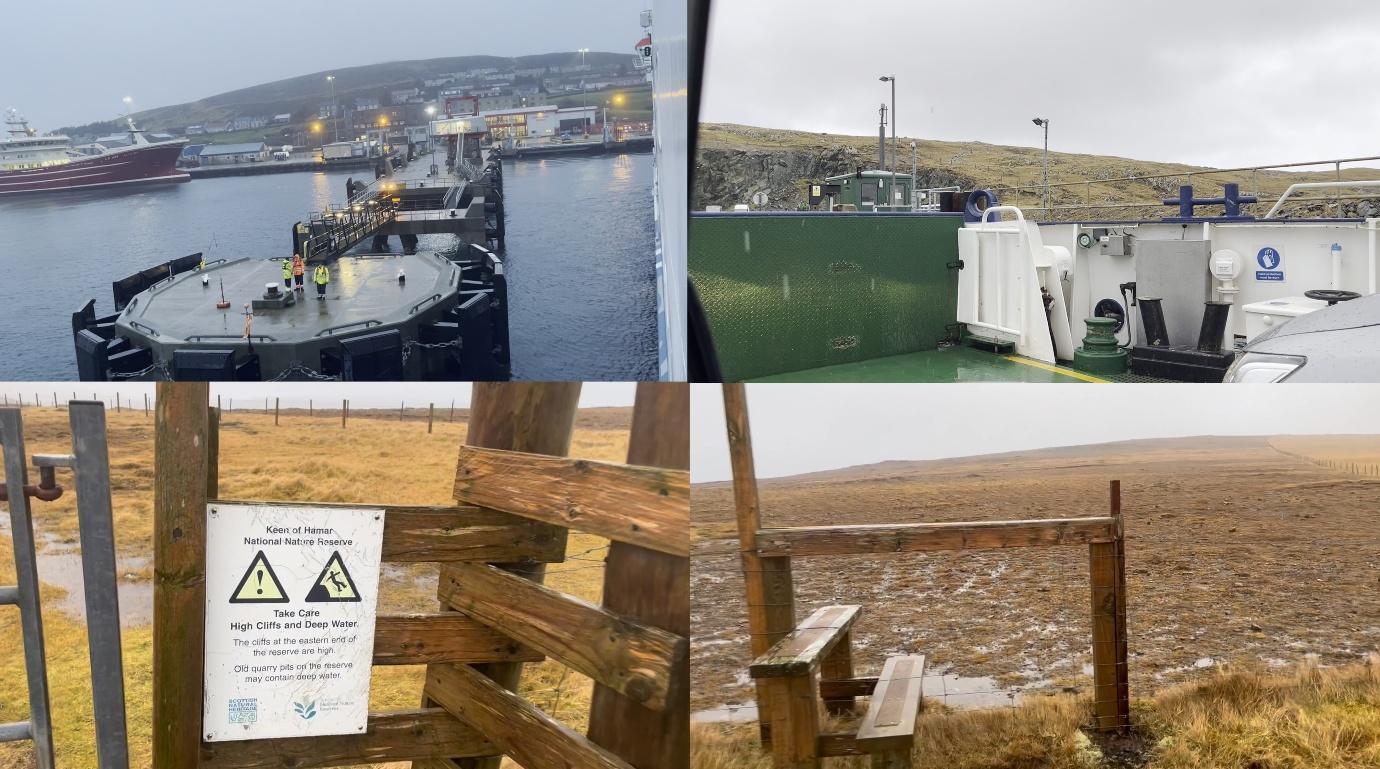
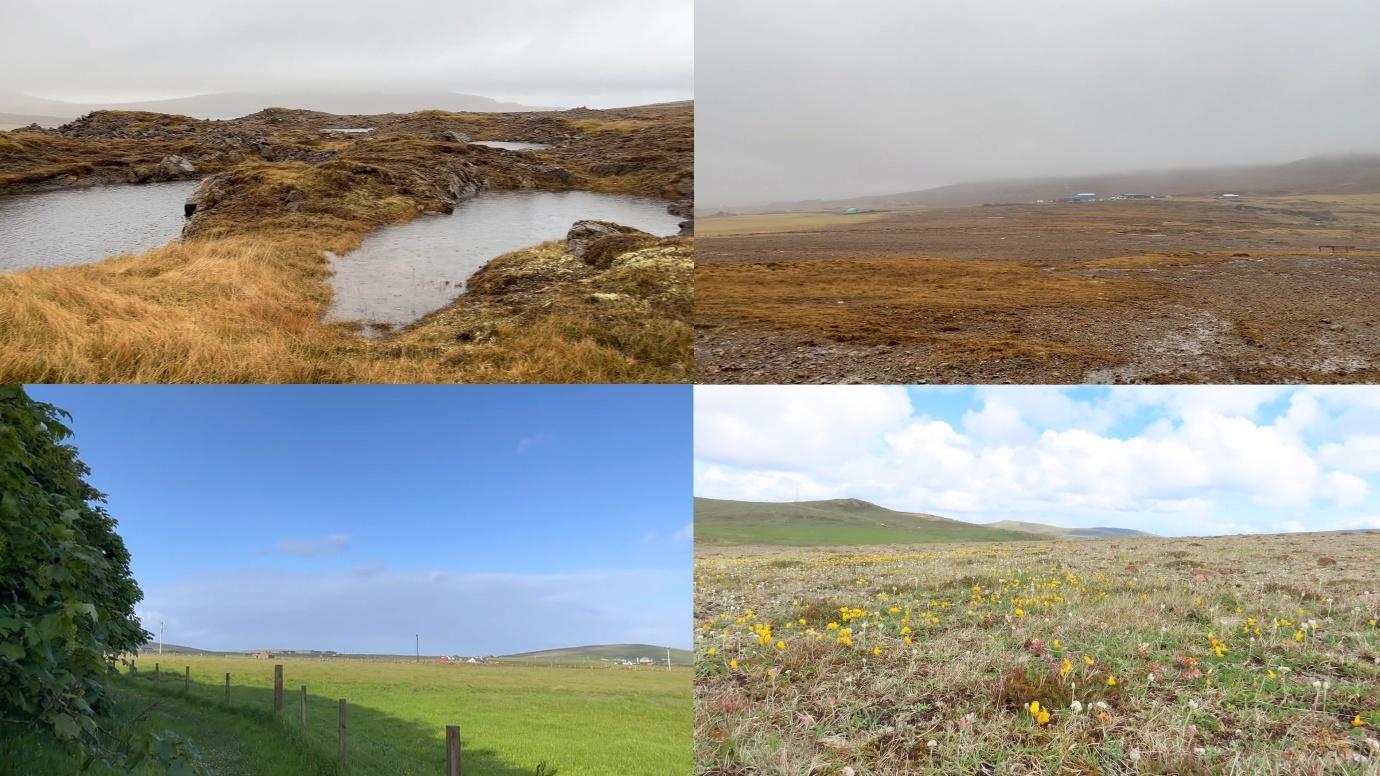
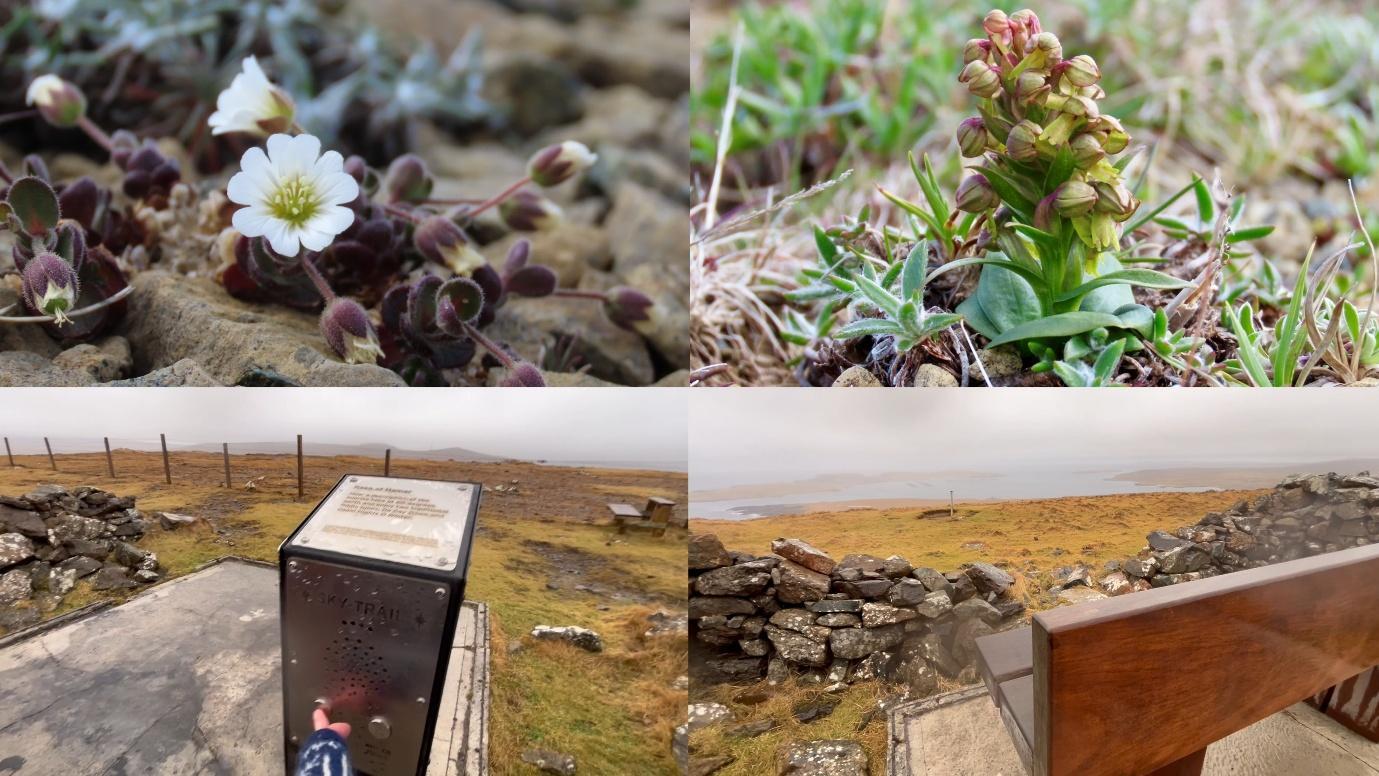
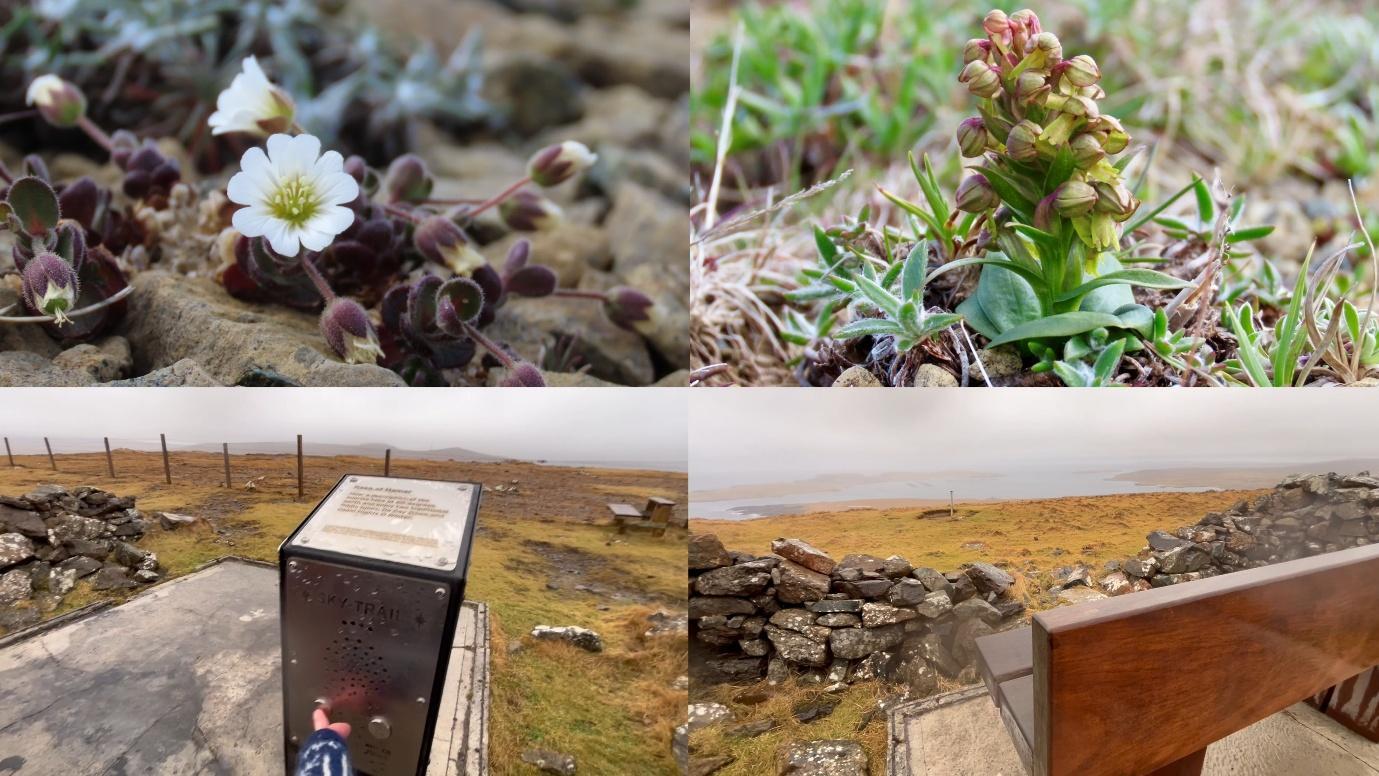
Relations with(in) place also came into being through movement and memory. I chose to use my own embodied experience to provide film visuals (Figures 1-3); I often use my smartphone camera to record my movement through the landscape, holding it or even taping it to the front of my waterproof jacket to enable me to have both hands free when needed for gates and stiles, or because the weather dictates it too wet, windy, or cold to hold the camera. In direct material engagement, photographs and videos were drawn into my analysis through reading-with and wondering-with the data. I used the process of wondering-with the audio material to “cut” (Barad, 2007, 2014) through my personal digital archive of video and photographs, scrolling through footage from my fieldwork and prior time spent in Shetland to draw upon memories of moments, objects that stood out to me, and the meaning ascribed to them. From this, I further separated visual material relating to my encounters with the Keen; travel to Shetland; through Shetland Mainland to Toft for the inter-island ferry to Ulsta; across Yell to Gutcher for the inter-island ferry to Belmont in the most northerly isle of Unst; across Unst through Baltasound and past Bobby’s Bus Stop to the small parking area close to the Keen.
I used DaVinci Resolve software to create the film, as my apparatus to diffract audio and video materials. The time limit made for a strict final cut through the material and how material was incorporated: as video or still image, spoken audio or on-screen quotation. The final film consisted of six voices. As oft happens in island communities, most of these interlocutors wore several hats including employees and/or volunteers from national and local environmental organisations (some working specifically with plants), naturalists, local guides, birders, authors, scientists, and crofter. One had been involved with early quadrat monitoring on the Keen. Each voice spoke about a different aspect of place, kinship and/or weather.
Sharing the film at the symposium invited intra-action with this audio-visual material and the sharing of collective memories of island place, including Shetland. I then re-turned to my diffractive analysis to responsively diffract again the audio and visual intra-actions into a new material-discursive form of the Keen. My creative writing was not intended as a reconstruction of the film, a simple transcript with explanatory comments. I iteratively re-turned to the film: sometimes watching and listening, sometimes watching, sometimes listening. Each re-turning brought something new into being as I responded to the words of my interlocutors with other memories and details of place brought into the diffraction process through my embodied experience of journeys and conversations. Some memories were prompted by the response I received on sharing the film.
My writing was telling another story of the Keen in different material form and, through this writing, different relations with(in) place came into being. In the film, my embodied experience appeared through the visuals captured by my camera. The audience could see what captured my attention and my movements through place, but I left the speaking to my interlocutors. In my creative writing, fragments of my experience can be read with interlocutors’ words (in italics), but my interlocutors are not heard. Intra-action with kinship on the Keen through the writing and photographs in the following section invites the bringing into being of further stories beyond either material medium.
Kinship on the Keen
Lerwick docks, past the pelagic fishing boats, early grey mist and low cloud, a solitary seabird. The NorthLink ferry from Aberdeen comes alongside at Lerwick Ferry Terminal. We had talked in the busy waiting area – one person arriving, the other departing.
I think Shetland rare plants mean to me how vulnerable we are.
A lot of the species, a lot of the rare species that are clinging on here tend to be arctic-alpine species, which with current forecast climate change we could well lose in my lifetime, let alone my children’s lifetime.
Inter-island ferry arriving at Unst, standing on the car deck, a gentle sway, diesel fumes in the rain. It is a landscape of grey and green today. Ready to disembark and be waved ashore.
I was out looking at some of the key species just a couple days ago and just seeing them there on the Keen of Hamar or Ronas Hill, you just realise what precarious existence they lead.
When you’re up there like, the weather we were there was it three days ago? Lashing with rain midsummer. You think there’s a reason why these things are so small and low to the ground!
Waterproof trousers on, waterproof socks on, boots on, coat on, hat on, gloves on. Out into the weather. Past the sign Welcome to the Keen of Hamar Nature Reserve, through the clanking gate.
But I think it’s fantastic, I mean that landscape up there, the broader landscape, is just moonscape, isn’t it? It’s like nowhere else that I’ve ever been.
Squelching through the sodden grass, over tractor tyre tracks. Pause to take in the warnings Take Care High Cliffs and Deep Water. Through another gate.
As my friend put it, it’s extreme natural history and it is really. Looking at an arctic sandwort, a couple of centimetres across, up there in sort of gale force winds in the middle of summer. It doesn’t get much more extreme, does it?
Across the strip of ground separating the lower Keen from the upper Keen. Over a wet stile then first steps on the moon(scape). We had talked about the Keen in a Lerwick office by a dock.
The Edmondston’s chickweed on the Keen of Hamar, that used to be a national nature reserve. Actually, my first job with NCCS up here was as reserve warden for Hermaness and Keen of Hamar so we go back all that way.
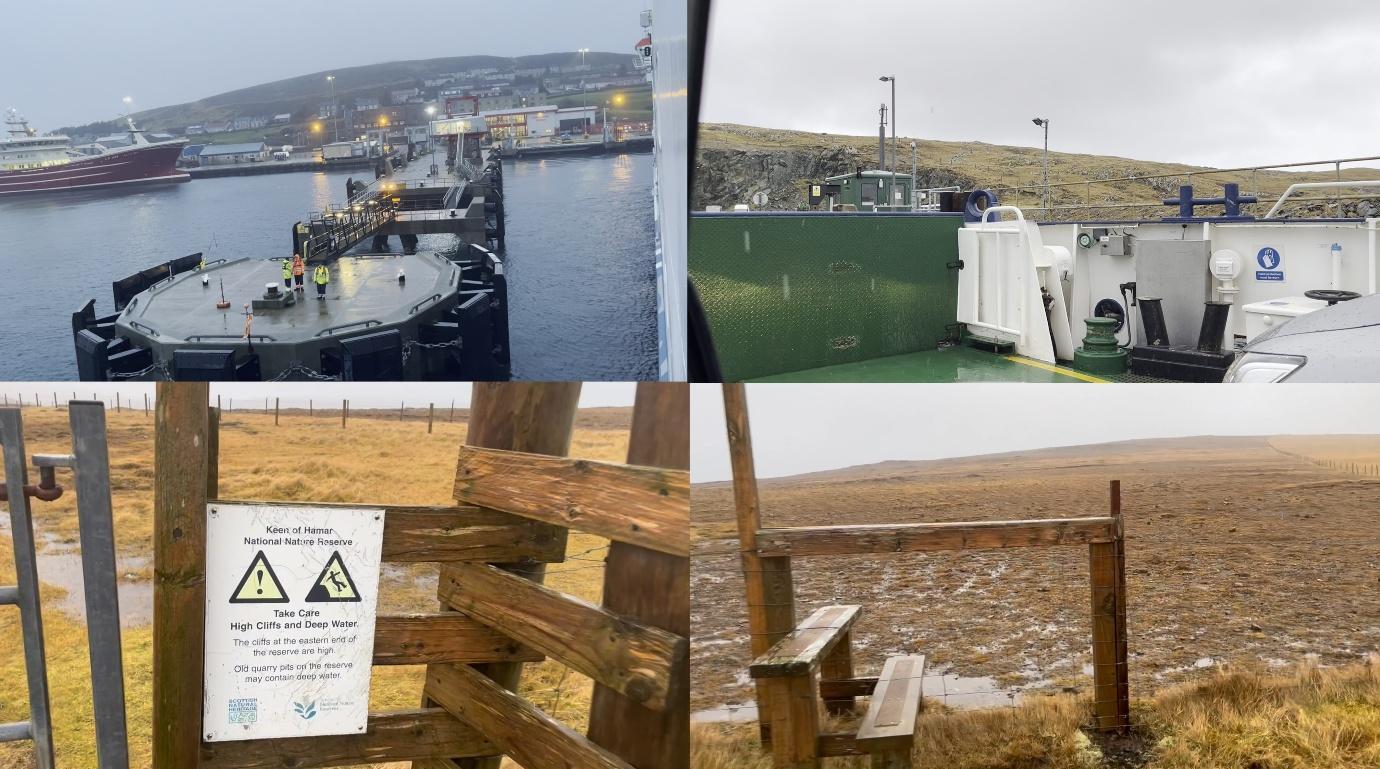
The rain has rendered the rocks of Keen dull, greying the greens of the serpentinite rock. It is early in the season for botanising when I am there, but there is still evidence of botanical recording with pegs for quadrats.
We also monitor the Arenaria norvegica, Norwegian sandwort, or Scottish sandwort depending on which you, which name you prefer and northern rock cress, Arabis petraea, on the same quadrat. Those are those are the three rarities that Keen of Hamar is important for.
Higher on the Keen, patches of more substantial cracked and fissured rock amongst the debris. The colonising vegetation that has survived over the winter has gone orange and brown. We had talked in a city kitchen, a warm welcome on a rainy Scottish day. We time-travelled over tea.
The implication was it had to be a refuge site because otherwise what was this Cerastium and Arenaria doing there if it hadn’t come through from 10,000 years ago? So, what was it doing for the last 10,000 years?
Discarded deep quarry pits full of water; chromite is not mined here now. Walking upwards again over strips of rocky debris and tussocky grass.
Did anybody describe the site before the chromite was discovered?
We actually found scraps from, sort of, 1770s onwards where people were visiting, and, you know, these people who did their Tours and wrote their diaries.
I turn, looking to the Hill of Clibberswick, to Hagdale and Heogs, the Final Checkout petrol station and shop, to Baltasound, then round to the top of the Keen.
And there was just enough there to strongly suggest that fundamentally the Keen looked like it looks today in the late 18th century.
And then you then fall back onto the argument about, well, these things are being interpreted as late glacial relics. They appear to be entirely dependent on an open habitat at the moment.
What does Unst look like 5,000-6,000 years ago? What does the Keen look like? And, pretty much, it was already there.
We talked as we walked on the Keen. A windy day in June. Every so often, we stopped to examine a plant, or stone, or ‘fossilised’ cow pat, or remnant of the Royal Air Force (RAF) post at the top of the Keen. My camera clicks when I take photographs, a way of remembering these intra-actions.
I love bringing people up on here because of, you know, there there’s such a story to this place.
Looking back at the Keen from Halligarth, home of the Edmondston family, standing outside the walled garden filled with mature trees in a treeless landscape, birds and bees. Blue sky.
I tell them about how Thomas discovered the chickweed when he was 12. How he met Joseph Hooker who became his sponsor, wrote the book when he was 15 and it’s still pretty much accurate. Became Professor of Botany at what is now Strathclyde University, when he was 19. He was only in the job for a few months when he was headhunted, went on HMS Herald. The correspondence with Darwin…
The hue of the Keen is brighter and lighter when dry. My turn to time travel. The first Edmondston’s chickweed that I ever found, a tiny plant with delicate white flowers on the serpentine debris. I had struggled to focus the camera in the wind; the chickweed goes out of focus.
…and then died off the coast of what is now Ecuador. It always gets a bit of an ‘aah’ when they find out he died at the age of 21 or whatever it was.
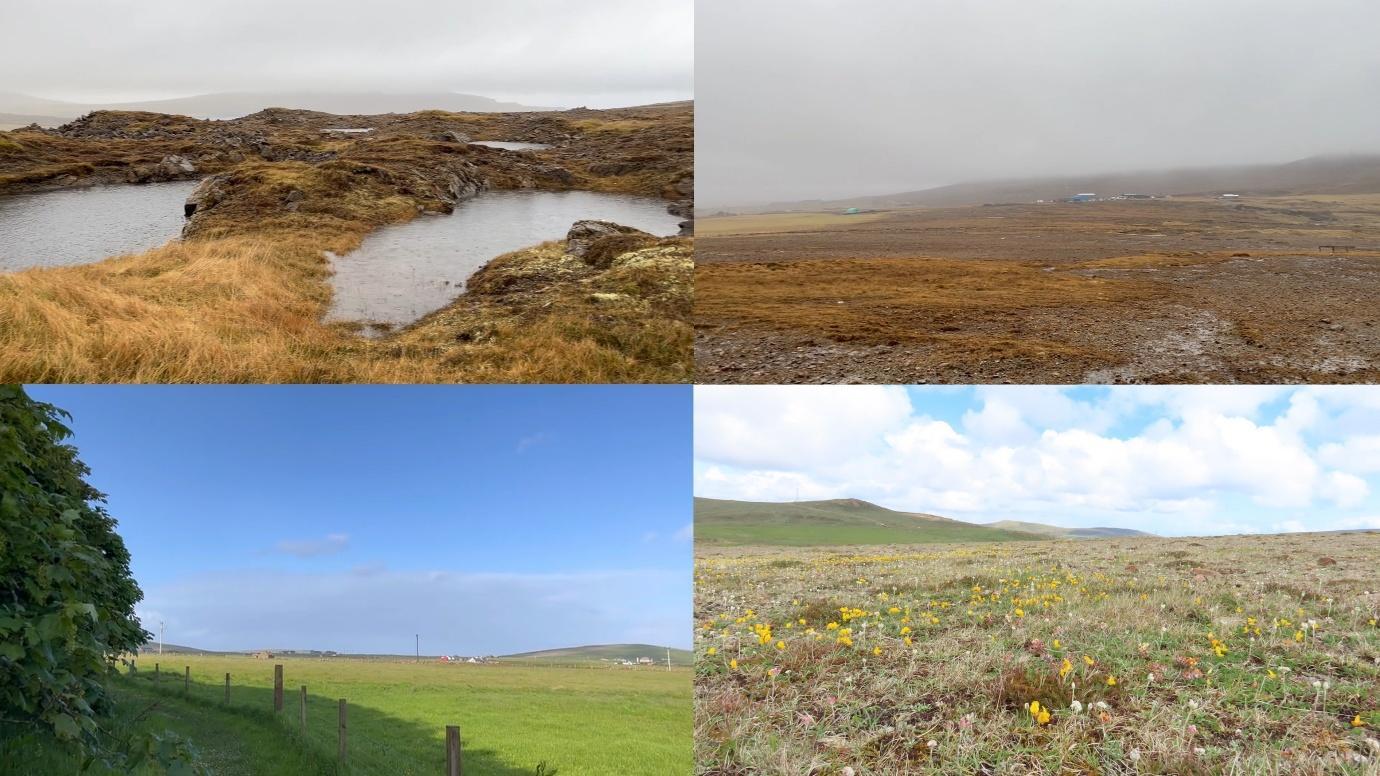
We talked at a lighthouse. The Shetland film crew were filming outside the window; trucks beeped backwards and forwards, and cast waited and talked in the adjoining room. We talked about life, loss, and hope, of people and plants.
I used to do an activity in Unstfest.
It does not always rain on the Keen. When it bursts into flower in early summer, it is far from barren.
I would get children to come to pretend that they’re going to Botany Moon.
I return to the photographs that I took on the Keen: tormentil, kidney vetch, mountain everlasting, sea pinks, spring squill, northern rock cress, arctic sandwort, butterwort, frog orchids…moonwort!
Tell them that this child essentially had found this plant new to science and their mission was to see if it still exists but there are other plants as well. So, I’d get them to go and be their own explorers.
So that’s lovely to connect children with their, with the landscape, and with the plants and to see that bairns could change, like could add to science.
At the top of the Keen is a Sky Trail installation. The audio tells of sunrise at 60 degrees north or plays traditional fiddle tunes. I listen to the description of equinox sunrise; the bench faces due East towards open sea. I am aligned in the cosmos. Rain beats down. Small islands shelter the inlet. We talked in another office near the docks in Lerwick. We were inside, talking of being outside.
I always think about when I go out for walks and being able to identify birds on call. I always think that, you know, it sort of makes a two-dimensional walk, three dimensional, if that makes sense.
You’re able to, you identify the plants, or you identify the birds, and you could walk around with your eyes closed and you could still know what’s going on around you.
So, I think when you have that, you know what you’ve got, and you know the value of it…
…then it gives you a greater value of the place that you live.
The top of the Keen is a place to linger, to savour the view from the bench with an imagined more-than-human chorus. Back in the kitchen where we talked, the puzzle of the landscape appears solved. Water. Lack of water.
Fundamentally it is drought that is controlling the lack of plant establishment on serpentine debris. It has so little available water capacity that it dries out.
So, the joke was that it was Britain’s most northerly desert.
We talked in a café with a view of Shetland Museum and Archives at Hay’s Dock. We talked of human flaws, policies, and fears. Water again. Climate change. We talked of a weathered place. Water again. Too much water,
I don’t know what the effects of climate change will be in terms of the hydrology or the desiccation of the Keen of Hamar, but that site seems to me the most important botanical site in Shetland.
We don’t get cold winters anymore; we just get more and more rain.
We have warm, damp summers rather than having a period of dry in summer.
I fear for the site as a whole.
Relations with(in) the Keen
What relational insights emerged from my film-making and creative writing? Where did the effects of differences in space, time and matter appear? In this section I discuss the relationality with(in) the Keen that has been made visible through the diffractive analysis at the heart of my engagement with creative practices.
Non-binary dissonance emerges through relationships. At our moment in time, the Keen is a northerly desert lashed by rain. Bairns are searching for relic species in a landscape just emerging from the ice age; a moonscape bursting into life, a nature reserve scarred by mining, a deep time persistence that might be lost in a human lifetime. Perhaps we can relate to the Keen as a microcosm of the tension in how we relate to islands: a non-binary weathered state of being, that of being both resilient and vulnerable.
Van Dooren insists that storying “must also involve learning new kinds of attentiveness to the stories of others – even if they are unspoken or are told in other-than-human languages” (van Dooren, 2014, p. 78). One story of the moonscape is a relational story seen in the rain and water vapour carried in atmospheric currents as part of the relational water cycle, in the rocks that weather into soil, and in the vegetation that takes hold in the process of ecological succession. The description of the weather on the Keen as “lashing with rain midsummer” and “sort of gale force winds in the middle of summer” did not arise from an extraordinary weather event, even if the embodied experience of botanising was described as “extreme natural history.” This is not, however, the weather that would first come to mind for “Britain’s most northerly desert.” The relationality between the low water capacity (lack of ability to retain water) of the Keen and the role of drought (lack of water) is critically important for maintaining the open moonscape habitat.
What of human embodied relations with(in) the more-than-human world? Interlocutors often shared memories: Barad described memory as “the pattern of sedimented enfoldings of iterative intra-activity (…) written into the fabric of the world” (Barad, 2014, p. 182). Human movement, just like the windblown plants and the weathering rocks, changes in response to high winds and heavy rain. A change from the normal adult human viewpoint is essential as it is not possible to be “looking at an arctic sandwort, a couple of centimetres across” without meeting the plant at its level. Other senses are important for understanding and making sense of place, especially hearing: “being able to identify birds on call (…) sort of makes a two-dimensional walk, three dimensional (…) you could walk around with your eyes closed and you could still know what’s going on around you.”
Conceptually, shifting baseline syndrome is steeped in memory, amnesia, and losses through time. We need a greater understanding of how “ecological well-being depends on aligning the temporal dimensions of many different beings, and the consequences of disruption and slippage between times” (Metcalf & van Dooren, 2012, p. vi). For example, a loss of habitat could lead to a loss of rare plants: "a lot of the rare species that are clinging on here tend to be arctic-alpine species." Van Dooren provides a temporal perspective on precarity:
Generations stretching before and after, beyond the horizon of our temporal comprehension. It is all their work and their possibilities that are at stake in the living and dying (van Dooren, 2014, p. 39).
The relations that come into being through personal encounter have a temporal component. Species noticed were only here due to the survival and reproduction of past generations: “just seeing them there on the Keen of Hamar or Ronas Hill, you just realise what precarious existence they lead.”
The Keen is also associated with the tragic loss of Thomas Edmondston (1825–1846) who published A Flora of Shetland in 1845 (T. Edmondston, 1845): “it always gets a bit of an ‘aah’ when they find out he died at the age of 21 or whatever it was.” Edmondston was a talented young Shetlander from Unst whose legacy lives on in the local name, Edmondston’s chickweed, for the endemic Cerastium nigrescens var. nigrescens that he first noticed as distinct through careful attentiveness during his youth botanising on the Keen, aided likely by the opportunities he had available for education and botanising through his social privilege of birth into a wealthy land-owning family. His sister, Jessie Saxby, did much to shape ideas about Shetland identity. However, the people that I spoke to related to Thomas himself through the chickweed.
Plants, habitat, and weather were intrinsically linked through adaptations over time: “You think there’s a reason why these things are so small and low to the ground!” The plants are “entirely dependent on an open habitat at the moment,” necessary for the continued survival of these rare arctic-alpine plants in this near sea-level location. But as a weather place, the Keen, “the most important botanical site in Shetland,” is affected and will continue to be affected by changes in the weather due to climate change: “I don’t know what the effects of climate change will be in terms of the hydrology or the desiccation of the Keen of Hamar.” This vulnerability of the Keen emerges from what van Dooren describes as:
a feature of the specific ways in which we are entangled in our multispecies world; some are diffusely entangled, while others are bound up tightly in relationships with specific nonhumans and local ecologies (and thus highly exposed to changes or disturbances) (van Dooren, 2014, pp. 57–58).
The potential loss of an “inheritance” in the form of a “specific place” (van Dooren, 2014, p. 82) puts the fate of individual beings at stake, and interlocutors talked of fears of possible extinctions within a “lifetime, let alone my children’s lifetime.” However, Barad challenges notions of a linear inheritance:
To address the past (and future), to speak with ghosts, is not to entertain or reconstruct some narrative of the way it was, but to respond, to be responsible, to take responsibility for that which we inherit (from the past and the future), for the entangled relationalities of inheritance that ‘we’ are. (Barad, 2014, p. 183)
Based on generational change, the timescale over which shifting baseline syndrome acts is fleeting compared to deep time. An interlocutor had wondered “what was this Cerastium and Arenaria doing there if it hadn’t come through from 10,000 years ago?” This resonated with van Dooren’s concept of “flight ways into the deep past and future that are contained within the emergent being a species” (van Dooren, 2014, p. 39). The deep time kinship of the arctic-alpine plants was key to understanding the evolution of the Keen: “What does Unst look like 5,000-6,000 years ago? What does the Keen look like? And, pretty much, it was already there.” With the rarities Cerastium nigrescens and Arenaria norvegica “being interpreted as late glacial relics,” bairns’ embodied experience of botanising brings them into relationship with plants in a place whose deep time history stretches back thousands of years and into the future.
Kinship is “calling out for care and responsibility” (van Dooren & Chrulew, 2022, p. 2). Puig de la Bellacasa drew attention to the difference between concern and care; that “one can make oneself concerned, but ‘to care’ more strongly directs us to a notion of material doing” (Puig de la Bellacasa, 2011, pp. 89–90). So, what were interlocutors doing that could be considered acts of relational care? Attentiveness went beyond just noticing, to purposefully seeking out plants known to be special: “I was out looking at some of the key species just a couple days ago.” This was no trivial undertaking given the terrain and weather at the time. Rare plants are carefully monitored through counting individuals present:
We also monitor the Arenaria norvegica, Norwegian sandwort, or Scottish sandwort depending on which you, which name you prefer and northern rock cress, Arabis petraea, on the same quadrat. Those are those are the three rarities that Keen of Hamar is important for.
Caring for the Keen in a professional capacity was expressed as a personal relationship with place: “Actually, my first job with NCCS up here was as reserve warden for Hermaness and Keen of Hamar so we go back all that way.”
The passing on of knowledge of people and plants in their more-than-human world is important and an act of relational care. For example, through tour-guiding: “I love bringing people up on here because of, you know, there there’s such a story to this place.” Through this, wider audiences were introduced to and connected with the more-than-human world of the Keen. An interlocutor spoke of how they “used to do an activity in Unstfest” (the annual Unst festival) and how “that’s lovely to connect children with their, with the landscape.” Such examples of intergenerational passing on of knowledge and expertise also existed in previous generations. Re-turning to Barad “to address the past (and future), to speak with ghosts” (Barad, 2014, p. 183), I heard of surviving materials used in recent work: “we actually found scraps from, sort of, 1770s onwards where people were visiting.” In an act of care towards the memory of her son, Thomas Edmondston’s mother, Eliza, collected and published an account of his life and how he learned from and was mentored by distinguished visiting scientists and naturalists; Unst was by no means removed from the wider scientific community in the nineteenth century (Mrs. L. Edmondston, 1868).
In the section that follows, I describe my return to Shetland with what had become knowable about the Keen and with my increasing insight into dissonance in relations, relations with(in) the more-than-human Keen, embodied experience of relating to the Keen, precarity and loss of the entangled relations between plants, people and place, and acts of care for the Keen.
Returning to the Keen
I returned to the Keen in May 2025 after sharing my film at the symposium. After three days researching in the Shetland Archives, I headed to Unst, ostensibly to write up my findings from the archives, but also to bring the historical plant records with me: to wonder-with them; to walk or perhaps, more aptly, to wander-with them; to be outside in the more-than-human world in which the records were made; to see, hear, touch, smell, and feel with them. And to be again on the Keen with the words that my interlocutors had shared with me, with the stories that had been woven, and with the responses and questions of Island Symposium participants. I brought my memories, my own “pattern of sedimented enfoldings of iterative intra-activity” to be diffracted afresh (Barad, 2014, p. 182).
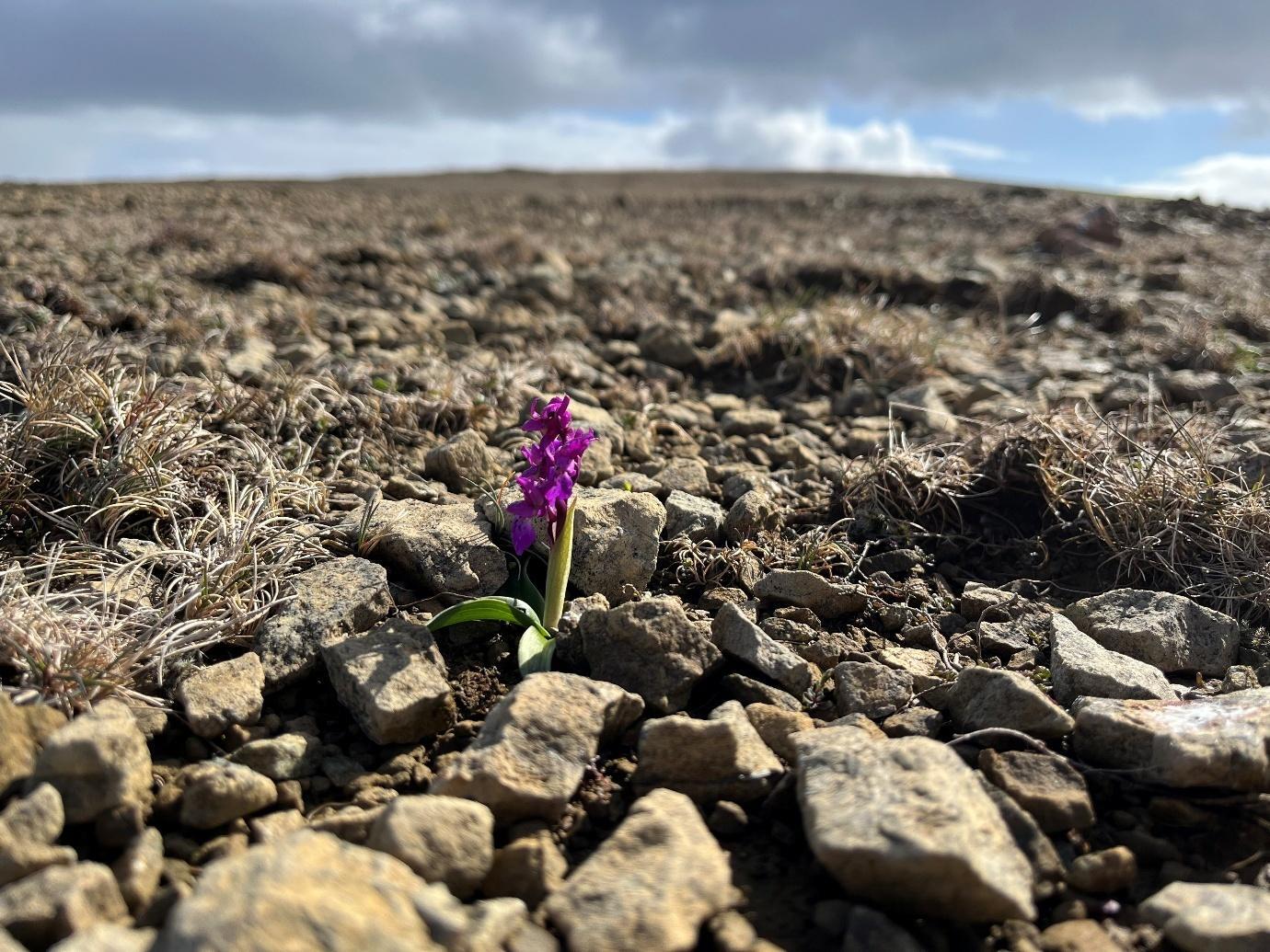
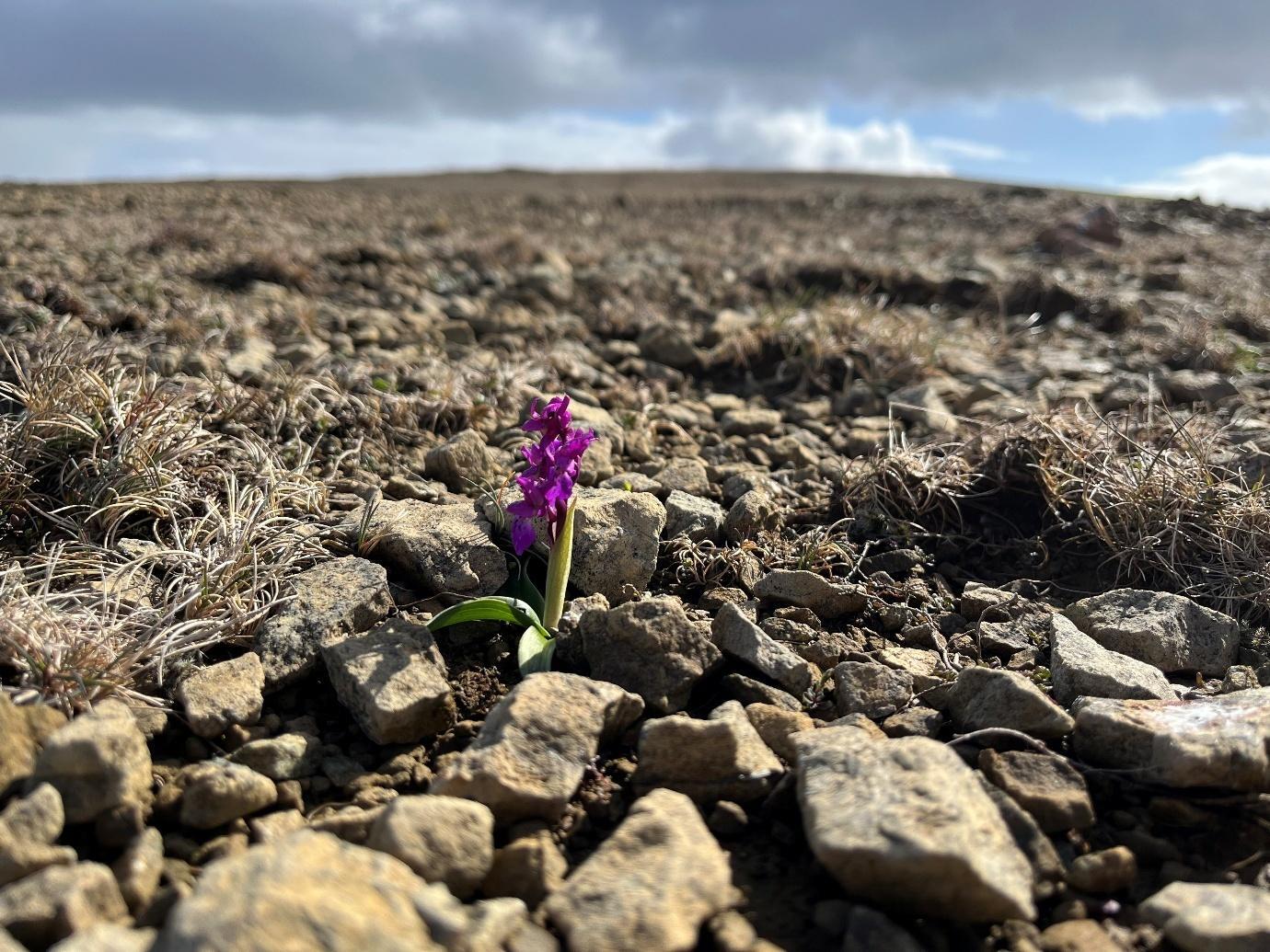
By my return to the Keen, many relational stories had come into being through my creative practice. But was I now intra-acting with “a new sensitivity to the storying and place-making practices of these nonhuman others, a sensitivity that just might provide an avenue to more sustaining possibilities of life, across species and generations” (van Dooren, 2014, p. 85)? My film-making journey had started with the idea that we know places through their weather. Although I experienced much wind, rain, and hail, this visit I was also blessed with sunshine on the Keen. I could orientate myself using the moss campion that flowered first on the south-facing side of its mossy cushion; I found my first early purple orchids coming into bloom and was aware of the agency of these tiny plants to draw me in. Once I was attuned to scanning the Keen from ground level (Figure 4), not an ambulatory human level, I found many more such orchids, their development and flowering affected by minute differences such as the presence of a slightly larger piece of rocky debris providing shelter and re-radiating the Sun’s heat. I was surprised how warm and dry the rocky debris became in the spring sunshine; a northerly desert made sense now. I was aware that time seemed to be collapsing upon itself; I was both in the twenty-first century and emerging from the last ice age. I re-turned to Barad: “there is no absolute boundary between here-now and there-then” (Barad, 2014, p. 168). But whilst the hyperlocal focus of my film had made visible more of the infinite multitude of wonderful relations with(in) the Keen, it exposed relational precarity from the dreadful threat from global-scale human action (and inaction) changing the climate and the weather patterns on the Keen, leading to the loss of precious habitat and the rare species that, to re-turn to Barad’s wording, “might yet (have)” live(d) there (Barad, 2014, p. 168).
A diffractive methodology is an ongoing process. Hence, in lieu of conclusion, I turned to the question that Bird Rose “returned to relentlessly”: “how we are to keep faith with such a world in the midst of ongoing processes of colonization and extinction, of ecocide and genocide” (van Dooren & Chrulew, 2022, p. 2). To approach her question, I re-turned to “the capacity for wonder that resides and radiates in data, or rather in the entangled relation of data-and-researcher” (MacLure, 2013, p. 228). The simple phrase when “you know what you’ve got” caught my attention. Film-making, sharing, writing, and embodied returning were part of how the Keen became knowable to me. What became visible about relations with(in) the Keen through iterative re-turning to my data in different material forms changed my embodied encounters with the Keen. Noticing what we have around us, caring for our relations with(in) the more-than-human-world even at a hyperlocal scale, caring for our knowledge about it, and the care-full relating of this situated knowledge both inter- or intra-generationally whether through botanical recording, through sensitive storytelling, or sharing creative practices might be ways not to sink into apathy or despair about climate change and biodiversity loss. Perhaps we might hold on to faith with the world through taking “responsibility for that which we inherit (from the past and the future)” (Barad, 2014, p. 183): going beyond just seeking to know more about a place, searching for and valuing the deep time kinship through which the place became knowable, and acting with growing response-ability with(in) our situated relationships.
Funding declaration
My wider research is funded by the Scottish Graduate School for the Arts and Humanities through AHRC DTP2 Grant Reference - AH/R012717/1.
Acknowledgements
I am especially grateful to my interlocutors for generously sharing their knowledge and experiences of Shetland plants and place, and for the interest and care shown towards my research. I would like to thank the Scottish Graduate School for the Arts and Humanities for funding my Shetland fieldwork through their Engagement Fund. I wish to thank the Historical Geography Research Group for assisting with travel costs to attend the symposium Island Narratives of Kinship, Place, and the Weather in South Uist in April 2025. My thanks go to the symposium organisers and participants for engaging so enthusiastically with my work. I would like to thank my supervisors Professor Donna Heddle (Institute for Northern Studies, UHI), Dr Rosalind Bryce (Centre for Mountain Studies, UHI), and Dr Aline Finger (Royal Botanic Garden Edinburgh) for their support and thoughtful guidance. I am most grateful to the reviewers of this paper for their constructive criticism and insightful comments. Finally, thank you to my sons, Jake and Tom, for their continued encouragement: who knew back in 2017 where our first encounter with the Keen would lead?